Unisoc T9100
vs
Qualcomm Snapdragon 8 Gen 3


SoC Comparison Result
Unisoc T9100 vs. Snapdragon 8 Gen 3: CPU and GPU Performance Comparison
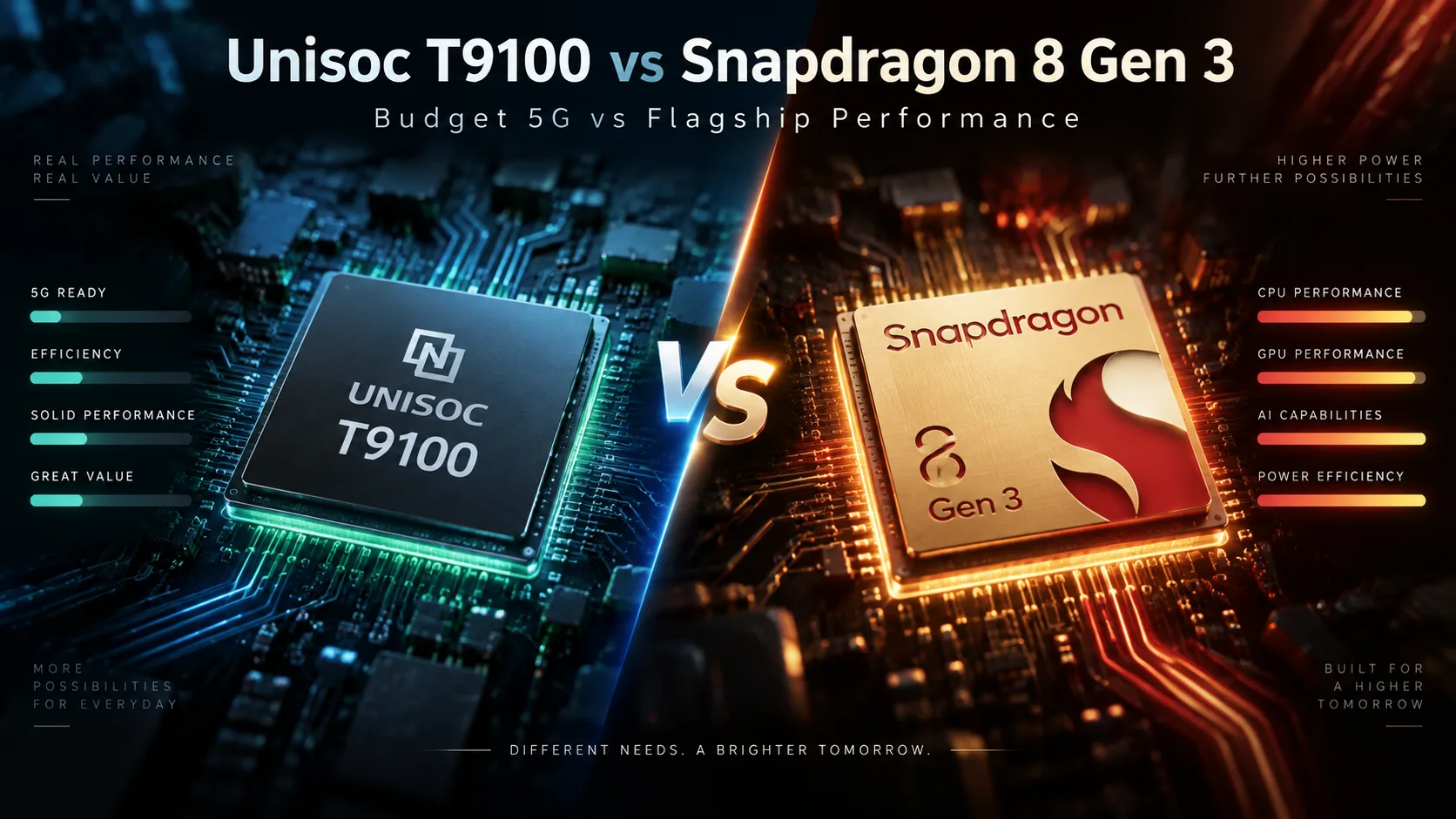
The Unisoc T9100 and Snapdragon 8 Gen 3 are chips from essentially different worlds and designed for different tasks. The former is intended for affordable 5G smartphones, while the latter was created for flagships with high CPU performance, powerful graphics, and faster interfaces. This is clearly reflected in the benchmarks: the Snapdragon 8 Gen 3 outperforms the T9100 by 2.4-2.9 times in Geekbench 6 and by 6.5-7.3 times in 3DMark Steel Nomad Light. This gap is related to the difference in generations: the T9100 uses Cortex-A76 and Mali-G57 MC4, while the Snapdragon 8 Gen 3 uses Cortex-X4/A720 and Adreno 750.
Key Differences
| Specification | Unisoc T9100 | Snapdragon 8 Gen 3 |
|---|---|---|
| Process technology | 6 nm | 4 nm |
| CPU | 1x Cortex-A76 + 3x Cortex-A76 + 4x Cortex-A55 | 1x Cortex-X4 + 5x Cortex-A720 + 2x Cortex-A520 |
| Maximum frequency | 2.7 GHz | up to 3.3 GHz |
| GPU | Mali-G57 MC4 | Adreno 750 |
| Memory | LPDDR4X | LPDDR5X |
| Storage | up to UFS 3.1 | UFS 4.0 |
The T9100 uses Cortex-A76 cores, which are several generations older than the Cortex-X4 and Cortex-A720 cores in the Snapdragon 8 Gen 3. Even its four Cortex-A76 cores do not close the gap in the multi-core test: the Snapdragon 8 Gen 3 is nearly three times faster.
Geekbench and AnTuTu
| Test | Unisoc T9100 | Snapdragon 8 Gen 3 | Difference |
|---|---|---|---|
| Geekbench 6 Single-Core | 900 | 2192 | 2.4x |
| Geekbench 6 Multi-Core | 2469 | 7085 | 2.9x |
| AnTuTu 10 | 542568 | 1933536 | 3.6x |
In Geekbench 6, the Snapdragon has a 2.4-fold advantage in Single-Core and a 2.9-fold advantage in Multi-Core. In the comprehensive AnTuTu 10 test, the difference increases to 3.6 times.
Real-World Smartphones: Benchmarks and Prices
There are still few commercial smartphones with the T9100, so the table includes the nubia Neo 3 GT 5G.
| Smartphone | Processor | Starting price | Geekbench 6 Single | Geekbench 6 Multi | AnTuTu 11 | 3DMark Steel Nomad Light |
|---|---|---|---|---|---|---|
| nubia Neo 3 GT 5G | Unisoc T9100 | around $230 | 872 | 2451 | 723825 | 233 |
| OnePlus 12 | Snapdragon 8 Gen 3 | $800 | 2182 | 6465 | 2401788 | 1676 |
| ASUS Zenfone 11 Ultra | Snapdragon 8 Gen 3 | $900 | 2281 | 7143 | 2444132 | 1710 |
| Samsung Galaxy S24 Ultra | Snapdragon 8 Gen 3 | $1300 | 2259 | 7330 | 2341394 | 1527 |
The prices are for the base configurations at the time the devices were released. For the nubia Neo 3 GT 5G, the table gives an approximate equivalent of its official price in dollars.
GPU: The Biggest Gap
The largest gap appears in the GPU test. In 3DMark Steel Nomad Light, the nubia Neo 3 GT scores 233 points, while smartphones with the Snapdragon 8 Gen 3 score 1527-1710 points. The difference is approximately 6.5-7.3 times.
In demanding games, the T9100 will more often require low or medium graphics settings. The Adreno 750’s performance headroom allows for higher settings and rendering resolution.
Memory, Storage, and Multimedia
The Snapdragon 8 Gen 3 supports LPDDR5X and UFS 4.0, while the T9100 is limited to LPDDR4X and UFS 3.1.
The Snapdragon 8 Gen 3 supports 8K 30 FPS and 4K 120 FPS video recording, while the T9100 supports up to 4K 60 FPS.
The Snapdragon 8 Gen 3 is also more up to date in terms of wireless interfaces: it supports Wi-Fi 7, while the T9100 supports Wi-Fi 5. Both platforms support 5G.
Conclusion
The T9100 and Snapdragon 8 Gen 3 can be compared directly by their benchmark figures, but they were originally designed for different smartphones and different tasks. The T9100 is aimed at affordable 5G models where price and basic performance are important, while the Snapdragon 8 Gen 3 is intended for flagships with demanding games, advanced cameras, and high peak performance.
The difference is 2.4-2.9 times in Geekbench 6 and up to 7.3 times in 3DMark Steel Nomad Light. At the same time, the nubia Neo 3 GT launched at approximately $230, while the Snapdragon 8 Gen 3 smartphones in the table started at $800 and above.
This is why the large benchmark gap is expected here: these SoCs address different tasks and occupy different price segments.
Advantages
- Newer Launch Date: March 2025 (March 2025 vs October 2023)
- Higher Technology: 4 nm (6 nm vs 4 nm)
- Higher Frequency: 3300 MHz (2700 MHz vs 3300 MHz)
Basic
5x (3x3.2 GHz/2x3.0GHz) – Cortex-A720
2x 2.3 GHz – Cortex-A520
GPU Specifications
Connectivity
Memory Specifications
Miscellaneous
- AIFF
- CAF
- MP3
- MP4
- WAV
- H.265
- VP9
Benchmarks
Comparison of Devices
Related SoC Comparisons



Share in social media
Or Link To Us
<a href="https://cputronic.com/index.php/soc/compare/unisoc-t9100-vs-qualcomm-snapdragon-8-gen-3" target="_blank">Unisoc T9100 vs Qualcomm Snapdragon 8 Gen 3</a>