MediaTek Dimensity 8350
vs
Qualcomm Snapdragon 8 Gen 3

SoC Comparison Result
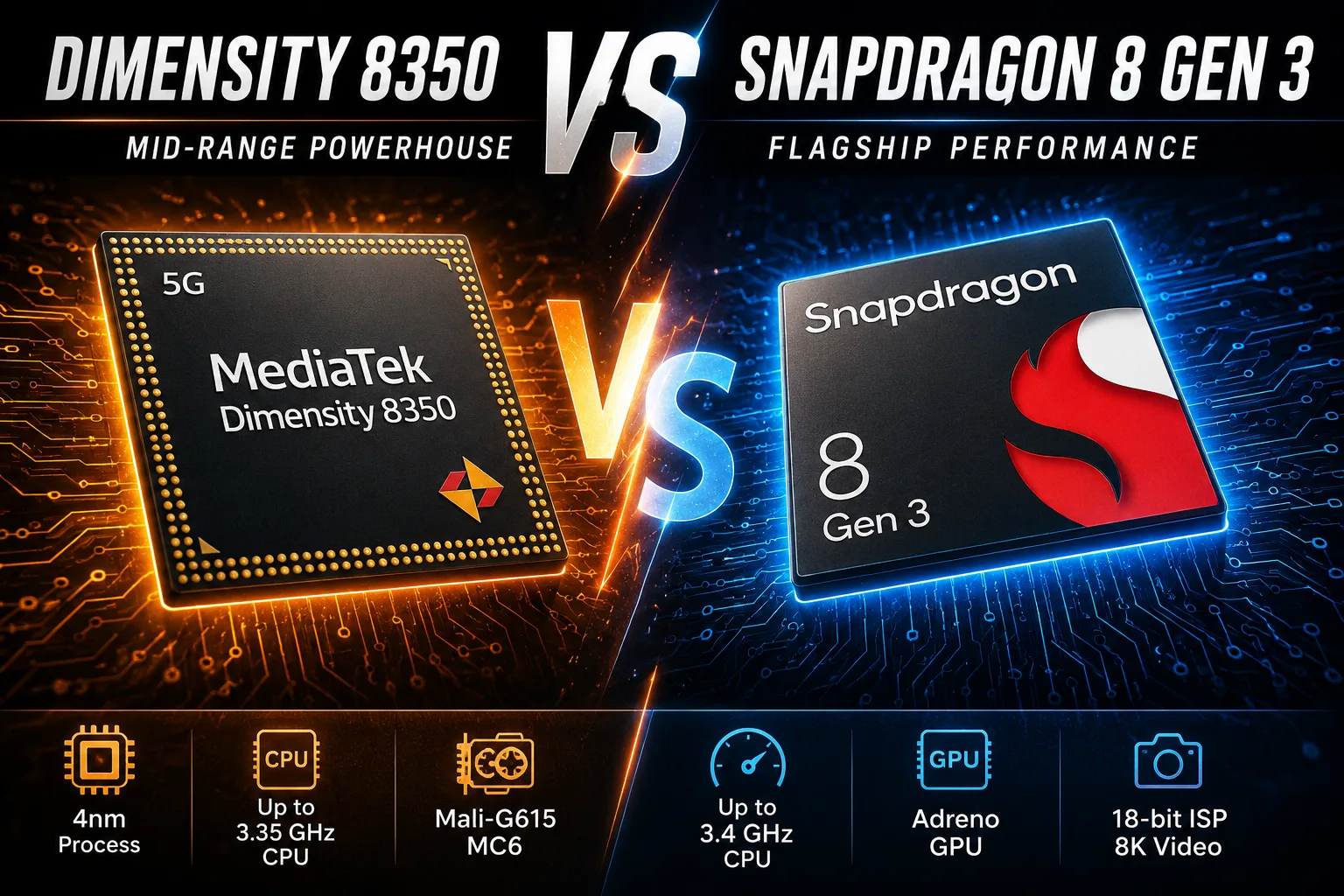
MediaTek Dimensity 8350 vs Snapdragon 8 Gen 3: Almost Flagship vs Flagship Platform
The MediaTek Dimensity 8350 and the Qualcomm Snapdragon 8 Gen 3 can be compared directly, but it's not entirely a fair duel. The Dimensity 8350 is a strong upper mid-range chip with a fast CPU, LPDDR5X, UFS 4.0, and a good performance cushion for everyday tasks. The Snapdragon 8 Gen 3 is a full-fledged flagship platform, where not only speed but also the class of graphics, cameras, modem, Wi-Fi, and all surrounding components are at a higher level.
Therefore, the main question is not "which one is more powerful." The Snapdragon 8 Gen 3 is more powerful in almost everything. What is more interesting is: how closely does the Dimensity 8350 come to the flagship feel, and where does it still fall noticeably short.
Dimensity 8350: Continuation of a Successful Base
The Dimensity 8350 does not look like a regular mid-range chip: it has a 4nm class process, eight cores, four powerful Cortex-A715 cores up to 3.35 GHz, four energy-efficient Cortex-A510 cores, Mali-G615 MC6 graphics, LPDDR5X memory up to 8533 Mbps, and UFS 4.0 storage with MCQ. In terms of key components, it is close to the Dimensity 8300, so it is more logical to perceive it not as a significant leap in generation, but as a continuation of MediaTek's successful platform.
And this is a normal strategy. Such a chip allows for the creation of a fast and modern smartphone at a lower price than models with a true flagship Snapdragon.
Snapdragon 8 Gen 3: Higher Class, Higher Ceiling
The Snapdragon 8 Gen 3 uses a more aggressive CPU architecture: 1 Prime core, 5 performance cores, and 2 efficiency cores. The Dimensity 8350 has a simpler setup: 4 performance + 4 efficiency cores. In everyday use, both chips will be fast, but Snapdragon is better suited for heavy scenarios: gaming, emulators, photo and video processing, prolonged load, and high-quality video recording.
The difference is not limited to the CPU cores. The Snapdragon 8 Gen 3 is a more expensive platform overall: a stronger GPU, a higher class ISP for the camera, a faster modem, more modern Wi-Fi, and greater performance headroom for demanding tasks.
Key Differences
| Difference | MediaTek Dimensity 8350 | Qualcomm Snapdragon 8 Gen 3 | What It Means |
|---|---|---|---|
| Chip Class | Upper Mid-Range | Flagship | Snapdragon is higher class, Dimensity is more rational in price |
| CPU Architecture | 4x Cortex-A715 + 4x Cortex-A510 | 1 Prime + 5 Performance + 2 Efficiency | Snapdragon is better for peak and sustained loads |
| GPU | Mali-G615 MC6 | Adreno | Snapdragon is noticeably stronger in heavy gaming |
| Gaming Technologies | MediaTek HyperEngine | Ray tracing, Snapdragon Game Super Resolution, Adreno Frame Motion Engine 2.0 | Snapdragon has a richer gaming platform |
| Camera ISP | 14-bit HDR native ISP, dual-camera 4K HDR | Triple 18-bit ISP | Snapdragon is better optimized for ISP and video |
| Video | up to 4K 60 FPS | up to 8K HDR, 4K 120 FPS | Snapdragon is stronger for advanced video recording |
| 5G | up to 5.17 Gbps | up to 10 Gbps | Snapdragon has a faster modem |
| Wi-Fi | Wi-Fi 6E | Wi-Fi 7 | Snapdragon is more modern in the wireless department |
| Typical Meaning | Fast smartphone without flagship markup | Maximum platform for expensive Android flagships | Choice depends on the device's price |
Performance and Gaming
Looking only at the maximum clock speed, the difference seems small: 3.35 GHz for Dimensity 8350 versus about 3.4 GHz for Snapdragon 8 Gen 3. However, the clock speed poorly explains the actual gap. More important are the core architecture, graphics, smartphone cooling, and how long the chip can maintain a high load.
The Dimensity 8350 is good for everyday speed. It quickly opens applications, confidently handles multitasking, and doesn't feel weak in browsing, social media, navigation, and regular camera work. In regular tasks, the difference from Snapdragon may be less than you expect from the tables.
In gaming, the difference is more noticeable. The Mali-G615 MC6 in the Dimensity 8350 is good enough for its class and suitable for popular games at medium to sometimes high settings. But the Adreno in the Snapdragon 8 Gen 3 is already at the flagship level: higher FPS, better performance in heavy projects, and more technologies surrounding graphics.
In simple terms, the Dimensity 8350 is suitable for gaming, but the Snapdragon 8 Gen 3 is better as a gaming platform. If maximum settings, stable frame rates, and performance headroom for future games are important, Snapdragon is significantly stronger.
Camera and Connectivity
The Dimensity 8350’s camera looks strong for its class. MediaTek claims a 14-bit HDR native ISP, support for 4K 60 FPS, and simultaneous dual-camera 4K HDR recording. This is sufficient for upper mid-range smartphones, especially if the manufacturer has included a good sensor and properly tuned the processing.
The Snapdragon 8 Gen 3 is higher class. It has a Triple 18-bit ISP, support for 8K HDR, 4K 120 FPS, and broader computational photography capabilities. The difference is not only in the maximum camera resolution but in the class of processing itself: the bit depth is higher, the processing is more complex, and video capabilities are stronger.
The situation with connectivity is similar. The Dimensity 8350 supports 5G up to 5.17 Gbps, Wi-Fi 6E, and Bluetooth 5.4-most users will find this sufficient. The Snapdragon 8 Gen 3 offers more: a Snapdragon X75 modem, 5G up to 10 Gbps, and Wi-Fi 7. On a normal day, the difference may go unnoticed, but for an expensive smartphone over the years, this is a plus.
Where the Difference Is Almost Unimportant
The Dimensity 8350 is already fast enough for messengers, browsers, YouTube, social media, navigation, banking applications, casual photo shooting, and popular games without maximum settings. In such tasks, it does not feel budget and does not require constant compromises.
The Snapdragon 8 Gen 3 shines in different areas: heavy games, prolonged load, flagship camera, 4K/8K video, emulators, Wi-Fi 7, and maximum performance headroom for the future.
Conclusion: Which Chip is Better
The Snapdragon 8 Gen 3 is stronger without qualification when comparing technical maximums. It is faster in heavy tasks, more powerful in graphics, better for gaming, advanced cameras, video, and smartphones with a lot of performance to spare for years.
The Dimensity 8350 is interesting for another reason. It excels not because it catches up with the Snapdragon 8 Gen 3, but because it brings some flagship traits-LPDDR5X, UFS 4.0, powerful CPU block, and modern connectivity-into more affordable smartphones.
If maximum performance is needed, the Snapdragon 8 Gen 3 is the better choice. If you need a fast smartphone with a good balance of price and capabilities, the Dimensity 8350 looks stronger where price is more important than high FPS, 8K video, and Wi-Fi 7.
Advantages
- Higher Frequency: 3350 MHz (3350 MHz vs 3300 MHz)
- Newer Launch Date: November 2024 (November 2024 vs October 2023)
Basic
5x (3x3.2 GHz/2x3.0GHz) – Cortex-A720
2x 2.3 GHz – Cortex-A520
GPU Specifications
Connectivity
Memory Specifications
Miscellaneous
- FLAC
- HE-AACv1
- HE-AACv2
- MP3
- H.265
- AV1
- VP9
Benchmarks
Comparison of Devices
Related SoC Comparisons

Share in social media
Or Link To Us
<a href="https://cputronic.com/index.php/soc/compare/mediatek-dimensity-8350-vs-qualcomm-snapdragon-8-gen-3" target="_blank">MediaTek Dimensity 8350 vs Qualcomm Snapdragon 8 Gen 3</a>