Qualcomm Snapdragon 8 Gen 5
vs
Qualcomm Snapdragon 7 Gen 4

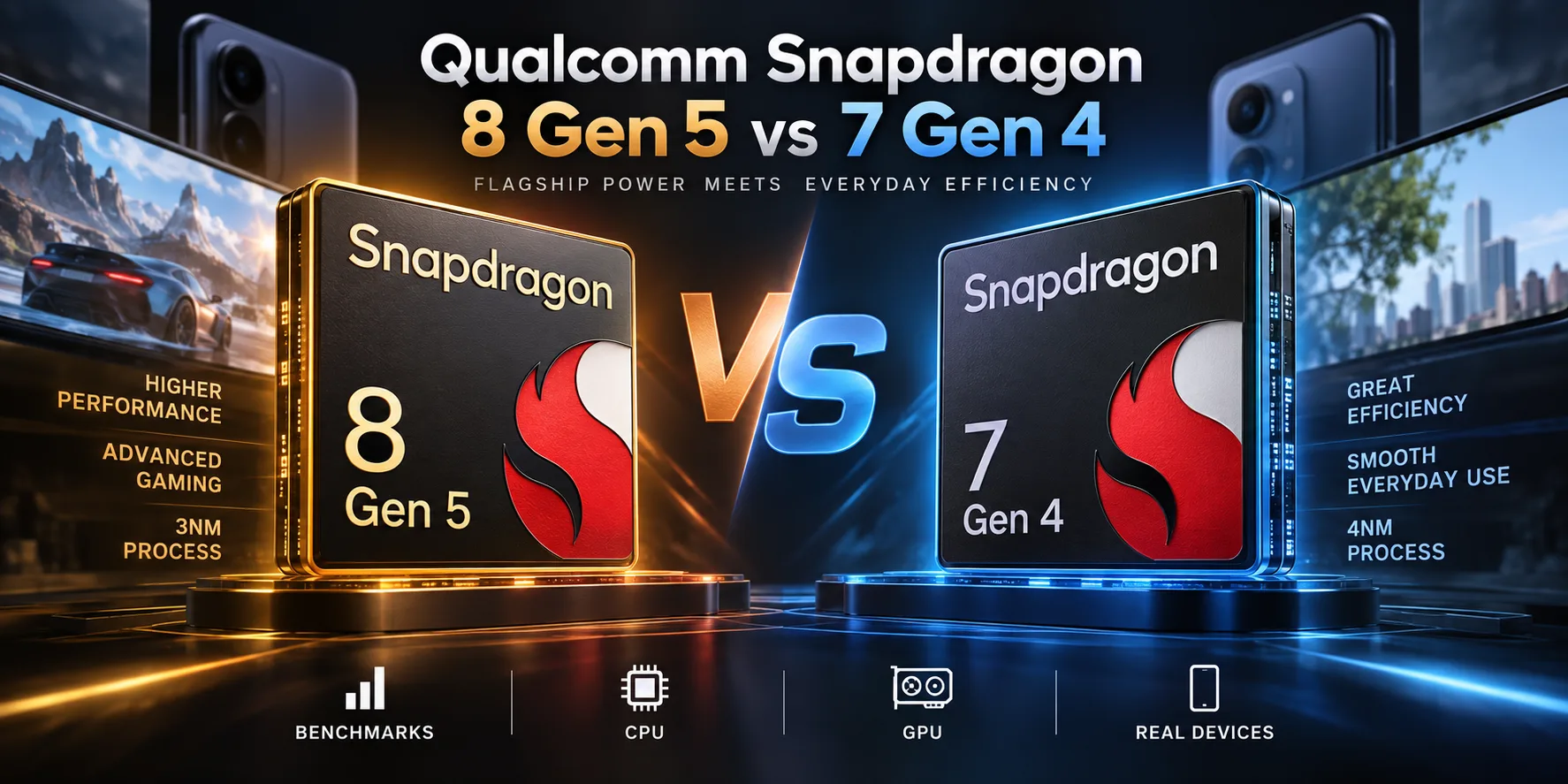
SoC Comparison Result
Qualcomm Snapdragon 8 Gen 5 vs Snapdragon 7 Gen 4: Oryon vs Cortex
Snapdragon 8 Gen 5 and Snapdragon 7 Gen 4 were released in 2025, but they belong to different segments. Snapdragon 8 Gen 5 uses Qualcomm Oryon cores, a 3 nm process, and the Adreno 829. Snapdragon 7 Gen 4 is built on Cortex-A720 and Cortex-A520 cores. In real devices, Snapdragon 8 Gen 5 scores roughly twice as high in AnTuTu 11, while the gap exceeds twofold in demanding graphics tests.
Key differences
| Specification | Snapdragon 8 Gen 5 | Snapdragon 7 Gen 4 |
|---|---|---|
| Announcement date | November 26, 2025 | May 15, 2025 |
| Class | Flagship | Mid-range |
| Process | 3 nm | 4 nm |
| CPU | 2x Oryon Prime 3.8 GHz + 6x Oryon Performance 3.32 GHz | 1x Cortex-A720 2.8 GHz + 4x Cortex-A720 2.4 GHz + 3x Cortex-A520 1.84 GHz |
| GPU | Adreno 829 | Adreno 722 |
| Maximum CPU frequency | 3.8 GHz | 2.8 GHz |
| Maximum 5G speed | up to 10 Gbps | up to 4.2 Gbps |
The platforms differ primarily in their CPU architecture. Snapdragon 8 Gen 5 uses Qualcomm’s own Oryon cores instead of standard ARM Cortex cores. Snapdragon 7 Gen 4 combines five Cortex-A720 cores with three Cortex-A520 cores. Snapdragon 8 Gen 5 is manufactured using a 3 nm process, while Snapdragon 7 Gen 4 uses a 4 nm process.
CPU
According to average Geekbench 6 results, Snapdragon 8 Gen 5 scores 2804 points in the single-core test and 10057 points in the multi-core test. Snapdragon 7 Gen 4 scores 1325 and 4081 points, respectively.
| Geekbench 6 | Snapdragon 8 Gen 5 | Snapdragon 7 Gen 4 | Difference |
|---|---|---|---|
| Single Core | 2804 | 1325 | +112% |
| Multi Core | 10057 | 4081 | +146% |
The gap is especially large in the multi-threaded Geekbench 6 test. Snapdragon 8 Gen 5 uses eight Oryon cores without a separate power-efficient Cortex-A5xx cluster, whereas Snapdragon 7 Gen 4 has three Cortex-A520 cores. The advantage in multi-threaded performance is particularly noticeable in multitasking, video processing, and other highly parallel workloads.
Real-world smartphone benchmarks
The gap remains similar in specific smartphones. Prices are listed for base versions at launch and depend on the market.
| Smartphone | Processor | Launch price | AnTuTu 11 | Geekbench 6 SC | Geekbench 6 MC |
|---|---|---|---|---|---|
| OnePlus Ace 6T | Snapdragon 8 Gen 5 | around $367 | 3 047 634 | 3057 | 10 447 |
| Vivo S50 Pro mini | Snapdragon 8 Gen 5 | around $524 | 2 974 201 | 3029 | 9401 |
| Nothing Phone (4a) Pro | Snapdragon 7 Gen 4 | $499 | 1 355 225 | 1332 | 4146 |
| Vivo V70 | Snapdragon 7 Gen 4 | around $500-540 | 1 410 609 | 1279 | 4114 |
OnePlus Ace 6T scores approximately 2.25 times higher in AnTuTu 11 than Nothing Phone (4a) Pro. In Geekbench 6, the advantage is approximately 2.3 times in the single-core test and 2.5 times in the multi-core test.
Vivo S50 Pro mini and Vivo V70 show a similar gap, so the difference also persists across other devices.
At the same time, OnePlus Ace 6T launched in China at approximately $367-cheaper than some global smartphones powered by Snapdragon 7 Gen 4.
GPU
Snapdragon 8 Gen 5 uses the Adreno 829, while Snapdragon 7 Gen 4 is equipped with the Adreno 722. In 3DMark, the gap between the GPUs is larger than the gap between the CPUs in Geekbench 6.
| Smartphone | GPU | 3DMark Wild Life Extreme | 3DMark Steel Nomad Light |
|---|---|---|---|
| OnePlus Ace 6T | Adreno 829 | 4962 | 2017 |
| Vivo S50 Pro mini | Adreno 829 | 4679 | 1733 |
| Nothing Phone (4a) Pro | Adreno 722 | 2068 | 765 |
| Vivo V70 | Adreno 722 | 2073 | 764 |
In Wild Life Extreme, OnePlus Ace 6T outperforms Nothing Phone (4a) Pro by approximately 2.4 times. In Steel Nomad Light, the gap increases to approximately 2.6 times.
The difference is similar for the two Vivo models: S50 Pro mini is approximately 2.3 times faster than V70 in Wild Life Extreme and more than 2.2 times faster in Steel Nomad Light.
Snapdragon 8 Gen 5 is noticeably better suited to high settings and high FPS in demanding games, while Snapdragon 7 Gen 4 reaches its GPU limit sooner.
Conclusion
Snapdragon 7 Gen 4 is designed for mid-range smartphones, and its performance is sufficient for everyday tasks. The Adreno 722 is suitable for most mobile games, but settings will have to be reduced in demanding titles.
Snapdragon 8 Gen 5 is noticeably more powerful in both CPU performance and, especially, graphics. Real-world smartphones using this chip outperform Snapdragon 7 Gen 4 models by more than twofold in AnTuTu 11 and demanding 3DMark tests.
When choosing between them, the most important factor is the price difference between the specific smartphones. If the difference between the devices is small, Snapdragon 8 Gen 5 provides substantially more performance headroom. Snapdragon 7 Gen 4 makes more sense in significantly cheaper models where maximum CPU and GPU performance is not a priority.
Advantages
- Higher Technology: 3 nm (3 nm vs 4 nm)
- Higher Frequency: 3800 MHz (3800 MHz vs 2800 MHz)
- Newer Launch Date: November 2025 (November 2025 vs May 2025)
Basic
GPU Specifications
Connectivity
Memory Specifications
Miscellaneous
Benchmarks
Comparison of Devices
Related SoC Comparisons



Share in social media
Or Link To Us
<a href="https://cputronic.com/index.php/soc/compare/qualcomm-snapdragon-8-gen-5-vs-qualcomm-snapdragon-7-gen-4" target="_blank">Qualcomm Snapdragon 8 Gen 5 vs Qualcomm Snapdragon 7 Gen 4</a>