MediaTek Dimensity 9500
vs
Qualcomm Snapdragon 7 Gen 4

SoC Comparison Result
MediaTek Dimensity 9500 vs. Snapdragon 7 Gen 4: Benchmark, Gaming, and Price Comparison
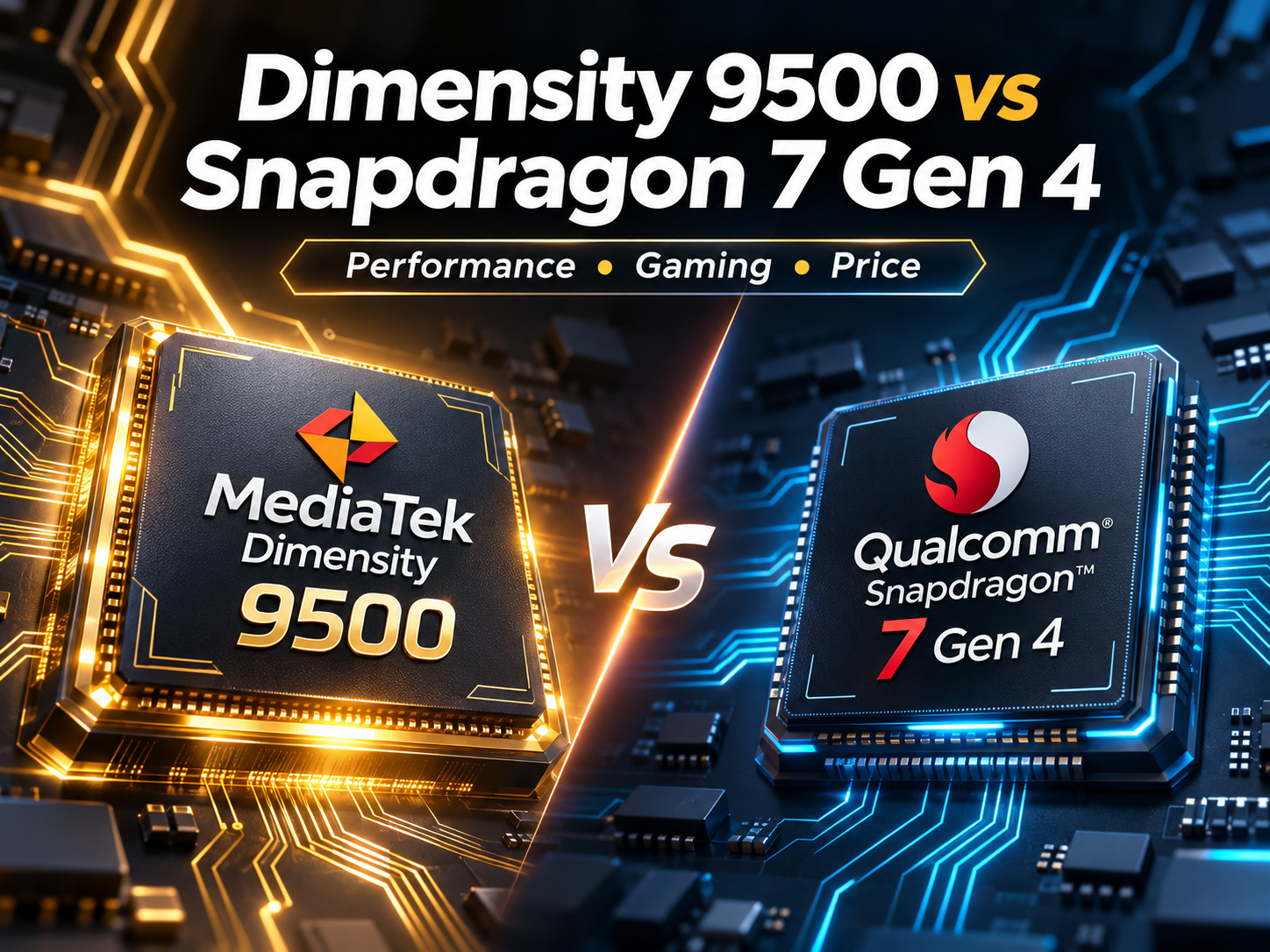
MediaTek Dimensity 9500 is used in flagship smartphones, while Qualcomm Snapdragon 7 Gen 4 powers mid-range models. In Geekbench 6, the flagship chip’s advantage exceeds 150%, while in the 3DMark graphics test it reaches fourfold. At the same time, smartphones with Dimensity 9500 cost significantly more. Let’s compare benchmark results, gaming performance, and the prices of specific devices.
Key Differences
| Specification | Dimensity 9500 | Snapdragon 7 Gen 4 |
|---|---|---|
| Process technology | TSMC 3 nm (N3P) | 4 nm |
| CPU | 1× C1-Ultra, 3× C1-Premium, 4× C1-Pro | 5× Cortex-A720, 3× Cortex-A520 |
| Maximum clock speed | 4.21 GHz | 2.8 GHz |
| GPU | Mali-G1 Ultra MC12 | Adreno 722 |
| RAM | LPDDR5X-10667 | LPDDR5X-8400 |
| Storage | UFS 4.1 | UFS 4.0 |
| NPU | MediaTek NPU 990 | Qualcomm Hexagon |
| Maximum 5G download speed | 7.4 Gbps | 4.2 Gbps |
| Maximum camera resolution | 320 MP | 200 MP |
| Video recording | Up to 8K at 60 FPS | Up to 4K at 60 FPS |
Dimensity 9500 uses an All Big Core architecture: all eight cores belong to Arm’s performance-oriented C1 series. Snapdragon 7 Gen 4 combines five Cortex-A720 cores with three power-efficient Cortex-A520 cores.
In graphics tests, the Mali-G1 Ultra MC12 significantly outperforms the Adreno 722, providing more performance headroom for games with highly detailed graphics.
Both processors support Wi-Fi 7 and Bluetooth 6.0, so their wireless connectivity capabilities are comparable.
Benchmarks: Results from Specific Smartphones
Four smartphones were selected for comparison, using their Geekbench 6 and 3DMark Wild Life Unlimited results.
| Smartphone and processor | Geekbench 6 Single | Geekbench 6 Multi | 3DMark Wild Life Unlimited |
|---|---|---|---|
| vivo X300 Pro - Dimensity 9500 | 3337 | 9983 | 26,529 |
| Oppo Find X9 - Dimensity 9500 | 2966 | 8710 | 26,128 |
| vivo V60 - Snapdragon 7 Gen 4 | 1256 | 3551 | - |
| realme 15 Pro (GoT Edition) - Snapdragon 7 Gen 4 | 1215 | 3536 | 6503 |
The special realme 15 Pro GoT Edition has a different design, but uses the same processor and main hardware components as the regular model.
Based on the average results of two devices with each processor, Dimensity 9500 is 155% faster in the single-core test and 164% faster in the multi-core Geekbench 6 test.
In 3DMark Wild Life Unlimited, the Oppo Find X9 scores 26,128 points versus 6,503 for the realme 15 Pro. The advantage is approximately fourfold.
In AnTuTu 10, the Oppo Find X9 scored 2,827,371 points, while the realme 15 Pro scored 978,212 points. The difference is approximately 189%.
Results depend on cooling, performance settings, and firmware. For example, the Oppo Find X9 records lower Geekbench 6 scores than the vivo X300 Pro despite using the same processor.
Gaming Performance
In Genshin Impact, the Oppo Find X9 with Dimensity 9500 averaged 60.1 FPS over 30 minutes of gameplay at maximum graphics settings with a 60 FPS cap.
In another test, the realme 15 Pro with Snapdragon 7 Gen 4 delivered 35-40 FPS at low settings with the 60 FPS mode selected. With the frame rate capped at 30 FPS, the game ran more consistently.
The measurements were conducted separately and with different graphics settings. Nevertheless, they show that Dimensity 9500 allows higher levels of detail without a significant reduction in frame rate.
Snapdragon 7 Gen 4 fares better in less demanding games. For example, the vivo V60 averages 59.8 FPS in BGMI with Smooth + Extreme settings, while the minimum frame rate in the test is 55 FPS.
The realme 15 Pro with the same processor supports 90 FPS mode in BGMI. The available game modes depend not only on the chip’s performance but also on the game settings provided for a particular smartphone.
Thus, Dimensity 9500 is better suited to demanding games at maximum graphics settings. Snapdragon 7 Gen 4 handles popular online games, but settings often have to be reduced in more demanding titles.
Cameras and Video Processing
Dimensity 9500 is equipped with the Imagiq 1190 image processor. It supports 4K recording at 120 FPS with electronic stabilization, a cinematic 4K mode at 60 FPS, and video recording at up to 8K and 60 FPS.
Snapdragon 7 Gen 4 uses a triple 12-bit Qualcomm Spectra ISP. The platform supports processing photos with resolutions of up to 200 MP and 4K HDR recording at 60 FPS.
Smartphone capabilities may be limited by the manufacturer. For example, the vivo V60 records video at a maximum of 4K and 30 FPS, while the realme 15 Pro with the same Snapdragon 7 Gen 4 supports 4K at 60 FPS.
ISP specifications do not allow photo quality to be compared directly. Shooting results also depend on the sensor, optics, and image-processing algorithms.
Memory and Artificial Intelligence
Dimensity 9500 supports LPDDR5X at speeds of up to 10,667 MT/s and UFS 4.1 storage. Snapdragon 7 Gen 4 supports LPDDR5X at up to 8,400 MT/s and UFS 4.0.
At the same time, the vivo V60 and realme 15 Pro use LPDDR4X, even though Snapdragon 7 Gen 4 itself supports faster memory. Actual memory bandwidth depends on the components installed by the smartphone manufacturer.
AI tasks are handled by the NPU 990 in Dimensity 9500 and Qualcomm Hexagon in Snapdragon 7 Gen 4. Both platforms support on-device AI processing, including image-processing functions and work with generative models.
Power Efficiency and Battery Life
Dimensity 9500 is manufactured using TSMC’s 3 nm N3P process, which improves the energy efficiency of computing. However, under maximum load, its performance cores and graphics subsystem may consume more power than those of Snapdragon 7 Gen 4.
A smartphone’s runtime depends not only on the processor but also on battery capacity, display, and system settings. Therefore, the battery life of the Oppo Find X9, vivo X300 Pro, vivo V60, and realme 15 Pro should be evaluated based on tests of the devices themselves rather than solely on the specifications of their chips.
Is Dimensity 9500 Worth the Extra Cost?
Smartphones using these processors belong to different price segments. For comparison, the approximate launch prices on the Indian market are shown in US dollars.
| Smartphone | Processor | Launch price |
|---|---|---|
| realme 15 Pro | Snapdragon 7 Gen 4 | about $345 |
| vivo V60 | Snapdragon 7 Gen 4 | about $400 |
| Oppo Find X9 | Dimensity 9500 | about $810 |
| vivo X300 Pro | Dimensity 9500 | about $1190 |
The Oppo Find X9 costs more than twice as much as the realme 15 Pro. The difference is explained not only by the processor: flagships also offer more expensive cameras, displays, and other components.
Dimensity 9500 is worth choosing for the following tasks:
- Demanding mobile games with high frame rates and detailed graphics.
- Video editing and processing on a smartphone.
- Resource-intensive applications that make heavy use of the CPU and GPU.
For messaging, video playback, web browsing, and most mobile games, Snapdragon 7 Gen 4 provides sufficient performance. In these scenarios, the difference from Dimensity 9500 is significantly smaller than synthetic benchmarks suggest.
Conclusion
Dimensity 9500 is significantly faster than Snapdragon 7 Gen 4, especially in graphics-intensive tasks. The extra cost is justified primarily under heavy gaming and computing workloads.
Snapdragon 7 Gen 4 offers a more affordable alternative without significant limitations in everyday use.
Advantages
- Higher Technology: 3 nm (3 nm vs 4 nm)
- Higher Frequency: 4210 (4210 vs 2800 MHz)
- Newer Launch Date: September 2025 (September 2025 vs May 2025)
Basic
GPU Specifications
Connectivity
Memory Specifications
Miscellaneous
- FLAC
- HE-AACv1
- HE-AACv2
- MP3
- H.265
- AV1
- VP9
Benchmarks
Comparison of Devices
Related SoC Comparisons


Share in social media
Or Link To Us
<a href="https://cputronic.com/index.php/soc/compare/mediatek-dimensity-9500-vs-qualcomm-snapdragon-7-gen-4" target="_blank">MediaTek Dimensity 9500 vs Qualcomm Snapdragon 7 Gen 4</a>