MediaTek Dimensity 9500s
vs
Qualcomm Snapdragon 8 Gen 5

SoC Comparison Result
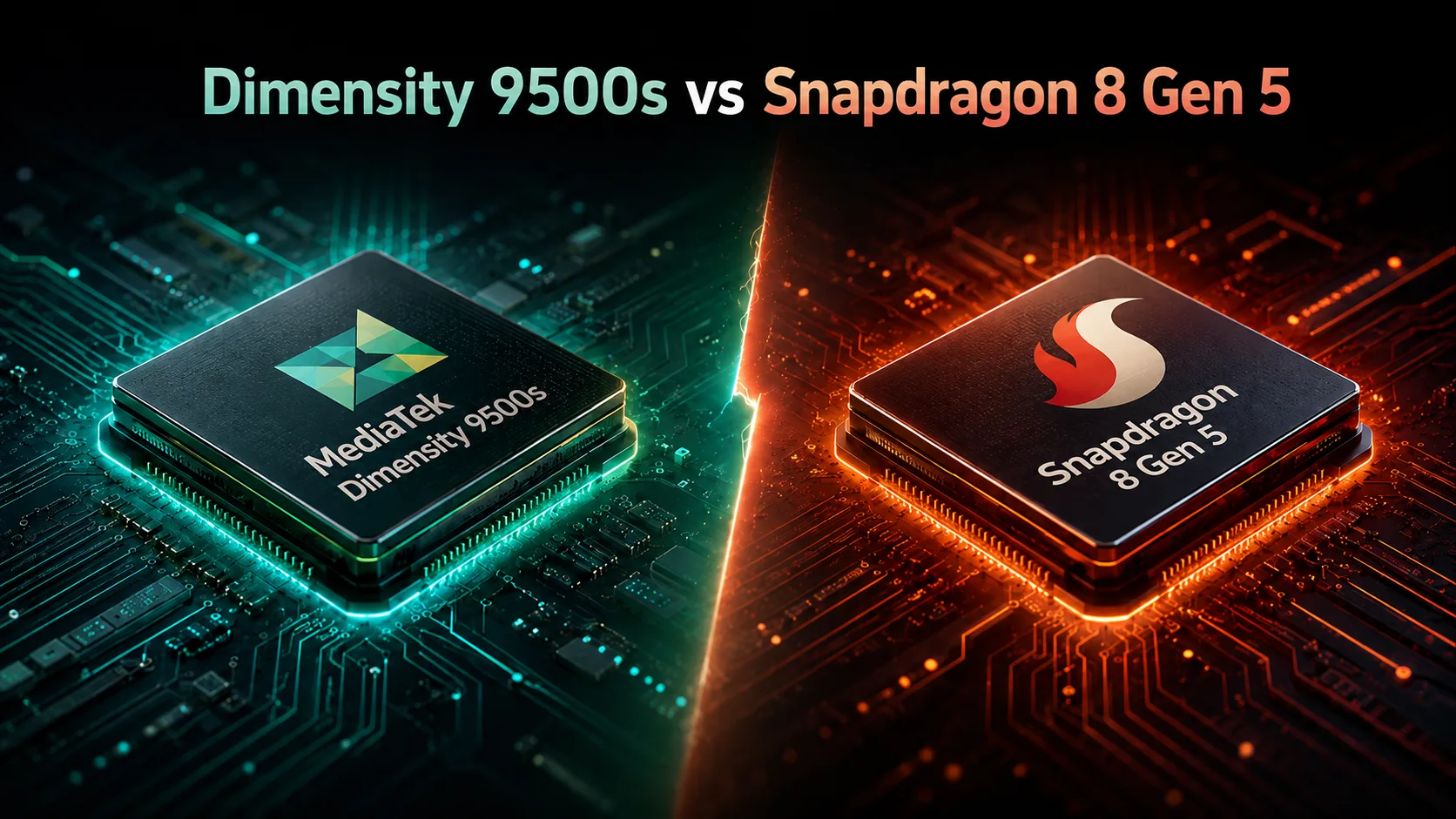
Dimensity 9500s vs Snapdragon 8 Gen 5: Qualcomm's new CPU, MediaTek's more powerful graphics
Snapdragon 8 Gen 5 is faster in processor benchmarks, while Dimensity 9500s is significantly stronger in heavy graphics. Both chips are aimed at sub-flagship smartphones, but Qualcomm and MediaTek achieved high performance in different ways.
Snapdragon has transitioned to its own Oryon cores and came out ahead in CPU workloads. Dimensity closely mimics the configuration of the 9400+: the same Arm cores and Immortalis-G925 graphics.
Positioning is the same, architecture is different
Snapdragon 8 Gen 5 was unveiled in November 2025, positioned below the Snapdragon 8 Elite Gen 5. Dimensity 9500s was released in January 2026 and occupies a similar position relative to the higher-end Dimensity 9500.
Both chips target models cheaper than top flagship devices but without a significant drop in performance. However, the names exaggerate their similarity to higher-end platforms.
Snapdragon 8 Gen 5 uses eight custom Qualcomm Oryon cores:
- two Prime cores with a frequency of up to 3.8 GHz;
- six performance cores up to 3.32 GHz.
Dimensity 9500s employs the following configuration:
- one Cortex-X925 up to 3.73 GHz;
- three Cortex-X4 cores;
- four Cortex-A720 cores.
Neither chip includes small energy-efficient cores. Qualcomm uses its own Oryon cores, while MediaTek uses off-the-shelf Arm cores. In this regard, the Dimensity 9500s configuration is almost entirely transferred from Dimensity 9400+: the cores, frequencies, cache sizes, LPDDR5X, and UFS 4 support are all the same.
Snapdragon is faster in CPU tasks
In Geekbench 6, Snapdragon 8 Gen 5 is 6% faster in single-core tests and almost 10% ahead in multi-core tests.
| Test | Dimensity 9500s | Snapdragon 8 Gen 5 | Advantage |
|---|---|---|---|
| AnTuTu 11 | 2,704,498 | 2,886,527 | Snapdragon +6.7% |
| Geekbench 6, single core | 2650 | 2808 | Snapdragon +6.0% |
| Geekbench 6, all cores | 8379 | 9198 | Snapdragon +9.8% |
| 3DMark Wild Life Extreme | 6131 | 4952 | Dimensity +23.8% |
| 3DMark Solar Bay | 10,937 | 8794 | Dimensity +24.4% |
| 3DMark Steel Nomad Light | 2315 | 1832 | Dimensity +26.4% |
The advantage of Snapdragon will be more noticeable in rendering, video processing, and other prolonged CPU loads.
It is also important for emulators. Many of them depend on single-threaded performance, drivers, and software support as much as on GPU power. In emulation, Snapdragon typically wins due to its faster CPU and better driver support.
In the interface, browser, and regular applications, the difference is almost imperceptible. In Speedometer 3.0, the results were almost identical: 19.4 points for Dimensity and 19.3 for Snapdragon.
Dimensity is significantly faster in graphics
In graphics tests, the ratio changes: Immortalis-G925 is significantly faster than the new Adreno.
In Wild Life Extreme, Dimensity outperforms Snapdragon by almost 24%. In Steel Nomad Light, the gap exceeds 26%. In Solar Bay, where ray tracing performance is evaluated, MediaTek also has an advantage of around 24%.
The new Adreno fell short of Immortalis-G925 in all three 3DMark tests. The gap of 24-26% is too large to attribute to mere differences between smartphones.
In AnTuTu, the gap between the graphics blocks is noticeably smaller. This test combines results from CPU, GPU, memory, storage, and interface, while 3DMark better isolates the graphics load.
The results indicate a higher graphical potential for Dimensity, though the result depends on the specific smartphone.
Throttling under prolonged loads
In a CPU stress test, Dimensity maintained about 76% of its initial performance, while Snapdragon maintained around 70%.
In a prolonged graphics test, Snapdragon showed a stability of 62.3%, while Dimensity had 59.1%. However, the stability percentage does not indicate absolute speed.
After frequency reductions, Dimensity scored around 3626 points, while Snapdragon scored 3085. Snapdragon loses a smaller fraction of speed, but Dimensity remains faster even after throttling.
In a real smartphone, cooling and temperature management settings play a significant role.
Which processor is better for gaming
According to 3DMark tests, Dimensity 9500s is better suited for demanding Android games. Its advantage is especially noticeable in scenarios involving ray tracing and high GPU load.
MediaTek supports frame interpolation and hardware-accelerated ray tracing, but the implementation of these features depends on the specific game.
The strong point of Snapdragon is its updatable drivers and better compatibility with emulators.
In most demanding Android games, GPU performance becomes crucial, while in emulators, CPU and drivers take precedence:
- in demanding Android games, Dimensity has the edge;
- in emulators and CPU-dependent projects, Snapdragon takes the lead.
AI: comparable tests are not yet available
Both chips are designed to run generative models directly on the smartphone.
MediaTek uses its NPU, while Qualcomm employs Hexagon with additional matrix accelerators. There are currently no comparable NPU tests, so it is not possible to declare a winner.
The utility of the neural block is determined by what features the smartphone manufacturer has implemented.
Cameras and video
Dimensity 9500s supports a higher maximum video recording mode - 8K at 60 frames per second. It also claims support for cameras up to 320 MP and 18-bit RAW.
Snapdragon utilizes a triple 20-bit ISP Spectra and a set of algorithms for autofocus, exposure, and night shooting.
Maximum resolution does not define camera quality. Much more important are the sensor, optics, stabilization, and image processing. The 8K60 mode will be available only if the smartphone manufacturer activates it.
Connectivity
Snapdragon 8 Gen 5 is equipped with an X80 modem supporting Sub-6, mmWave, download speeds up to 10 Gbps, Dual SIM Dual Active, and UWB.
Dimensity 9500s is limited to Sub-6 networks and claims a speed of up to 7 Gbps. The claimed Wi-Fi 7 speed for Dimensity is higher: 6.5 vs. 5.8 Gbps.
In real mobile networks, the difference between the claimed 7 and 10 Gbps is unlikely to be noticeable. However, Snapdragon additionally supports mmWave and UWB.
mmWave is notably important in specific markets, including the US. UWB is used for precise tracking of tags, digital car keys, and determining the position of nearby devices.
Conclusion
Snapdragon 8 Gen 5 is faster in CPU tests, better supported by emulators, and additionally offers mmWave and UWB. Dimensity 9500s utilizes the processor core configuration from Dimensity 9400+, but outperforms Snapdragon in graphics tests by approximately 24-26%.
For emulation, video processing, and other CPU loads, Snapdragon is the better option. For demanding Android games and ray tracing, Dimensity shines, provided the smartphone is equipped with sufficiently effective cooling.
Advantages
- Newer Launch Date: January 2026 (January 2026 vs November 2025)
- Higher Frequency: 3800 MHz (3730 MHz vs 3800 MHz)
Basic
3x 3.3 GHz – Cortex-X4
4x 2.4 GHz – Cortex-A720
GPU Specifications
Connectivity
Memory Specifications
Miscellaneous
- FLAC
- HE-AACv1
- HE-AACv2
- MP3
- H.265
- AV1
- VP9
Benchmarks
Comparison of Devices
Related SoC Comparisons





Share in social media
Or Link To Us
<a href="https://cputronic.com/index.php/soc/compare/mediatek-dimensity-9500s-vs-qualcomm-snapdragon-8-gen-5" target="_blank">MediaTek Dimensity 9500s vs Qualcomm Snapdragon 8 Gen 5</a>