MediaTek Dimensity 9500s
vs
MediaTek Dimensity 8400
SoC Comparison Result
MediaTek Dimensity 9500s vs Dimensity 8400: Where the Powerful Mid-Range Ends
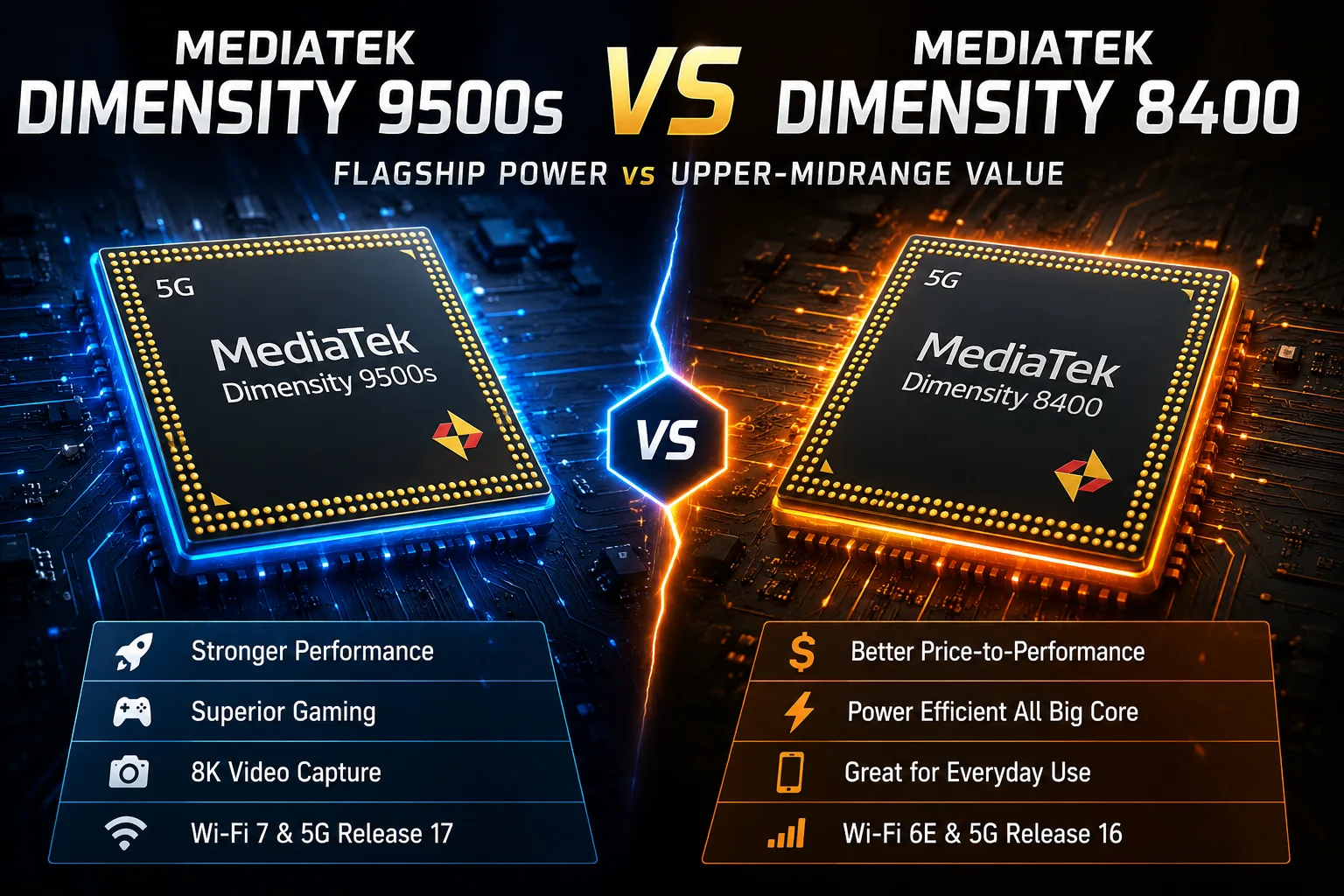
MediaTek Dimensity 8400 looks almost like a flagship until you place it next to the Dimensity 9500s. Then, it becomes clear where the very fast upper mid-range ends and a platform with real performance headroom begins.
Both chips use eight large CPU cores, support LPDDR5X memory, and UFS 4. But the similarity here is more superficial. The Dimensity 8400 is a successful attempt to bring the All Big Core design to a more affordable segment. The Dimensity 9500s is a higher-level platform with Cortex-X925, increased caches, powerful graphics, Wi-Fi 7, 8K video, and a faster 5G modem.
Key Differences
| Feature | MediaTek Dimensity 9500s | MediaTek Dimensity 8400 | What It Changes |
|---|---|---|---|
| Class | Flagship / premium | Premium / upper-midrange | 9500s is positioned higher |
| CPU | 1x Cortex-X925 + 3x Cortex-X4 + 4x Cortex-A720 | 8x Cortex-A725, 1+3+4 scheme | 9500s is stronger at peak |
| Max Frequency | up to 3.73 GHz | up to 3.25 GHz | higher single-core in 9500s |
| L3 + SLC | 12 MB + 10 MB | 6 MB + 5 MB | 9500s has double the large caches |
| GPU | Arm Immortalis-G925 | Arm Mali-G720 MC7 | 9500s is significantly stronger in games |
| Memory | LPDDR5X up to 10667 Mbps | LPDDR5X up to 8533 Mbps | higher bandwidth in 9500s |
| Storage | UFS 4 + MCQ | UFS 4 + MCQ | parity |
| Camera | up to 320 MP, 3x36 MP | up to 320 MP, 3x32 MP | slight advantage for 9500s |
| Video | 8K60 capture, 8K60 decode | 4K60 capture/playback | significant advantage for 9500s |
| Display | WQHD+ up to 180 Hz | WQHD+ up to 144 Hz | 9500s is better for top-tier screens |
| 5G | Release 17, up to 7 Gbps | Release 16, up to 5.17 Gbps | 9500s is more advanced |
| Wi-Fi | Wi-Fi 7 | Wi-Fi 6E | advantage for 9500s |
The Dimensity 8400 does not appear weak even next to the more expensive chip. Its main feature is the eight Cortex-A725 cores without small energy-efficient cores. For its class, this is a strong configuration: a smartphone with such a SoC should quickly open applications, handle multitasking confidently, and manage heavy gaming adequately.
The Dimensity 9500s is built tougher. It has one super-powerful Cortex-X925, three Cortex-X4, and four Cortex-A720. This configuration is better suited for short burst loads: browsing, interface, launching applications, photo processing, game scenes, and tasks where high speed in one or two threads is important.
Important Note: 9500s is Not the Regular Dimensity 9500
The name can be confusing. The Dimensity 9500s should not be perceived as just "the same Dimensity 9500, only with an 's'." The regular Dimensity 9500 uses a different Arm C1 CPU configuration and a different GPU class, while the 9500s is built on Cortex-X925, Cortex-X4, Cortex-A720, and Immortalis-G925.
Therefore, the Dimensity 9500s is more logically perceived as a separate premium platform. It is noticeably stronger than the Dimensity 8400 but is not a complete copy of the senior Dimensity 9500.
CPU: The Difference Is Not Just in Frequency
At first glance, the Dimensity 8400 looks very bold: eight large cores, a frequency of up to 3.25 GHz, and no small cores. But the 9500s has an advantage deeper than just 3.73 GHz versus 3.25 GHz.
The 9500s has double the large caches: 12 MB L3 and 10 MB SLC versus 6 MB L3 and 5 MB SLC in the Dimensity 8400. This helps the CPU and GPU access RAM less frequently and better handle heavy scenarios. In ordinary tasks, the difference may not always be dramatic, but in gaming, camera usage, data processing, and multitasking, such headroom becomes crucial.
Benchmarks
| Test | MediaTek Dimensity 9500s | MediaTek Dimensity 8400 | Difference |
|---|---|---|---|
| AnTuTu 11 | 3,041,307 | 1,934,134 | about +57% |
| Geekbench 6 Single-Core | 2,877 | 1,576 | about +83% |
| Geekbench 6 Multi-Core | 9,236 | 5,893 | about +57% |
| Geekbench GPU Compute | 24,941 | 12,162 | about +105% |
Benchmarks should be viewed as a guideline, not a guarantee for every smartphone. The final figures depend on cooling, firmware, memory, and manufacturer settings. But the overall scale is clear: the Dimensity 9500s is faster not by a symbolic 10-15%, but significantly stronger in almost all heavy tests.
The gap in single-core and GPU Compute is particularly important. The former shows the advantage of a more powerful CPU core, while the latter indicates the difference in GPU class.
Gaming and Graphics
In gaming, the Dimensity 9500s appears much more promising. Its Arm Immortalis-G925 is a higher-level GPU than the Mali-G720 MC7 in the Dimensity 8400. The difference should manifest not only in average FPS but also in headroom for high settings, heavy scenes, elevated resolutions, and future games.
The Dimensity 8400 cannot be written off either. For its class, the Mali-G720 MC7 remains strong graphics, especially if the smartphone has decent cooling. However, this is more of a "play comfortably" option rather than "squeeze the maximum." The 9500s is better suited for devices where manufacturers want to provide high FPS, more stable graphics, and fewer compromises in settings.
However, the chip itself does not solve everything. A smartphone with Dimensity 8400 with good cooling might perform better than a poorly cooled model with a more powerful SoC. But when comparing platforms outright, the advantage of 9500s is obvious.
AI, Camera, and Video
The Dimensity 8400 already looks modern: it has an NPU 880, supports AI functions, cameras up to 320 MP, and 4K60 video. For most smartphones, this is enough. Photos, portrait modes, noise reduction, and local processing do not seem to be the weak points of the 8400.
The Dimensity 9500s goes further. It is better suited for smartphones with a more expensive camera system: up to 320 MP, 3x36 MP, 8K60 recording, 8K60 decoding, and 8K30 10-bit encoding. This is already a level for more advanced videography and processing.
For the average user, 4K60 in the Dimensity 8400 will be more than sufficient. But if the smartphone emphasizes camera, gaming, or local AI functions, the capabilities of the 9500s look more convincing.
Connectivity, Memory, and Display
The Dimensity 9500s gets Wi-Fi 7, 5G Release 17, 4CC-CA, and a claimed download speed of up to 7 Gbps. The Dimensity 8400 has Wi-Fi 6E, 5G Release 16, 3CC-CA, and up to 5.17 Gbps.
In real life, this difference may not always be noticeable: much depends on the operator, region, and antennas in a particular smartphone. But for a device aimed at several years ahead, Wi-Fi 7 and a newer modem is a plus.
Regarding memory, the advantage is also on the side of the 9500s: LPDDR5X up to 10667 Mbps versus 8533 Mbps. This is important for gaming, AI, camera, video processing, and heavy multitasking.
What to Choose
The Dimensity 8400 should be chosen if you need a fast smartphone without overpaying for flagship levels. It is a good option for those looking for strong performance, decent gaming, a fast system, and modern features but not seeking 8K video, Wi-Fi 7, or maximum GPU.
The Dimensity 9500s is more logical to take if the smartphone is purchased with headroom. It is better suited for heavy gaming, long-term usage, advanced cameras, more expensive displays, and scenarios where today's speed is not only crucial but also future-proofing is important.
Conclusion
The MediaTek Dimensity 9500s is noticeably stronger than the Dimensity 8400 in almost every aspect: CPU, GPU, cache, memory, video, connectivity, and support for top-tier displays. This is not a minor upgrade but a higher-class platform.
The Dimensity 8400 does not lose because it is weak. On the contrary, it is one of the most interesting chips in its level: it has brought the All Big Core design to more affordable smartphones and provided a lot of performance without flagship pricing.
If you remove the price from the equation, the choice is obvious. The Dimensity 8400 is a strong option concerning price-to-performance ratio. The Dimensity 9500s is a choice without regard for compromises.
Advantages
- Higher Technology: 3 nm (3 nm vs 4 nm)
- Higher Frequency: 3730 MHz (3730 MHz vs 3250 MHz)
- Newer Launch Date: January 2026 (January 2026 vs December 2024)
Basic
3x 3.3 GHz – Cortex-X4
4x 2.4 GHz – Cortex-A720
3x 3.0 GHz – Cortex-A725
4x 2.1 GHz – Cortex-A725
GPU Specifications
Connectivity
Memory Specifications
Miscellaneous
- FLAC
- HE-AACv1
- HE-AACv2
- MP3
- H.265
- AV1
- VP9
Benchmarks
Comparison of Devices
Related SoC Comparisons




Share in social media
Or Link To Us
<a href="https://cputronic.com/index.php/soc/compare/mediatek-dimensity-9500s-vs-mediatek-dimensity-8400" target="_blank">MediaTek Dimensity 9500s vs MediaTek Dimensity 8400</a>