NVIDIA GeForce RTX 5090 D
NVIDIA GeForce RTX 5090 D: AI Cut Back, but Gaming Remains Intact
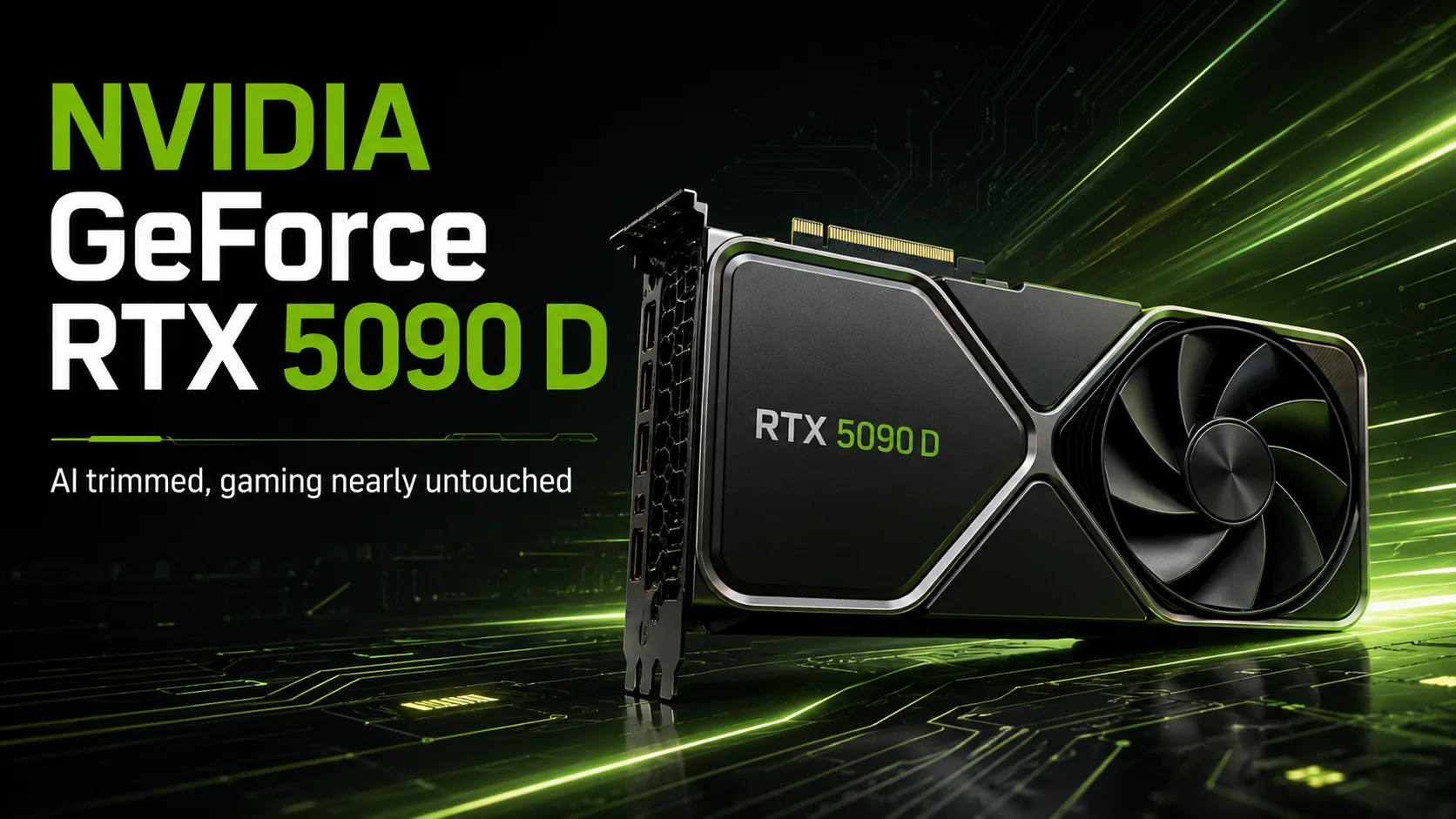
The GeForce RTX 5090 D has been launched for the Chinese market due to U.S. export restrictions. Unlike the RTX 4090 D, NVIDIA has hardly cut back on its gaming capabilities; the number of CUDA cores, memory, and core GPU units remain at the level of the standard RTX 5090. The main limitation concerns AI performance.
What Exactly Was Cut in the RTX 5090 D
The RTX 5090 D retains 21,760 CUDA cores, 680 Tensor Cores, 170 RT Cores, 32 GB of GDDR7 memory, a 512-bit memory bus, and a 575-watt power limit.
The main difference is the declared performance of the Tensor cores: 2375 AI TOPS for the RTX 5090 D compared to 3352 AI TOPS for the standard RTX 5090, which is approximately 29% lower.
In gaming, this limitation hardly affects performance: rasterization, ray tracing, and the memory subsystem of the RTX 5090 D remain intact.
Performance Details of the RTX 5090 D
The performance of partner models for the RTX 5090 D is particularly indicative.
| Graphics Card | 3DMark Time Spy Extreme Graphics | 3DMark Port Royal |
|---|---|---|
| Colorful iGame GeForce RTX 5090 D Advanced 32GB | 25,497 | 36,497 |
| ZOTAC GeForce RTX 5090 D SOLID OC 32GB | 25,901 | 35,252 |
| GALAX GeForce RTX 5090 D Xingyao LUNA OC | 24,946 | 34,017 |
The results were obtained on different test systems, so it's not advisable to compare models based on a few hundred points directly. The difference among the three cards is only a few percent-typical variability among different versions of the same GPU.
Factory overclocking offers only minor improvements, so when choosing a specific RTX 5090 D, it's better to focus on cooling, noise, dimensions, and power limits.
RTX 5090 D in 4K
4K is the most indicative mode for the RTX 5090 D: at 1440p and especially at 1080p, results are increasingly limited by the CPU or game engine.
Results with DLSS 4 Multi Frame Generation should be considered separately from regular tests: frame generation significantly boosts the FPS count, but the graphics card doesn't draw frames that much faster. Therefore, for direct comparisons, the RTX 5090 D's performance is better reflected in tests without Frame Generation.
Why the Original RTX 5090 D Needs 32 GB
The original RTX 5090 D received 32 GB of GDDR7, a 512-bit bus, and a bandwidth of 1792 GB/s.
In most modern games, 32 GB isn't always necessary, but such capacity is beneficial for 3D rendering, video editing, large scenes, and running local AI models.
However, for computational tasks, the RTX 5090 D is no longer a complete analog of the standard RTX 5090. The declared AI performance of the D version is lower, and the real difference depends on the application and format of computations.
In AI tasks, the limitations of the D version are far more significant than in gaming.
575 Watts Require Serious Power and Cooling
The RTX 5090 D retains the 575-watt TGP of the standard RTX 5090. Partner versions with expanded power limits can consume even more.
A powerful power supply, a well-ventilated case, and enough space for the massive graphics card will be necessary. Larger partner models occupy up to four slots and weigh more than 2.5 kg.
For such heavy cards, support for the graphics card is no longer just a decorative accessory.
RTX 5090 D and RTX 5090 D V2 - Not the Same Thing
The original RTX 5090 D comes with:
- 32 GB of GDDR7;
- 512-bit memory bus;
- bandwidth of 1792 GB/s.
Later, the RTX 5090 D V2 was introduced: it has the same 21,760 CUDA cores but comes with only 24 GB of GDDR7 and a 384-bit bus. The memory bandwidth has dropped to 1344 GB/s.
The V2 was released after another tightening of export restrictions and effectively replaced the original version in the Chinese market.
In gaming, reduced memory and bandwidth typically have a lesser impact than in work workloads, but the difference is more noticeable for AI and heavy professional tasks. Therefore, the designation V2 should not be taken as a simple revision of the same card.
Conclusion
The original RTX 5090 D hardly falls short of the RTX 5090 in gaming capabilities: NVIDIA has transferred the main limitations to AI computations.
If the standard RTX 5090 is priced the same, there’s little point in choosing the D version. However, at a lower price, the original 32GB RTX 5090 D loses almost nothing in gaming.
The key when purchasing is to not confuse it with the RTX 5090 D V2. The V2 already has 24 GB of memory and a 384-bit bus: this is not a cosmetic revision, but a significantly altered version of the card.
GPU Comparison
Compare GeForce RTX 5090 D with other GPUs
Basic
Memory Specifications
Display and Media
3x DisplayPort 2.1b
Theoretical Performance
Miscellaneous
Benchmarks
Compared to Other GPU
Related GPU Comparisons

Share in social media
Or Link To Us
<a href="https://cputronic.com/index.php/gpu/nvidia-geforce-rtx-5090-d" target="_blank">NVIDIA GeForce RTX 5090 D</a>