AMD Ryzen Z2 Go
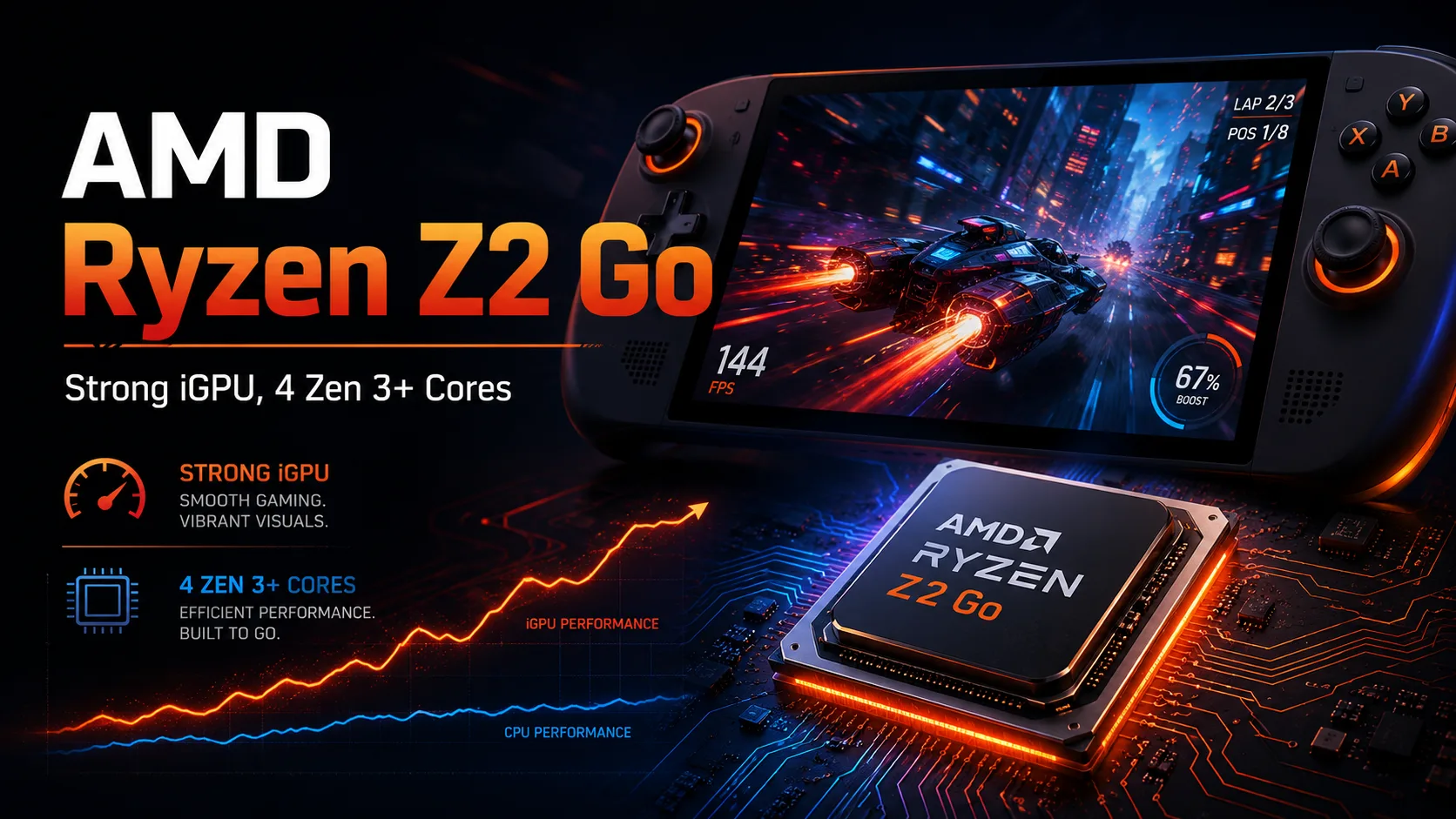
AMD Ryzen Z2 Go: Strong Integrated Graphics and Only Four Zen 3+ Cores
The Ryzen Z2 Go occupies the entry-level position in the AMD Z2 series, but it is not built on a new architecture; rather, it is based on the Rembrandt platform. The CPU section is limited to four Zen 3+ cores and eight threads, while the integrated graphics retain 12 RDNA 2 compute units. Therefore, the chip significantly lags behind eight-core APUs in CPU tests but maintains acceptable gaming performance at moderate resolutions and with FSR.
Performance in Specific Devices
Currently, the Ryzen Z2 Go is installed only in the Lenovo Legion Go S, making it impossible to assess performance variation across different devices with this processor. The table includes versions of the Legion Go S with Windows and SteamOS, as well as similar models featuring the Ryzen Z1 Extreme and the Steam Deck APU.
| Device | Processor | OS | Memory | Power Limit | Geekbench 6, Single-core | Geekbench 6, Multi-core |
|---|---|---|---|---|---|---|
| Lenovo Legion Go S | Ryzen Z2 Go | SteamOS | 32 GB LPDDR5X-6400 | 30 W | 1,871 | 6,320 |
| Lenovo Legion Go S | Ryzen Z2 Go | Windows 11 | 16 GB LPDDR5X-6400 | 30 W | 1,400 | 4,966 |
| ASUS ROG Ally X | Ryzen Z1 Extreme | Windows 11 | 24 GB LPDDR5X-7467 | 30 W | 2,550 | 12,026 |
| Valve Steam Deck OLED | Steam Deck OLED APU | SteamOS | 16 GB LPDDR5 | 15 W | 1,348 | 4,587 |
The results were obtained using a single testing methodology, but the memory configurations, operating systems, and power settings differ.
The difference between the two versions of the Legion Go S cannot be attributed to testing error. With SteamOS, the processor scores 34% higher in single-thread and 27% higher in multi-thread Geekbench 6. Overall, the SteamOS version performed about 24% faster in CPU tests.
However, even with the lighter operating system, the Z2 Go significantly lags behind the Ryzen Z1 Extreme. The ASUS ROG Ally X is approximately 36% faster in single-thread and 90% faster in multi-thread Geekbench 6. The Ryzen Z1 Extreme features eight Zen 4 cores, while the Z2 Go has only four Zen 3+ cores, which is particularly evident in multi-threaded tests.
Against the Steam Deck OLED, the Z2 Go's position is stronger. The Legion Go S with SteamOS outperforms it by about 39% in both single-thread and multi-thread tests. With Windows, the advantage narrows to a minimum, even though the power limit of the Legion Go S is approximately twice as high.
Four-Core CPU - The Main Limitation of Z2 Go
The Ryzen Z2 Go is not merely a scaled-down version of the Ryzen Z2 but rather a processor based on a different architectural foundation. The standard Ryzen Z2 utilizes eight Zen 4 cores and RDNA 3 graphics, whereas the Z2 Go combines Zen 3+ with RDNA 2.
Architecturally, the chip resembles the Ryzen 7 6800U, but it has half the CPU cores. In gaming workloads, the integrated graphics typically consume most of the available power, so additional CPU cores are not beneficial in all scenarios. However, the lack of cores becomes apparent in CPU-dependent games, shader compiling, heavy emulation, and multitasking background applications.
The four-core configuration also hinders performance in productivity tasks on the Legion Go S. For archiving, video encoding, and model compiling, the Ryzen Z1 Extreme, Ryzen 7 7840U, and Ryzen 7 8840U are significantly faster.
SteamOS Significantly Accelerates Legion Go S
SteamOS creates less background overhead and is designed primarily for the console interface of a portable computer. In gaming tests, the Legion Go S with SteamOS outperformed the Windows version by 30-45%, depending on the project.
Under identical settings, higher frame rates were recorded in Cyberpunk 2077, GTA V, Strange Brigade, and Shadow of the Tomb Raider. This does not mean the difference will be the same across all games, but for the Z2 Go, the choice of operating system has a stronger impact on results than for most modern portable APUs.
The gap with the Ryzen Z1 Extreme in games is usually smaller than in CPU tests. The graphical capabilities of the Z2 Go are trimmed much less than the CPU performance, so the double deficit in multi-threaded Geekbench does not directly translate to gaming performance.
In 3DMark Time Spy Graphics, the Legion Go S with Windows scores 2,058 points compared to 2,854 points for the ASUS ROG Ally with the Ryzen Z1 Extreme. The deficit is around 28%, whereas, in multi-threaded Geekbench, the gap approaches a twofold difference.
Settings for Modern Games
In demanding games, it is advisable to lower the resolution to 1280 × 800, select low or medium settings, and enable FSR. The native resolution of the Legion Go S is 1920 × 1200, which is convenient for menus and less demanding projects but places too high a load on the integrated graphics in modern AAA games.
For heavy projects, a stable 30 frames per second remains a reasonable target. In less demanding games, 40-60 FPS can be expected, especially when using dynamic resolution and scaling.
At the same time, SteamOS does not support all games. Some projects with anti-cheat measures and certain third-party launchers do not run or require additional configuration. Third-party stores can be installed via desktop mode, but the setup is more complicated than in Windows.
Lenovo releases the Legion Go S with the Ryzen Z2 Go in versions with Windows 11 and SteamOS, 16 or 32 GB of LPDDR5X-6400 memory, and storage of up to 1 TB. All available results for this processor have, so far, been obtained on a single device and depend on Lenovo’s power settings, cooling, and operating system.
Conclusion
The AMD Ryzen Z2 Go is a specialized APU with a clear bias toward integrated graphics. The four-core CPU significantly lags behind eight-core models, but the graphics with 12 compute units allow the Legion Go S to maintain acceptable performance in modern games.
The highest results for the device are achieved with SteamOS at a power limit of around 25-30 W. With Windows, the advantage over the Steam Deck OLED considerably shrinks, and in CPU-dependent games and productivity applications, the lack of cores becomes apparent more quickly.
The Legion Go S on the Z2 Go should only be considered at a noticeably lower price than devices with the Ryzen Z1 Extreme. If prices are close, the eight-core model is preferable for new games, heavy emulation, and productivity applications.
CPU Comparison
Compare Ryzen Z2 Go with other CPUs
Basic
CPU Specifications
GPU Specifications
Miscellaneous
Benchmarks
Compared to Other CPU
Related CPU Comparisons


Share in social media
Or Link To Us
<a href="https://cputronic.com/index.php/cpu/amd-ryzen-z2-go" target="_blank">AMD Ryzen Z2 Go</a>