AMD Ryzen 7 5800H
AMD Ryzen 7 5800H in 2026: The Processor Has Aged Slower than the Laptops Around It
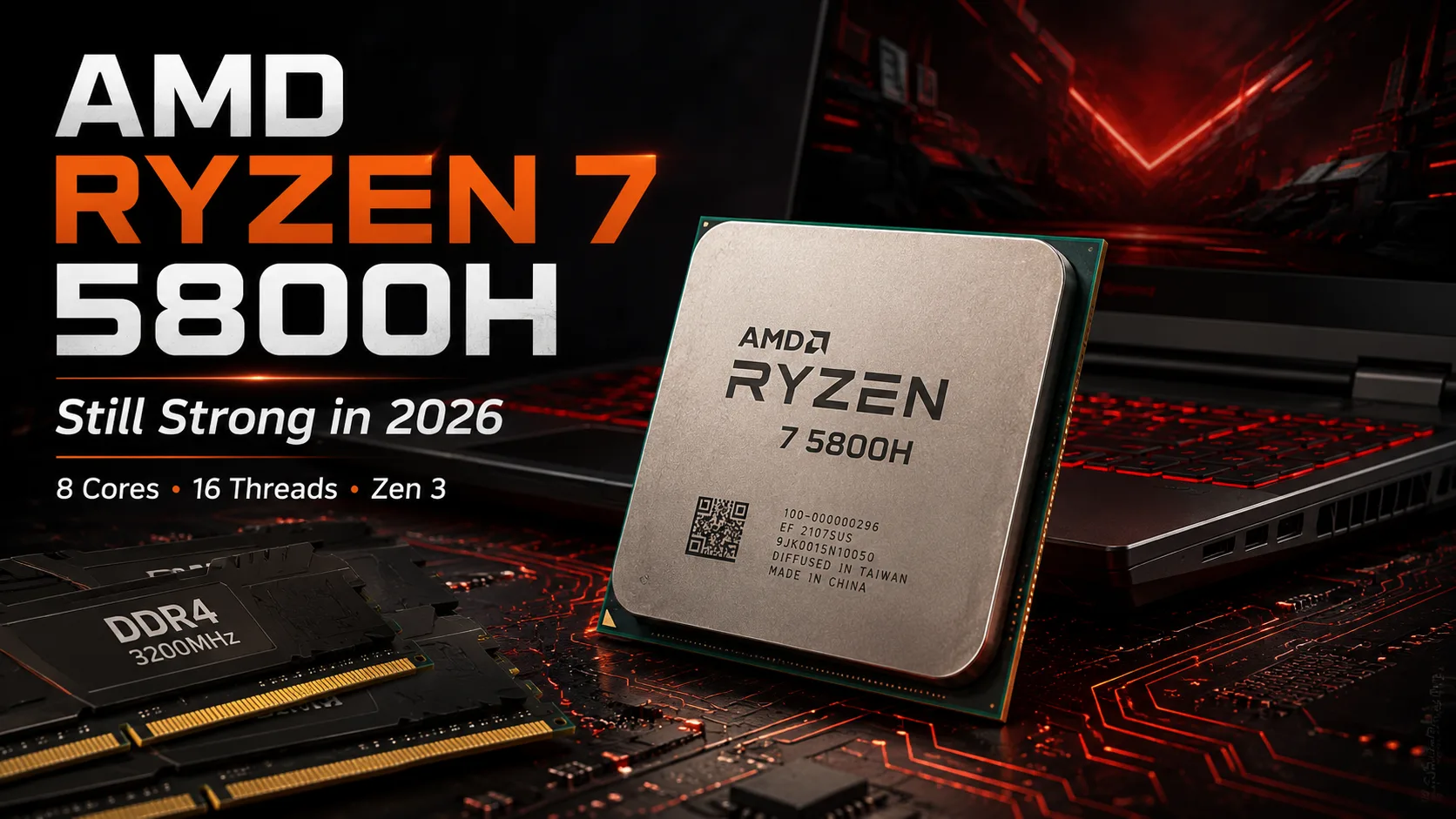
AMD Ryzen 7 5800H was released in January 2021, but it’s too early to disregard it just because of its age. Its eight Zen 3 cores and 16 threads are still capable of handling gaming, compilation, photo, and video processing. The main issue with the 5800H today is different: the processor itself has aged noticeably less than the platform around it - DDR4, PCIe 3.0, and RTX 30 series graphics cards.
Why Ryzen 7 5800H Is Aging So Slowly
The Ryzen 7 5800H belongs to the Cezanne family and utilizes the Zen 3 architecture. It features 8 cores, 16 threads, a base clock speed of 3.2 GHz, and Boost up to 4.4 GHz. The nominal TDP is 45 W, and AMD allows adjustments in the range of 35-54 W.
The main advantage of the 5800H is its eight cores and 16 threads. Even after five years, it maintains a decent speed in demanding multi-threaded tasks.
According to the current PassMark database, the processor scores around 20,500 in CPU Mark and about 2,990 in the single-threaded test. The Core i5-13420H is approximately 12% faster in single-thread performance but falls behind the 5800H in overall CPU Mark. The Ryzen 7 7735HS is ahead by about 8% in both metrics.
Age is primarily evident in single-threaded performance, but in multi-threaded tasks, the 5800H still holds its ground next to newer mid-range mobile processors.
Cinebench R23 in Laptops with Ryzen 7 5800H
The results of mobile H processors heavily depend on the specific laptop: power limits, cooling, and manufacturer settings.
| Device | Cinebench R23 Single Core | Cinebench R23 Multi Core |
|---|---|---|
| Lenovo Legion 5 15ACH-82JU00C6GE-FL | 1410 | 13028 |
| Alienware m15 R5 Ryzen Edition | 1430 | 12195 |
| MSI Alpha 15 B5EEK-008 | 1415 | 12083 |
| HP Victus 16-e0179ng | 1407 | 10097 |
In the single-thread test, the difference between these laptops is minimal. In the multi-threaded test, the Lenovo Legion 5 is nearly 30% faster than the HP Victus 16. This is no longer a margin of error but a consequence of different power limits and cooling systems.
On average, the Ryzen 7 5800H scores around 11,800 points, with the best implementations exceeding 13,000.
Therefore, when buying a laptop with a 5800H, the specific model is more important than the numbers in the processor specification. The Legion 5 allows the 5800H to maintain high multi-threaded performance longer than models with stricter power limits.
In Gaming, the Graphics Card Matters More
The Ryzen 7 5800H is still sufficiently fast for gaming laptops with RTX 3060 or Radeon RX 6600M. At 1440p, the graphics card often becomes the limiting factor. In Full HD with high target frame rates, newer processors can offer an advantage.
The combination of 5800H + RTX 3060 is significantly more appealing than 5800H + RTX 3050. In 2026, when choosing such a laptop, you should primarily consider the graphics card, cooling, and price, and only then look at the processor itself.
The Platform Reveals Its Age
The age of the 5800H is most noticeable not in the CPU cores but in the rest of the platform. The built-in Radeon Graphics uses an old Vega architecture with eight compute units. It’s sufficient for Windows interface, video, and less demanding games, but the Radeon 680M and newer integrated GPUs are significantly faster.
The platform supports DDR4-3200 or LPDDR4x and PCIe 3.0. In a gaming laptop with discrete graphics, this isn’t critical, but against the backdrop of DDR5, PCIe 4.0, and more powerful integrated graphics, the age of the platform is evident.
Therefore, the condition and configuration of the laptop today are more important than the 5800H itself. A fast processor does not compensate for a weak screen, worn-out battery, clogged cooling system, or RTX 3050.
What’s Happening with Prices in 2026
New mass-market laptops with Ryzen 7 5800H have virtually disappeared. Currently, this processor is mainly found in used and refurbished laptops.
In the American secondary market, a refurbished HP Omen 15 with Ryzen 7 5800H and RTX 3060 can be found for around $588. An Acer Nitro 5 with RTX 3060 is available for about $600, while a Lenovo Legion with the same graphics card is roughly $650-750 depending on the model and condition.
At a price of around $600-700, such a configuration is still justified in terms of price-to-gaming performance ratio.
It’s a completely different story for unsold new units. The Dell G15 5515 with Ryzen 7 5800H and RTX 3060 is still found in European retail for about €1279. There’s no reason to pay €1279 for a five-year-old platform.
What to Look For When Buying
For Ryzen 7 5800H in 2026, the condition of a specific laptop is more important than the processor itself. First and foremost, check temperatures under sustained load, battery health, fan noise, screen quality, and memory configuration.
The minimum requirement is 16GB DDR4 in dual-channel mode. It's best to look for configurations with RTX 3060 or Radeon RX 6600M. The RTX 3050 and RTX 3050 Ti significantly decrease the laptop's value unless compensated by a truly low price.
For used gaming models, check hinges, keyboard, power connector, and the stability of the discrete graphics card under load. Five years is already a significant age for a gaming laptop.
Conclusion
In 2026, the Ryzen 7 5800H should only be considered within affordable last-generation laptops. A functioning Legion, Omen, or Nitro with RTX 3060 for $600-700 is still worth considering. Paying $1000 or more for old stock is pointless.
The Ryzen 7 5800H itself has not yet become weak. It’s just that paying for it as if it were modern hardware is no longer viable.
CPU Comparison
Compare Ryzen 7 5800H with other CPUs
Basic
CPU Specifications
Memory Specifications
GPU Specifications
Benchmarks
Compared to Other CPU
Related CPU Comparisons


Share in social media
Or Link To Us
<a href="https://cputronic.com/index.php/cpu/amd-ryzen-7-5800h" target="_blank">AMD Ryzen 7 5800H</a>