NVIDIA GeForce RTX 6070
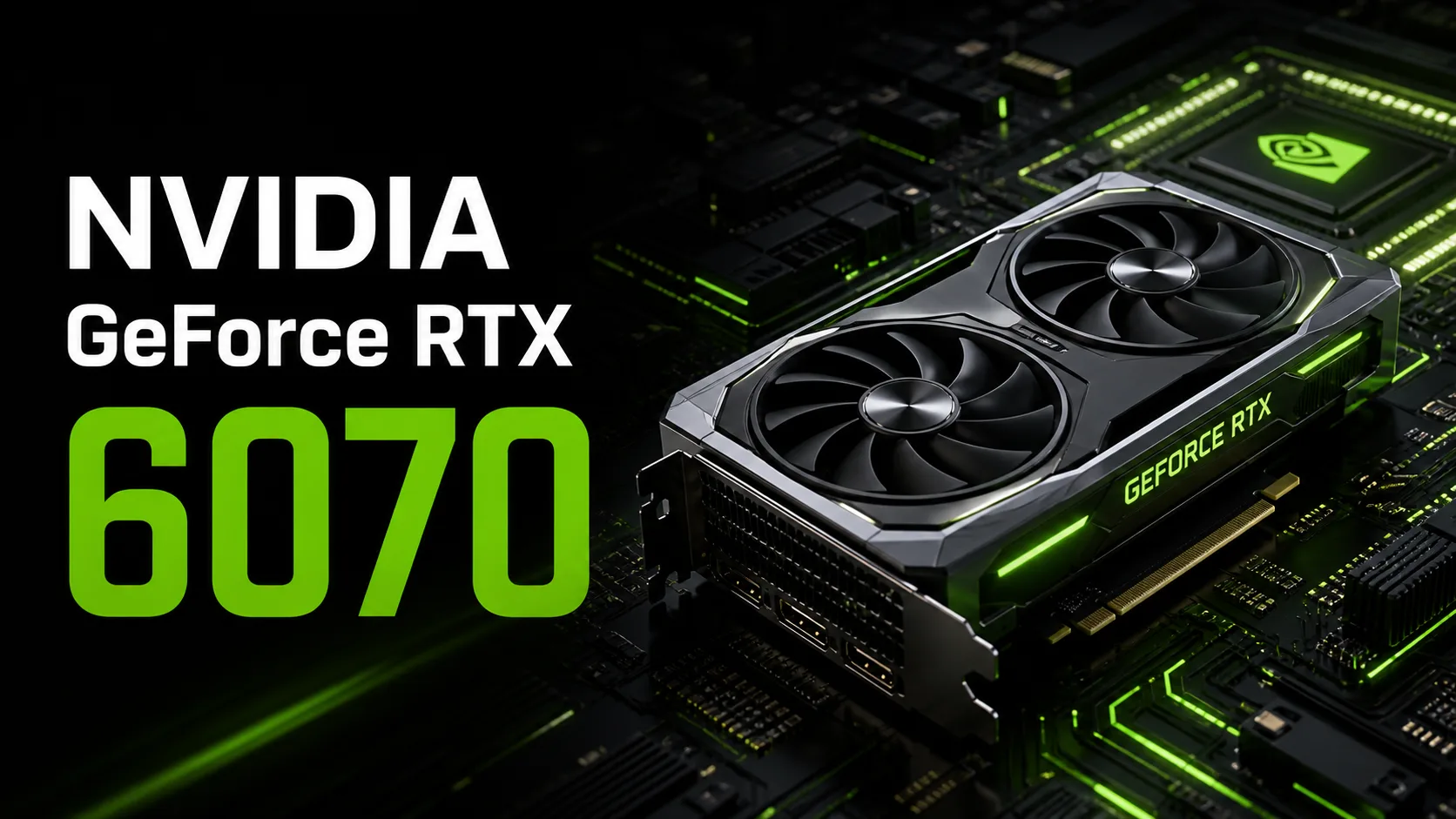
NVIDIA GeForce RTX 6070
NVIDIA GeForce RTX 6070 graphics card review

NVIDIA GeForce RTX 6070: Rumors about Specifications and Release Date

The NVIDIA GeForce RTX 6070 has not been officially announced yet. Currently, the relevant model at this level remains the RTX 5070 based on the Blackwell architecture, so all information concerning the RTX 6070 should be considered as early rumors rather than final specifications.

According to rumors, the RTX 6070 may feature the GR205 GPU, 16 GB GDDR7, and a 256-bit memory bus. If confirmed, the card would represent a significant improvement over the RTX 5070, particularly in terms of video memory capacity and memory bandwidth.

The architecture is likely to be associated with Rubin or a gaming derivative of Rubin. The main focus is expected not only on traditional rasterization but also on ray tracing, path tracing, and AI features. However, the exact number of CUDA cores, clock speeds, power consumption, and price remain unknown.

Regarding the RTX 60 Series in general, the increase in traditional graphics performance may be moderate, while a more noticeable leap is expected specifically in ray tracing and neural network rendering. However, it is still too early to directly transfer these expectations to the RTX 6070.

There is also no clarity on the release date. Previously, the RTX 60 Series was anticipated closer to 2027, but the option of postponing it to 2028 is becoming more frequent due to memory shortages and prioritizing AI accelerators for data centers.

Preliminary Rumors

Parameter What the Rumors Say
Status Not Announced
Possible Architecture Rubin / Gaming Derivative of Rubin
GPU GR205
Memory 16 GB GDDR7
Memory Bus 256 bits
Main Focus 1440p/4K, ray tracing, AI
Rasterization Increase Moderate, exact data not available
RT/PT Increase Expected to be more significant than regular graphics
Possible Release 2027-2028, often mentioned as 2028
Price Unknown

Conclusion

The RTX 6070 currently appears to be a future upper mid-range graphics card for 1440p, demanding games, ray tracing, and entry-level 4K. The most important rumor is the transition to 16 GB GDDR7 and a 256-bit bus, as memory could become the key difference from the RTX 5070.

But for now, this is not a confirmed product. Until the official announcement, it is more accurate to view the RTX 6070 as an anticipated model of the upcoming RTX 60 Series, rather than a graphics card with already known specifications.

Basic

Label Name
NVIDIA
Platform
Desktop
Launch Date
March 2027
Model Name
GeForce RTX 6070
Generation
GeForce 60
Base Clock
2400 MHz
Boost Clock
2600 MHz
Bus Interface
PCIe 5.0 x16
Transistors
Unknown
RT Cores
48
Tensor Cores
?
Tensor Cores are specialized processing units designed specifically for deep learning, providing higher training and inference performance compared to FP32 training. They enable rapid computations in areas such as computer vision, natural language processing, speech recognition, text-to-speech conversion, and personalized recommendations. The two most notable applications of Tensor Cores are DLSS (Deep Learning Super Sampling) and AI Denoiser for noise reduction.
192
TMUs
?
Texture Mapping Units (TMUs) serve as components of the GPU, which are capable of rotating, scaling, and distorting binary images, and then placing them as textures onto any plane of a given 3D model. This process is called texture mapping.
192
Foundry
TSMC
Process Size
3 nm
Architecture
Rubin

Memory Specifications

Memory Size
16GB
Memory Type
GDDR7
Memory Bus
?
The memory bus width refers to the number of bits of data that the video memory can transfer within a single clock cycle. The larger the bus width, the greater the amount of data that can be transmitted instantaneously, making it one of the crucial parameters of video memory. The memory bandwidth is calculated as: Memory Bandwidth = Memory Frequency x Memory Bus Width / 8. Therefore, when the memory frequencies are similar, the memory bus width will determine the size of the memory bandwidth.
256bit
Memory Clock
1750 MHz
Bandwidth
?
Memory bandwidth refers to the data transfer rate between the graphics chip and the video memory. It is measured in bytes per second, and the formula to calculate it is: memory bandwidth = working frequency × memory bus width / 8 bits.
896.0GB/s

Theoretical Performance

Pixel Rate
?
Pixel fill rate refers to the number of pixels a graphics processing unit (GPU) can render per second, measured in MPixels/s (million pixels per second) or GPixels/s (billion pixels per second). It is the most commonly used metric to evaluate the pixel processing performance of a graphics card.
208.0 GPixel/s
Texture Rate
?
Texture fill rate refers to the number of texture map elements (texels) that a GPU can map to pixels in a single second.
499.2 GTexel/s
FP16 (half)
?
An important metric for measuring GPU performance is floating-point computing capability. Half-precision floating-point numbers (16-bit) are used for applications like machine learning, where lower precision is acceptable. Single-precision floating-point numbers (32-bit) are used for common multimedia and graphics processing tasks, while double-precision floating-point numbers (64-bit) are required for scientific computing that demands a wide numeric range and high accuracy.
31.95 TFLOPS
FP64 (double)
?
An important metric for measuring GPU performance is floating-point computing capability. Double-precision floating-point numbers (64-bit) are required for scientific computing that demands a wide numeric range and high accuracy, while single-precision floating-point numbers (32-bit) are used for common multimedia and graphics processing tasks. Half-precision floating-point numbers (16-bit) are used for applications like machine learning, where lower precision is acceptable.
499.2 GFLOPS
FP32 (float)
?
An important metric for measuring GPU performance is floating-point computing capability. Single-precision floating-point numbers (32-bit) are used for common multimedia and graphics processing tasks, while double-precision floating-point numbers (64-bit) are required for scientific computing that demands a wide numeric range and high accuracy. Half-precision floating-point numbers (16-bit) are used for applications like machine learning, where lower precision is acceptable.
32.589 TFLOPS

Miscellaneous

SM Count
?
Multiple Streaming Processors (SPs), along with other resources, form a Streaming Multiprocessor (SM), which is also referred to as a GPU's major core. These additional resources include components such as warp schedulers, registers, and shared memory. The SM can be considered the heart of the GPU, similar to a CPU core, with registers and shared memory being scarce resources within the SM.
48
Shading Units
?
The most fundamental processing unit is the Streaming Processor (SP), where specific instructions and tasks are executed. GPUs perform parallel computing, which means multiple SPs work simultaneously to process tasks.
6144
L1 Cache
128 KB (per SM)
L2 Cache
48 MB
TDP
225W
Vulkan Version
?
Vulkan is a cross-platform graphics and compute API by Khronos Group, offering high performance and low CPU overhead. It lets developers control the GPU directly, reduces rendering overhead, and supports multi-threading and multi-core processors.
1.4
OpenCL Version
3.0
OpenGL
4.6
DirectX
12 Ultimate (12_2)
CUDA
12.0
Power Connectors
1x 16-pin
Shader Model
6.9
ROPs
?
The Raster Operations Pipeline (ROPs) is primarily responsible for handling lighting and reflection calculations in games, as well as managing effects like anti-aliasing (AA), high resolution, smoke, and fire. The more demanding the anti-aliasing and lighting effects in a game, the higher the performance requirements for the ROPs; otherwise, it may result in a sharp drop in frame rate.
80
Suggested PSU
550 W

Benchmarks

FP32 (float)
Score
32.589 TFLOPS

Compared to Other GPU

FP32 (float) / TFLOPS
39.2 +20.3%
35.404 +8.6%
L4
30.703 -5.8%
27.215 -16.5%