AMD Radeon 8065S Graphics
AMD Radeon 8065S Graphics: The High-End iGPU for Ryzen AI Max PRO for Local AI
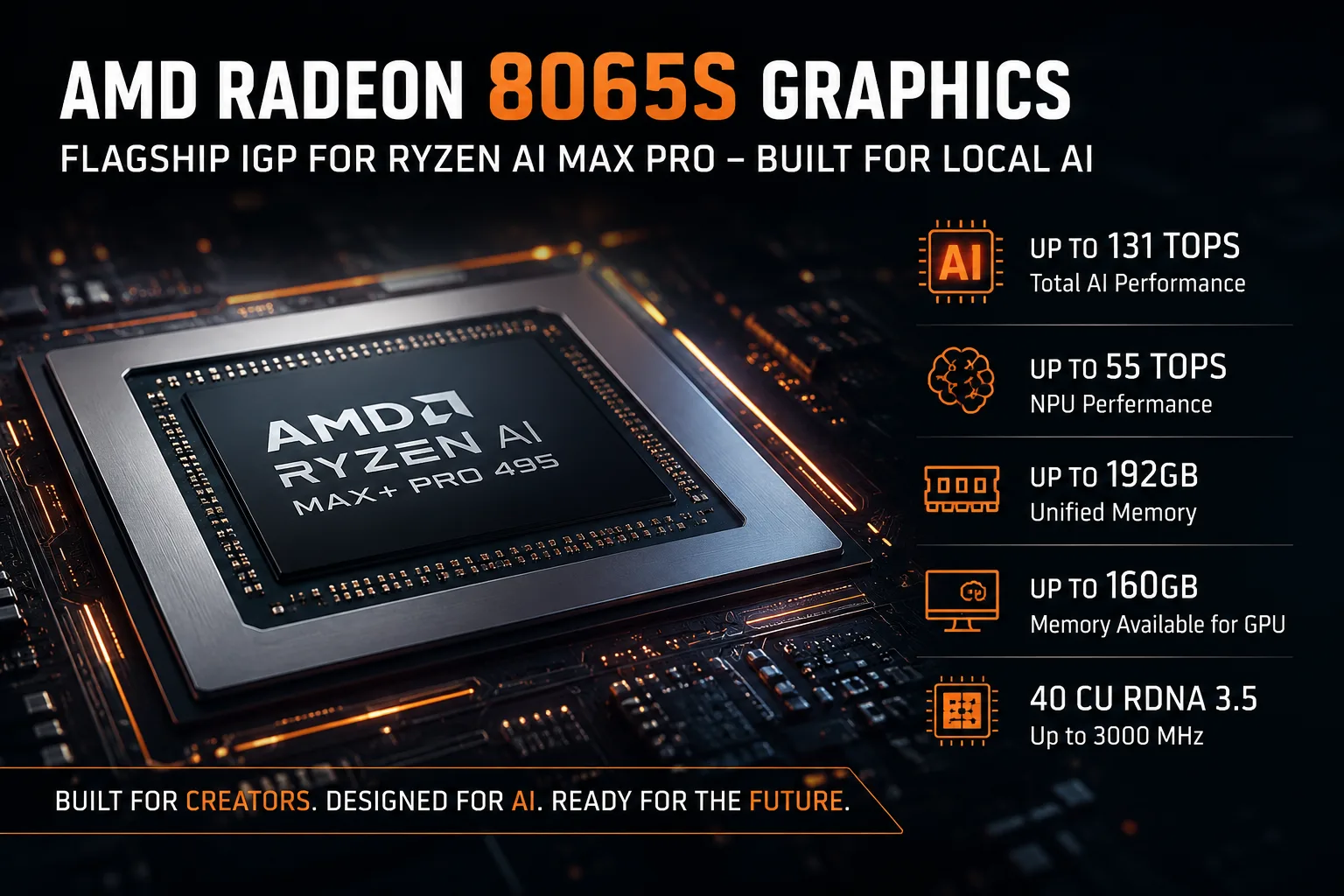
AMD Radeon 8065S Graphics - the high-end integrated graphics for the Ryzen AI Max PRO 400 platform. However, in terms of the GPU itself, this is not a significant leap compared to the Radeon 8060S. The graphics unit remains similar: 40 compute units (CUs) based on the RDNA 3.5 architecture, but the frequency has increased to 3000 MHz. The main difference lies not in the additional 100 MHz, but in the platform surrounding it.
The Radeon 8065S appears in the Ryzen AI Max+ PRO 495 - an updated version of AMD's large APU for local AI, compact workstations, and professional systems. Here, AMD shifts the focus even more from gaming to AI: up to 192 GB of unified memory, up to 160 GB of total memory can be used as GPU memory, the NPU delivers up to 55 TOPS, and the overall AI ceiling of the platform reaches 131 TOPS.
This is no longer just a gaming story. The Radeon 8065S is significant as part of a platform where AMD is attempting to expand its territory in local AI: providing a compact device with a large shared memory pool, a powerful CPU, substantial RDNA graphics, and an NPU without a separate discrete graphics card.
Why the Radeon 8065S Matters
The Radeon 8065S does not have its own GDDR6 memory like a discrete graphics card. It operates with the shared memory of the entire platform. For a typical gaming GPU, this might seem like a limitation, but for local AI, the situation is more complex: often, not only speed matters, but also the volume of available memory.
If a model or context does not fit into the available video memory, high GPU speed no longer helps: the task either fails to start properly or requires significant compromises. The Ryzen AI Max PRO 400 aims to fill this gap. The platform provides the client device with a large local memory pool for LLM, image generation, long contexts, and multiple AI tasks simultaneously.
AMD claims the ability to locally run models with over 300 billion parameters with 4-bit quantization. This does not mean that such a computer replaces a server with professional accelerators. But for a laptop, mini-PC, or compact workstation, this is a significant proposition: large models can be discussed theoretically, but now can actually be run locally with the appropriate software stack.
8065S vs. 8060S: The Key Difference Is in the Platform
The Radeon 8065S is a close relative of the Radeon 8060S. The number of CUs remains the same, the architecture is the same, and the increase in frequency is minor. Therefore, the transition from 8060S to 8065S does not promise a significant increase in FPS on its own.
| Parameter | Radeon 8060S | Radeon 8065S |
|---|---|---|
| Architecture | RDNA 3.5 | RDNA 3.5 |
| Graphic Units | 40 CU | 40 CU |
| GPU Frequency | up to 2900 MHz | up to 3000 MHz |
| Platform | Ryzen AI Max 300 | Ryzen AI Max PRO 400 |
| Maximum Unified Memory | up to 128 GB | up to 192 GB |
| Memory Available to GPU | up to 112 GB | up to 160 GB |
Comparing solely by frequency overlooks the main difference - the platform's memory limit. For gaming, the difference between 8060S and 8065S will likely be moderate. For local AI, the increase in unified memory from 128 to 192 GB is more important than the slight increase in GPU frequency.
Expected Gaming Performance
Currently, there is limited independent data on the Radeon 8065S, so it is logical to gauge gaming performance through the Radeon 8060S and the small difference in frequency. In configuration, these are very close GPUs: the 8065S has the same wide 40-CU block but with slightly higher frequency. Therefore, the gaming gain relative to the 8060S will likely be small: 100 MHz extra does not elevate this graphics unit to a new class.
The practical scenario remains as follows:
- 1080p - the primary mode, often with medium or high settings;
- 1440p - possible in less demanding games or with FSR;
- 4K - more suitable for older and lighter projects;
- Ray Tracing - supported but not a strong suit of this iGPU.
The Radeon 8065S should not be marketed as a direct replacement for mobile RTX cards. This is integrated graphics with shared memory, and its performance will depend on power limits, cooling, and the specific device. In gaming, the Radeon 8065S remains an unusually strong iGPU, while in AI, the main advantage comes not from frequency but from access to a large amount of shared memory.
AI: The Main Scenario for Ryzen AI Max PRO 400
The Ryzen AI Max PRO 400 is significantly more oriented towards local AI than serving as a typical gaming platform. The CPU, GPU, NPU, and unified memory operate as parts of a single APU platform rather than as separate components with different memory pools.
The Radeon 8065S may be interesting for tasks such as:
- Running local LLMs, especially if models do not fit into 8-12 GB VRAM;
- Inference and testing of AI pipelines;
- Working with long contexts;
- Image generation and diffusion models;
- Local AI agents and automated scenarios;
- Tools like PyTorch/ROCm, ONNX, Ollama, llama.cpp, Amuse, and others - provided specific configuration support.
Training large models from scratch remains a task for server accelerators. But launching, testing, local development, small fine-tuning, and working with models that do not fit into a typical mobile graphics card is precisely where the Ryzen AI Max+ PRO 495 and the Radeon 8065S appear particularly interesting.
ROCm, PyTorch, and Limitations
The strong point of this platform is not its compatibility with CUDA but the large unified memory pool and the scenarios supported by the AMD stack. However, it is essential not to overstate this. AMD is still catching up to NVIDIA in the AI ecosystem, and compatibility must be checked against specific OS, ROCm version, PyTorch, model, and tool.
In one scenario, the Radeon 8065S can be used effectively as an accelerator, while in another, the software may not utilize it as a GPU or may require workarounds. Therefore, it is better to describe the 8065S not as a universal AI accelerator for any software but as part of a new AMD platform for local AI, where the significant advantage is the very large amount of available memory.
CUDA-dependent software remains a non-target scenario for the Radeon. If the program requires CUDA, an NVIDIA graphics card is needed. For the Radeon 8065S, the point is different: to run local models through tools supported by the AMD stack and handle tasks where memory is more critical than pure compatibility with CUDA.
Where the Radeon 8065S Fits in the Lineup
The Radeon 8065S currently appears as the high-end model in the Radeon 8000S family. Below it are the Radeon 8060S, Radeon 8050S, and Radeon 8040S. The difference between the 8065S and the 8060S is minor regarding the graphics unit but significant concerning the platform context.
The Radeon 8060S was the high-end iGPU for the Ryzen AI Max 300. The Radeon 8065S has become the updated flagship for the Ryzen AI Max PRO 400. For gaming, these are almost in the same class, while for AI, the 8065S shines primarily due to the Ryzen AI Max+ PRO 495 and its extended memory limit.
The Main Downsides - Price and Niche
The Radeon 8065S cannot be purchased separately. It is part of the expensive professional platform Ryzen AI Max+ PRO 495. Therefore, its value depends not on the line “8065S Graphics” itself but on the price of the entire device and whether local AI scenarios are needed by the user.
If a simple gaming laptop is needed, a model with a discrete RTX 4060 or RTX 4070 may be a more logical choice: separate video memory, DLSS, a familiar gaming ecosystem, and CUDA for compatible software. But if a compact workstation with enormous unified memory, a strong CPU, integrated graphics, and the ability to run large models locally is required, the Radeon 8065S becomes much more interesting.
This is not a mass-market solution for typical gaming laptops. It is a high-end iGPU from AMD's niche platform for local AI, workstations, and compact systems where large memory is just as important as raw graphical power.
Conclusion
AMD Radeon 8065S Graphics is not a revolution compared to the Radeon 8060S in pure GPU terms. It is a newer and expanded version of the same idea: 40-CU RDNA 3.5 graphics within a large APU platform, where the main bet is placed on local AI and unified memory.
For gaming, the Radeon 8065S remains very strong integrated graphics, but it does not replace discrete graphics cards. For AI, it is more interesting: not because AMD has caught up to NVIDIA in terms of software ecosystem, but because the Ryzen AI Max+ PRO 495 provides what is rarely found in mobile systems - up to 192 GB of unified memory.
The significance of the Radeon 8065S is not due to it being noticeably faster than the 8060S in games but rather because it solidifies a new meaning for the Ryzen AI Max: it is no longer just a powerful APU, but a client AI platform where memory for local models becomes the main argument.
GPU Comparison
Compare Radeon 8065S Graphics with other GPUs
Basic
Memory Specifications
Theoretical Performance
Miscellaneous
Benchmarks
Compared to Other GPU
Related GPU Comparisons



Share in social media
Or Link To Us
<a href="https://cputronic.com/gpu/amd-radeon-8065s-graphics" target="_blank">AMD Radeon 8065S Graphics</a>