Intel Core Ultra 5 225F

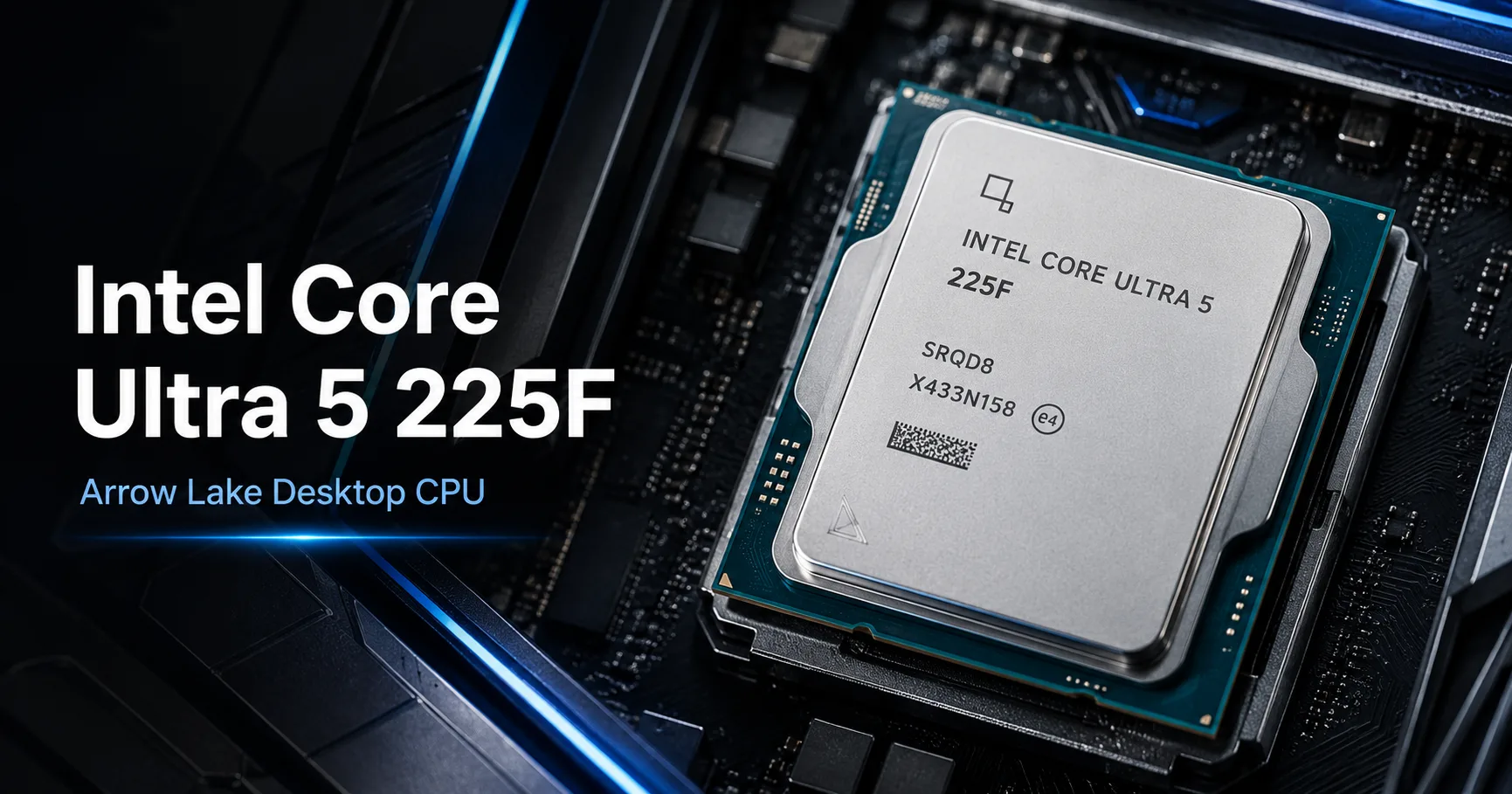
Intel Core Ultra 5 225F: Affordable Arrow Lake for PCs with Discrete Graphics
The Intel Core Ultra 5 225F is a mid-range desktop processor for the LGA1851 platform. Its main idea is simple: to provide the fresh Arrow Lake architecture, high single-core speeds, and a modern platform, but without integrated graphics. Therefore, this chip should not be considered for an "just-in-case" office PC, but rather for a build where a discrete graphics card will be installed right away.
The processor comes with 10 cores and 10 threads: 6 performance P-cores and 4 energy-efficient E-cores. The maximum frequency of the P-cores reaches 4.9 GHz, while the E-cores can go up to 4.4 GHz. The cache volume consists of 20 MB Intel Smart Cache and 22 MB L2. The base power is rated at 65W, but in turbo mode, the processor can spike up to 121W, so it shouldn't be considered “cold”.
What the F Stands For
The suffix F indicates the absence of integrated graphics. The Intel Core Ultra 5 225F requires a separate graphics card: without it, you cannot simply connect a monitor to the motherboard and use the computer.
For a gaming build, this is usually not an issue. If the system will have a GeForce or Radeon anyway, integrated graphics is often not used at all. However, for a versatile home PC, a temporary setup without a graphics card, or a computer that needs to operate even if the GPU fails, a non-F version would be more convenient.
On the other hand, the Core Ultra 5 225F can be more affordable. If you already have a discrete graphics card, paying extra for an integrated graphics core doesn’t always make sense.
Performance
The Core Ultra 5 225F shows its strengths in tasks that require high single-core speeds. This includes games, browsing, office applications, system interfaces, and some engineering and creative software. According to benchmark tests, the processor scores about 2774 points in Geekbench 6 Single-Core and approximately 13666 points in Geekbench 6 Multi-Core. In PassMark, the results are also strong for the mid-range: about 4471 points in Single-Core and 31647 points in Multi-Core.
For everyday tasks, the processor is fast: the system will be responsive, applications launch without feeling "budget," and the 6 performance cores provide a decent buffer for several years.
In multi-threaded tasks, the situation is calmer. 10 physical cores are sufficient for gaming, studying, programming, photo processing, light editing, and compiling small projects. However, the lack of Hyper-Threading limits its potential in heavy scenarios. Where higher-end processors utilize 16, 20, or more threads, the Core Ultra 5 225F no longer appears to be a universal workhorse.
It's not a weak processor, but it shouldn't be seen as a replacement for the Core Ultra 5 245K/245KF, Ryzen 7, or higher-end Core Ultra 7 models. Its domain is a balanced mid-range PC.
Gaming
For gaming, the Core Ultra 5 225F makes sense, especially if the graphics card is mid-range. At resolutions of 1440p and higher, the load often hits the GPU, so the processor will not be the main limitation in most modern titles.
In 1080p with very high FPS, the situation depends on the game. In esports disciplines where 200-300 frames per second are important, more advanced processors may provide a better buffer. But for an ordinary gaming build with a reasonable balance between CPU and graphics card prices, the Core Ultra 5 225F is a good fit.
The key is not to install it in a "future-proof" system with the most expensive graphics card. For top-tier GPUs, it’s better to look at higher models or gaming processors with larger caches.
Platform and Memory
The Core Ultra 5 225F uses the LGA1851 socket. This means that a new motherboard is required, and owners of systems on LGA1700 cannot simply swap processors without changing platforms.
The processor supports DDR5 memory, PCIe 5.0, and modern NVMe SSDs. This is a plus for a new build: the platform is geared towards current motherboards, fast memory, and fresh drives. However, the final cost may be higher than setups based on older Core i5 for LGA1700, where motherboards sometimes come at a lower price.
Thus, the Core Ultra 5 225F is particularly interesting in a new system. As a discrete upgrade for an old PC, it doesn’t make much sense.
Who to Compare With
| Processor | When it's more interesting |
|---|---|
| Core Ultra 5 225F | If a graphics card already exists and a more affordable version without integrated graphics is needed |
| Core Ultra 5 225 | If integrated graphics are needed for diagnostics or operation without a discrete GPU |
| Core Ultra 5 235 / 245 | If a greater core, frequency, and prolonged load reserve is needed |
| Core i5-14400F / i5-14500 | If you want to save on the older LGA1700 platform |
| Ryzen 5 7500F / 7600 | If the AM5 platform and good gaming balance are important |
| Ryzen 5 9600X | If a stronger AMD competitor in single-threaded tasks is required |
Against older Core i5 processors, the chip wins thanks to its fresh architecture and modern platform. Against Ryzen 5, it increasingly depends on the specific build's price: the processor, motherboard, memory, and cooler can significantly alter the final benefit.
Who is the Intel Core Ultra 5 225F For?
The Core Ultra 5 225F should be considered for gaming or versatile PCs with a discrete graphics card. It is suitable for modern games, studying, office work, programming, photo processing, and light editing. It is a good option if you need a fresh Intel processor without paying extra for higher models.
It’s not the best choice for PCs without a graphics card, heavy rendering, professional editing, frequent multi-threaded loads, or builds with flagship GPUs. In such cases, it's better to look higher up the lineup.
Conclusion
The Intel Core Ultra 5 225F is a practical processor for modern mid-range builds. It doesn't try to be a flagship but offers the fresh Arrow Lake architecture, good single-core speeds, support for DDR5 and PCIe 5.0, as well as sufficient performance for gaming and everyday tasks.
Its main advantages are high system responsiveness, a modern platform, and potentially lower price compared to the Core Ultra 5 225. The main downsides include the lack of integrated graphics, blocked overclocking, and limited headroom in heavy multi-threaded tasks.
If you already have a graphics card and the price is significantly lower than that of the non-F version, the Core Ultra 5 225F looks like a sensible choice. This CPU is not for maximum records but for a balanced PC where price, fresh platform, and decent performance without unnecessary markup are important.
CPU Comparison
Compare Core Ultra 5 225F with other CPUs
Basic
CPU Specifications
Memory Specifications
GPU Specifications
Interfaces and Ports
Benchmarks
Compared to Other CPU
Related CPU Comparisons


Share in social media
Or Link To Us
<a href="https://cputronic.com/en/cpu/intel-core-ultra-5-225f" target="_blank">Intel Core Ultra 5 225F</a>