AMD Ryzen Z2 A
AMD Ryzen Z2 A: Is the Steam Deck Processor Under a New Name?
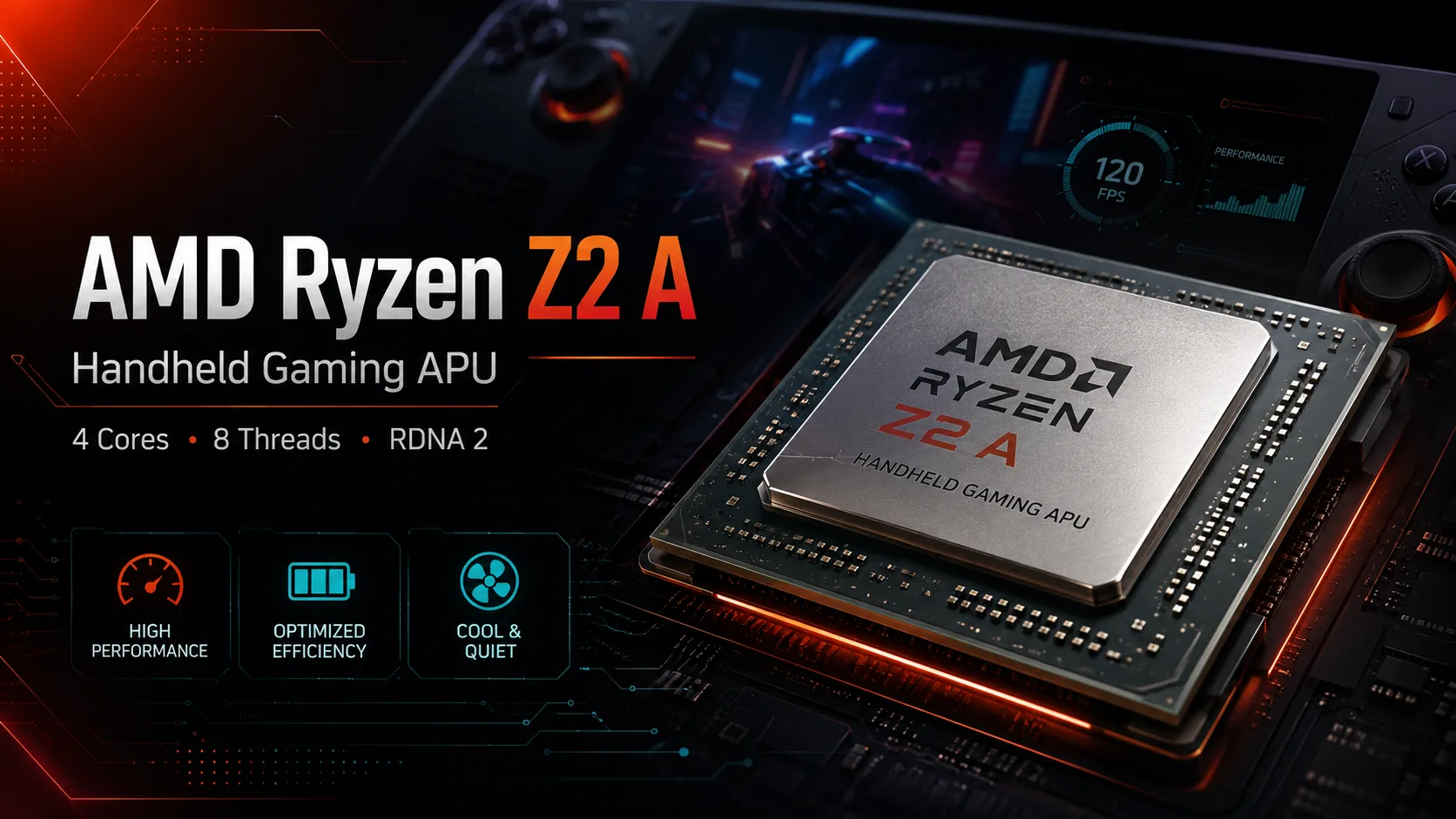
The AMD Ryzen Z2 A is the entry-level processor in the Ryzen Z2 family for portable gaming PCs. Despite its new name, it utilizes a familiar configuration: four Zen 2 cores and integrated RDNA 2 graphics with eight compute units. In terms of architecture, the chip is closer to the Steam Deck processor than to the Ryzen Z1 Extreme or Z2 Extreme.
The processor supports eight threads, boosts up to 3.8 GHz, and operates within a power range of 6 to 20 watts. The frequency of the integrated graphics reaches 1.8 GHz. There is no separate neural processor; thus, this model does not belong to the Ryzen AI platforms.
How Ryzen Z2 A Differs from the Steam Deck APU
| Parameter | Ryzen Z2 A | Steam Deck APU |
|---|---|---|
| CPU Architecture | Zen 2 | Zen 2 |
| Cores and Threads | 4 / 8 | 4 / 8 |
| Max CPU Frequency | 3.8 GHz | 3.5 GHz |
| Integrated Graphics | 8 CU RDNA 2 | 8 CU RDNA 2 |
| Max GPU Frequency | 1.8 GHz | 1.6 GHz |
| Power Range | 6-20 W | 4-15 W |
There are almost no architectural differences. The Ryzen Z2 A has higher frequencies and an expanded power range, but the number of cores and graphics units remains the same.
Effectively, AMD has raised the frequency limits and adapted the proven configuration for modern portable Windows devices. This provides a slight performance boost compared to the Steam Deck but does not change the performance class.
Benchmarks of Ryzen Z2 A in ASUS ROG Xbox Ally
At the time of this writing, the Ryzen Z2 A is used in production only in the ASUS ROG Xbox Ally RC73YA. Therefore, the table below displays not different devices but the results of one model in tests from various outlets.
| Device | Test Source | Power Mode | Geekbench 6, Single-Core | Geekbench 6, Multi-Core | Cinebench R23, Single-Core | Cinebench R23, Multi-Core |
|---|---|---|---|---|---|---|
| ASUS ROG Xbox Ally RC73YA | Notebookcheck | Turbo, 20 W | 1,333 | 3,950 | 1,071 | 4,953 |
| ASUS ROG Xbox Ally RC73YA | Stuff | Up to 20 W | 1,390 | 4,872 | - | - |
| ASUS ROG Xbox Ally RC73YA | Windows Central | Turbo, 20 W, AC Power | 1,421 | 4,843 | - | - |
| ASUS ROG Xbox Ally RC73YA | Tom’s Guide | Not specified | 1,169 | 4,381 | - | - |
The results vary significantly even for the same device. Factors such as BIOS version, power profile, operation on AC or battery, temperature, and background processes in Windows affect performance. Therefore, it is more accurate to refer to the range rather than a single maximum value.
In Geekbench 6, the processor scores about 1,200-1,400 points in single-core mode and 4,000-4,900 points in multi-core mode. A score around 5,000 points in Cinebench R23 Multi confirms that in terms of processing power, Z2 A remains on par with low-cost four-core mobile chips.
Gaming Performance
The optimal resolution for Ryzen Z2 A is 1280 × 720 or something close to it. At 1920 × 1080, the eight RDNA 2 graphics units quickly become a bottleneck, especially in modern games.
In tests with the ASUS ROG Xbox Ally, lowering the resolution from 1080p to 720p improved the results:
- In Gears Tactics - from 32 to 54 FPS;
- In Shadow of the Tomb Raider - from 26 to 43 FPS.
For indie games, platformers, emulation, and titles from previous generations, the capabilities of Z2 A are sufficient. In new AAA games, low settings, FSR, or RSR may need to be used, and sometimes even frame generation AFMF.
Upgrading the resolution helps improve the frame rate but does not eliminate the main limitation: the chip has only four Zen 2 cores and comparatively limited integrated graphics.
Which Power Mode to Use
The official power consumption range for the Ryzen Z2 A is 6-20 watts. The practical application of modes looks like this:
- 6-10 W - Indie games, emulation, and low-demand projects;
- 15 W - Main mode for most games;
- 20 W - Maximum performance at noticeably lower battery life.
After 15 W, the performance increase typically slows down. Additional power raises the frequencies, but four Zen 2 cores and eight RDNA 2 compute units become the main limitation.
In specific modes, the ASUS ROG Xbox Ally can briefly exceed 20 W. This is a characteristic of the specific device settings, not a separate official mode of the processor itself.
Battery Life
Battery life depends not only on the processor but also on the battery capacity, display, and settings of the specific console. The ASUS ROG Xbox Ally is equipped with a 60 W·h battery.
The manufacturer claims up to 5.4 hours of light gaming at around 10 W and up to 2.3 hours in Forza Horizon 5 at 15 W. In heavier games with maximum power profiles, battery life can drop below two hours.
Thus, the advantage of the Z2 A primarily reveals itself under power constraints. Using the maximum mode reduces operating time but does not make the chip a competitor to the Ryzen Z1 Extreme.
Conclusion
The AMD Ryzen Z2 A is not a fully new generation but an updated version of the Steam Deck formula: four Zen 2 cores, eight RDNA 2 blocks, and slightly higher frequencies.
The processor is suitable for entry-level portable consoles meant for gaming at 720p and with a power consumption of around 10-15 W. It handles indie projects, older AAA games, and emulation well, but has limited headroom for new demanding releases.
Purchasing a device with the Ryzen Z2 A is only justified at a significantly lower price. If a model with the Ryzen Z1 Extreme is only slightly more expensive, the more powerful processor will be more advantageous, offering eight Zen 4 cores and three times more graphics units without the need to constantly lower resolutions and settings.
CPU Comparison
Compare Ryzen Z2 A with other CPUs
Basic
CPU Specifications
GPU Specifications
Miscellaneous
Benchmarks
Compared to Other CPU
Related CPU Comparisons





Share in social media
Or Link To Us
<a href="https://cputronic.com/en/cpu/amd-ryzen-z2-a" target="_blank">AMD Ryzen Z2 A</a>