AMD Ryzen Z1 Extreme
vs
AMD Ryzen Z2 A
CPU Comparison Result
AMD Ryzen Z1 Extreme vs AMD Ryzen Z2 A: the new index does not mean higher performance
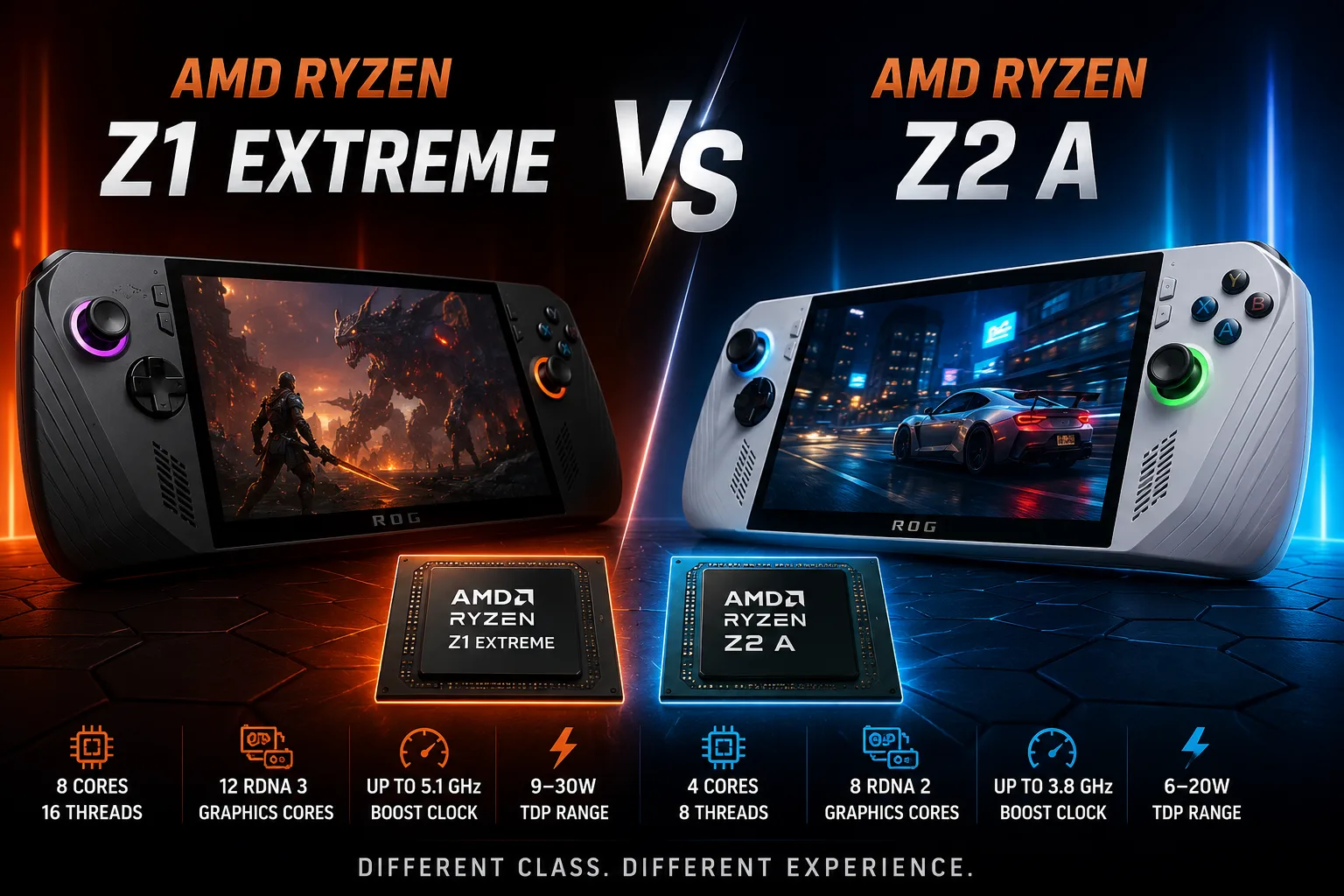
The AMD Ryzen Z2 A belongs to a newer series but does not replace the Ryzen Z1 Extreme. It is a budget processor for economical portable consoles, featuring four Zen 2 cores and eight RDNA 2 graphics blocks. The Z1 Extreme is significantly more powerful: it has eight Zen 4 cores and RDNA 3 graphics with 12 compute units.
As a result, the Ryzen Z1 Extreme is faster not only in gaming but also in emulation, archiving, and other CPU-dependent tasks. The advantage of the Z2 A lies primarily in lower power consumption and the ability to use simpler cooling systems.
Key Differences
| Feature | AMD Ryzen Z1 Extreme | AMD Ryzen Z2 A |
|---|---|---|
| CPU Architecture | Zen 4 | Zen 2 |
| Cores / Threads | 8 / 16 | 4 / 8 |
| Base Frequency | 3.3 GHz | 2.8 GHz |
| Max Frequency | 5.1 GHz | 3.8 GHz |
| L2 Cache | 8 MB | 2 MB |
| L3 Cache | 16 MB | 4 MB |
| GPU Architecture | RDNA 3 | RDNA 2 |
| Graphics Units | 12 CU | 8 CU |
| GPU Frequency | up to 2.9 GHz | up to 1.8 GHz |
| Standard TDP | 28 W | 15 W |
| cTDP Range | 9-30 W | 6-20 W |
The Z1 Extreme has twice as many CPU cores, four times the L3 cache, and 50% more graphics blocks. The additional advantages come from the more modern Zen 4 and RDNA 3 architectures.
In Which Devices Are the Processors Found
The Ryzen Z1 Extreme is used in several well-known portable gaming PCs:
- ASUS ROG Ally;
- ASUS ROG Ally X;
- Lenovo Legion Go;
- certain configurations of Lenovo Legion Go S.
The implementations differ in memory capacity, power settings, and cooling solutions. The first ROG Ally received 16 GB LPDDR5-6400, while the ROG Ally X is equipped with 24 GB LPDDR5X-7500. The Lenovo Legion Go has 16 GB LPDDR5X-7500, so the difference from Ally X is determined not by memory frequency but by the overall configuration, firmware, and ability to sustain high power output.
The Ryzen Z2 A is significantly less common. The main serial device on this processor is the ASUS ROG Xbox Ally with 16 GB LPDDR5X-6400 and a 512 GB storage. The higher-end model ROG Xbox Ally X uses a different processor - the Ryzen AI Z2 Extreme.
Performance in Specific Devices
The table lists the maximum performance of serial devices, not the results of processors at the same TDP. The Z1 Extreme can operate at a sustained power of around 30 W, while the Z2 A's limit is around 20 W. Therefore, the overall gap depends on both the architectures of the processors and the available power limit.
| Device | Processor | Testing Mode | Cinebench R23 Single | Cinebench R23 Multi | 3DMark Time Spy Graphics |
|---|---|---|---|---|---|
| ASUS ROG Ally X | Ryzen Z1 Extreme | Turbo, AC power, 30 W sustained | 1733 | 15 120 | 3196 |
| ASUS ROG Ally | Ryzen Z1 Extreme | Turbo, around 30 W sustained | 1779 | 14 960 | 2854 |
| Lenovo Legion Go | Ryzen Z1 Extreme | Max TDP 30 W | 1733 | 13 004 | 2646 |
| ASUS ROG Xbox Ally | Ryzen Z2 A | Up to 20 W sustained | 1071 | 4953 | 1769 |
In single-threaded Cinebench R23, devices with the Z1 Extreme score between 1733 and 1779 points compared to 1071 points for the Z2 A. The advantage is approximately 62-66%.
In multi-threaded tests, the gap is significantly larger: 13,004-15,120 points versus 4,953 points. The Z1 Extreme is about 2.6-3.1 times faster due to the doubled core count, newer architecture, increased cache, and higher power limit.
The variation between devices on the same Z1 Extreme is also notable. The ROG Ally X scores 15,120 points, while Lenovo Legion Go scores 13,004. Results are influenced by power settings, firmware, and the cooling system's ability to maintain clock speeds under sustained load.
This is especially evident in the ROG Ally X. In a quiet profile with a sustained limit of around 13 W, the device scores 8,446 points in Cinebench R23 Multi, while in network Turbo mode at 30 W, it reaches 15,120 points. Time Spy Graphics simultaneously increases from 1,840 to 3,196 points.
Which Integrated Graphics Is Faster
The Ryzen Z1 Extreme uses RDNA 3 graphics with 12 CU and a frequency of up to 2.9 GHz. In contrast, the Ryzen Z2 A is equipped with eight RDNA 2 CU running at up to 1.8 GHz.
In terms of CPU and GPU configurations, the Z2 A is close to the Steam Deck APU, but the performance of ready-made devices is not identical. It is influenced by clock speeds, memory bandwidth, power limits, and the operating system.
In 3DMark Time Spy Graphics, devices with the Z1 Extreme score between 2,646 and 3,196 points. The result for the ROG Xbox Ally with the Z2 A is 1,769 points. Depending on the specific implementation, the Z1 Extreme's advantage is in the range of approximately 50-81%.
The highest score is shown by the ROG Ally X. Compared to the original ROG Ally, it benefits from faster LPDDR5X-7500 memory. Lenovo Legion Go uses memory of the same speed, so its lower result is related to power settings, firmware, and cooling system implementation.
The difference between the processors directly affects the available settings:
- The Z1 Extreme is better suited for modern games at 720p, 900p, and 1080p with image scaling;
- The Z2 A is primarily aimed at 720p and low or medium settings;
- In less demanding and older games, both processors can deliver a comfortable frame rate;
- In new AAA projects, the reserve of the Z2 A is significantly lower.
At 1080p without scaling, the Z2 A quickly hits the limits of its integrated graphics. For such a processor, it is more rational to use 720p, FSR, and frame rate limiting.
Power Consumption and Battery Life
The official power range for the Z2 A is 6-20 W, while the Z1 Extreme is rated at 9-30 W. This allows devices on the Z2 A to operate with lower power consumption, but does not guarantee better battery life.
For example, the ROG Xbox Ally received a 60 Wh battery, while the ROG Ally X has an 80 Wh battery. In gaming tests, both devices lasted about two hours: the larger battery in the Ally X compensated for the increased power consumption of the Z1 Extreme.
Therefore, the Z2 A should not be regarded as an unequivocally more energy-efficient solution but rather as a processor capable of operating in a compact device with a lower power limit.
What to Choose
Choose Ryzen Z1 Extreme for:
- Modern AAA games;
- Higher graphics settings;
- Emulation of demanding platforms;
- Processor-intensive applications;
- Connecting to an external monitor;
- Greater performance headroom.
Ryzen Z2 A is justified if:
- The device is significantly cheaper than models with the Z1 Extreme;
- The main library consists of indie games and past-generation projects;
- 720p resolution is adequate;
- Low power consumption is more important than maximum performance.
Conclusion
The AMD Ryzen Z1 Extreme wins the comparison by a substantial margin. In the tested portable devices, it is 62-66% faster in single-threaded Cinebench R23, 2.6-3.1 times faster in multi-threaded tests, and approximately 50-81% more powerful in Time Spy Graphics.
The Ryzen Z2 A is not an upgrade to the Z1 Extreme, despite belonging to the newer Z2 series. It is a budget APU based on Zen 2 and RDNA 2 architectures, primarily aimed at 720p resolution and moderate settings. Its main argument is not performance but a lower power limit.
Advantages
- More Total Cores: 8 (8 vs 4)
- Higher Max Turbo Frequency: Up to 5.1 GHz (Up to 5.1 GHz vs Up to 3.8 GHz)
- Larger L3 Cache: 16 MB (16 MB vs 4 MB)
- Newer Launch Date: June 2025 (April 2023 vs June 2025)
Basic
CPU Specifications
GPU Specifications
Miscellaneous
Benchmarks
Related CPU Comparisons




Share in social media
Or Link To Us
<a href="https://cputronic.com/en/cpu/compare/amd-ryzen-z1-extreme-vs-amd-ryzen-z2-a" target="_blank">AMD Ryzen Z1 Extreme vs AMD Ryzen Z2 A</a>