AMD Ryzen AI Max+ 388
AMD Ryzen AI Max+ 388: Radeon 8060S benchmarks and comparison with Ryzen AI Max+ 395
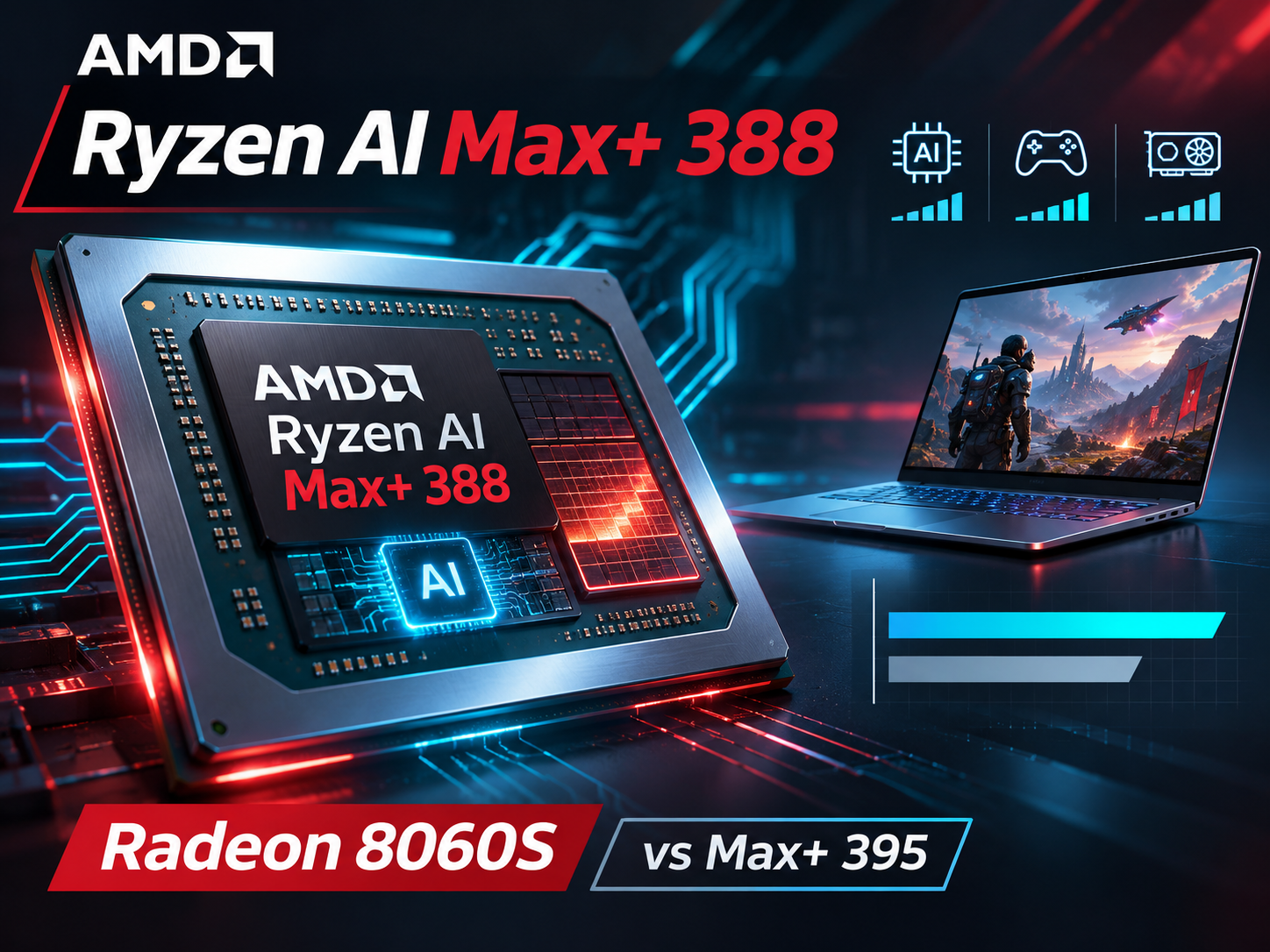
The AMD Ryzen AI Max+ 388 is an eight-core processor from the Strix Halo family, introduced in January 2026. It uses the same Radeon 8060S with 40 compute units as the 16-core Ryzen AI Max+ 395. In tests of the ASUS ProArt PX13, the higher-end Max+ 395 was 6% faster in 3DMark Time Spy Graphics and 30% faster in multithreaded Geekbench 6.
Differences from Other Ryzen AI Max Processors
| Processor | Cores / threads | Integrated graphics | GPU compute units |
|---|---|---|---|
| Ryzen AI Max 385 | 8 / 16 | Radeon 8050S | 32 |
| Ryzen AI Max+ 388 | 8 / 16 | Radeon 8060S | 40 |
| Ryzen AI Max 390 | 12 / 24 | Radeon 8050S | 32 |
| Ryzen AI Max+ 392 | 12 / 24 | Radeon 8060S | 40 |
| Ryzen AI Max+ 395 | 16 / 32 | Radeon 8060S | 40 |
The Max+ 388 has 25% more GPU compute units than the Max 385: 40 versus 32. Its maximum clock speed is also higher-2.9 versus 2.8 GHz. Both processors feature eight Zen 5 cores clocked at up to 5.0 GHz.
The 12-core Max 390 and Max+ 392 have the same distinction: the former is equipped with Radeon 8050S, while the latter uses Radeon 8060S. Thus, the Max+ designation in this lineup indicates the use of more powerful integrated graphics.
Benchmark Performance
The table shows the results of four laptops, including the ASUS ProArt PX13 with the Ryzen AI Max+ 388 and Max+ 395. The ASUS configurations differ in memory capacity: 32 and 128 GB, respectively.
| Laptop, processor, and graphics | Geekbench 6 Single | Geekbench 6 Multi | 3DMark Time Spy Graphics |
|---|---|---|---|
| ASUS ProArt PX13 (32 GB) - Ryzen AI Max+ 388 / Radeon 8060S | 2 872 | 14 915 | 9 801 |
| ASUS ProArt PX13 GoPro Edition (128 GB) - Ryzen AI Max+ 395 / Radeon 8060S | 2 975 | 19 364 | 10 434 |
| MSI Prestige 14 Flip AI+ - Core Ultra X7 358H / Arc B390 | 2 906 | 16 989 | 6 982 |
| HP OmniBook X Flip 14 - Ryzen AI 9 465 / Radeon 880M | 2 844 | 14 069 | 3 247 |
In single-threaded Geekbench 6, the difference between the Max+ 388 and Max+ 395 is about 4%. In the multithreaded test, the higher-end model's advantage grows to 30%.
The Intel Core Ultra X7 358H outperforms the Max+ 388 by approximately 14% in Geekbench 6 Multi-Core, while the Ryzen AI 9 465 trails it by about 6%.
In 3DMark Time Spy Graphics, the laptop with the Radeon 8060S and Max+ 388 outperforms the system with Intel Arc B390 by 40%, and the model with Radeon 880M by approximately three times. The ASUS system with the Max+ 395 scores only 6% higher.
Gaming Performance
The Radeon 8060S is based on the RDNA 3.5 architecture and uses shared system memory.
Results for the specific laptops at a resolution of 1920 × 1080 and Ultra settings, without image scaling:
| Laptop, processor, and graphics | Cyberpunk 2077 | Baldur's Gate 3 |
|---|---|---|
| ASUS ProArt PX13 (32 GB) - Ryzen AI Max+ 388 / Radeon 8060S | 68,9 FPS | 83,5 FPS |
| ASUS ProArt PX13 GoPro Edition (128 GB) - Ryzen AI Max+ 395 / Radeon 8060S | 79,5 FPS | 90,5 FPS |
| MSI Prestige 14 Flip AI+ - Core Ultra X7 358H / Arc B390 | 45,5 FPS | 44,6 FPS |
| HP OmniBook X Flip 14 - Ryzen AI 9 465 / Radeon 880M | 20,5 FPS | 31,4 FPS |
In Cyberpunk 2077, the system with the Max+ 388 delivers 51% more FPS than the laptop with Intel Arc B390. In Baldur's Gate 3, the advantage reaches 87%.
In the tested laptops, the Ryzen AI Max+ 395 delivers 8-15% more FPS than the Max+ 388. Both processors use the Radeon 8060S, but they differ in CPU core count, while the configurations themselves differ in memory capacity. Therefore, the observed difference cannot be attributed solely to CPU performance.
The Impact of Power Mode
The ASUS ProArt PX13 with the Ryzen AI Max+ 388 lets users choose between several performance modes.
| Mode | Power limits | Time Spy Graphics | Cyberpunk 2077, Ultra |
|---|---|---|---|
| Silent | 50/40 W | 6 279 | 48,2 FPS |
| Standard | 65/55 W | 8 435 | 53,7 FPS |
| Performance | 85/70 W | 9 801 | 68,9 FPS |
Switching from Silent to Performance increases the Time Spy graphics score by 56% and the frame rate in Cyberpunk 2077 by 43%.
Therefore, Radeon 8060S performance depends not only on the GPU's specifications, but also on the laptop's cooling system and power settings.
Memory and Running Local AI Models
Strix Halo uses a 256-bit LPDDR5x-8000 memory bus. The platform supports up to 128 GB of shared system memory accessible to both the CPU and GPU.
Because of the shared memory, the GPU can use a large amount of RAM for 3D scenes and local language models that exceed the memory capacity of typical discrete graphics cards. Actual capabilities depend on the installed amount of RAM and its allocation between the CPU and GPU.
The tested ASUS ProArt PX13 with the Ryzen AI Max+ 388 is equipped with 32 GB of memory soldered to the motherboard. For large language models, a system with 64 or 128 GB of RAM may be more useful than a faster laptop with 32 GB: in such workloads, memory capacity is often more important than CPU performance.
Generation speed depends on the model's size and architecture, support for GPU acceleration, and software optimization.
The Max+ 388 also includes an XDNA 2 neural accelerator with performance of up to 50 TOPS. It is used by compatible AI applications, whereas when running large language models, the primary computational load usually falls on the GPU.
What the Ryzen AI Max+ 388 Is Suitable For
- Gaming without a discrete graphics card. The Radeon 8060S delivers more than 60 FPS in the tested Cyberpunk 2077 and Baldur's Gate 3 at 1080p and Ultra settings.
- Photo processing, video editing, and 3D. The Radeon 8060S accelerates compatible graphics operations, while the eight Zen 5 cores are used for rendering and video processing.
- Local AI models. Shared CPU and GPU memory makes it possible to run models that require more memory than is available on a typical mid-range discrete graphics card, provided that there is sufficient RAM.
- Development. Eight cores and 16 threads are suitable for compiling projects, working with containers, and running multiple development tools simultaneously.
For sustained multithreaded rendering and other workloads that make heavy use of all CPU cores, the Ryzen AI Max+ 392 and Max+ 395 will be faster.
Is It Worth Buying the Ryzen AI Max+ 388 in 2026?
The ASUS ProArt PX13 with the Ryzen AI Max+ 388 and 32 GB of RAM costs approximately $1 900. For comparison, the MSI Prestige 14 Flip AI+ with the Core Ultra X7 358H and 32 GB of RAM is available for about $1 300.
If the laptop is primarily needed for development, office applications, and everyday multitasking, the MSI looks like the more economical choice. Its processor is also faster in multithreaded Geekbench 6.
The approximately $600 premium for the ASUS primarily makes sense for users who need higher integrated graphics performance. The Radeon 8060S significantly outperforms the Intel Arc B390 in the tests presented, making the Max+ 388 more attractive for gaming and applications with intensive GPU workloads.
Compared with the Ryzen AI Max+ 395, the lower-end model is appealing to users who do not need 16 CPU cores. In the tested ASUS ProArt PX13 systems, the difference in graphics performance is small, while the higher-end processor has a substantial advantage in multithreaded CPU workloads.
Conclusion
The AMD Ryzen AI Max+ 388 is primarily interesting for its Radeon 8060S graphics, whose performance is close to that of the GPU in the higher-end Ryzen AI Max+ 395. Eight Zen 5 cores are sufficient for the tested games and many work applications, but for sustained multithreaded rendering and compilation of large projects, the higher-end Strix Halo models are preferable.
CPU Comparison
Compare Ryzen AI Max+ 388 with other CPUs
Basic
CPU Specifications
Memory Specifications
GPU Specifications
Miscellaneous
Benchmarks
Compared to Other CPU

Share in social media
Or Link To Us
<a href="https://cputronic.com/en/cpu/amd-ryzen-ai-max-plus-388" target="_blank">AMD Ryzen AI Max+ 388</a>