Intel Core Ultra X9 378H

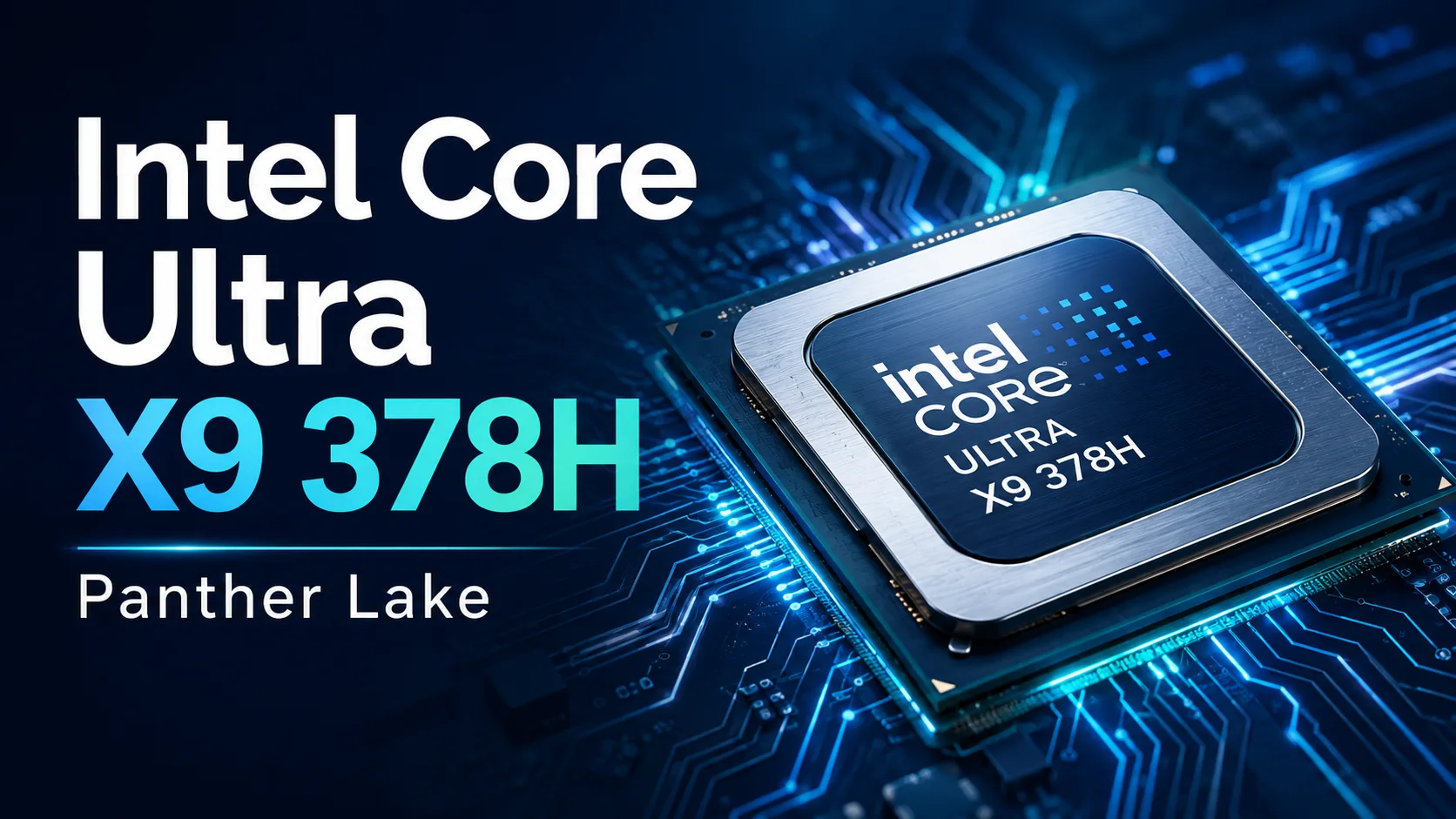
Intel Core Ultra X9 378H: Powerful Panther Lake for Thin Laptops
Intel Core Ultra X9 378H is a high-end mobile processor from the Core Ultra Series 3 family, also known as Panther Lake. It is designed for fast laptops where not only CPU performance matters but also integrated graphics, AI block, battery life, and modern interfaces.
This is not a replacement for HX processors for heavy workstations. The Core Ultra X9 378H is more like a versatile platform for premium laptops: powerful enough for work, study, programming, photo editing, light video, and everyday multitasking.
Positioning
The Core Ultra X9 378H is nearly at the top of the mobile Panther Lake lineup. Above it is the Core Ultra X9 388H, and nearby is the Core Ultra X7 368H. The difference between these models may not always be noticeable during regular use, so much will depend on the laptop's price, cooling, power limits, and memory configuration.
The main idea behind the Core Ultra X9 378H is to provide a powerful processor, Intel Arc B390 integrated graphics, and an NPU for local AI tasks in one energy-efficient chip. Such a processor is logically expected in premium ultrabooks, compact work laptops, and models for users who need high speed without a mandatory discrete graphics card.
Architecture and Specifications
The Core Ultra X9 378H features 16 cores and 16 threads:
| Block | Configuration |
|---|---|
| Performance-cores | 4 cores |
| Efficient-cores | 8 cores |
| Low Power Efficient-cores | 4 cores |
| Total | 16 cores / 16 threads |
The maximum frequency of P-cores reaches 5.0 GHz, E-cores up to 3.8 GHz, and LP E-cores up to 3.6 GHz. The size of Intel Smart Cache is 18 MB. The base power of the processor is 25 W, and the maximum turbo power is 80 W.
An important note: Panther Lake is a multi-tile platform. For the CPU part, Intel specifies the process as Intel 18A, and for the graphics tile with Arc B390, it is TSMC N3E. Therefore, it is more accurate to say not just "a processor on Intel 18A," but "a platform with a CPU tile on Intel 18A and a graphics tile on TSMC N3E."
Performance
The Core Ultra X9 378H should handle everyday multitasking, browsers with many tabs, office work, programming, photo editing, light video editing, and other tasks where the balance of CPU, graphics, and battery life is important.
The 4 performance cores are responsible for system responsiveness and fast single-threaded tasks. The 8 E-cores assist with multi-threaded workloads, while the 4 LP E-cores take care of light background processes with lower power consumption.
Real speed will depend on the specific laptop. In a thin chassis, the processor may operate quieter and more efficiently but may reduce frequencies more quickly under sustained load. In a model with good cooling, the Core Ultra X9 378H will be able to maintain high performance levels for longer.
Intel Arc B390 Integrated Graphics
One of the main strengths of the Core Ultra X9 378H is the Intel Arc B390 graphics. It features 12 Xe-cores, a frequency of up to 2.5 GHz, support for DirectX 12 Ultimate, ray tracing, AV1 encode/decode, H.264/H.265 encode/decode, and H.266/VVC decoding.
For the average user, this means that the laptop can comfortably handle multiple monitors, high-resolution videos, media tasks, graphic applications, and light gaming without a discrete graphics card.
The Arc B390 should be seen as strong integrated graphics for Full HD. Esports games and older titles should run smoothly, while newer heavy games may run best at low or medium settings, depending on cooling, memory speed, and the specific game's demands. For high resolution, maximum graphics, and heavy AAA titles, a discrete graphics card will still be superior.
AI Capabilities
The Core Ultra X9 378H is equipped with an NPU with performance up to 50 TOPS INT8. This block is intended for local AI functions: noise suppression, background blurring, image processing, some Windows features, and applications that can utilize the NPU.
It is important not to overestimate this block. The NPU does not replace a powerful graphics card in heavy AI tasks such as image generation or working with large language models. Its strength lies elsewhere: it can perform small AI scenarios efficiently without overloading the CPU and GPU.
Memory and Interfaces
The Core Ultra X9 378H supports up to 96 GB LPDDR5X-9600 in dual-channel mode. Fast memory is particularly critical for integrated graphics, as the iGPU uses shared system memory.
The platform also supports Thunderbolt 4, PCIe 5.0/4.0, and up to 12 PCI Express lanes. This makes the processor suitable for modern thin laptops with fast SSDs, docking stations, external monitors, and high-speed peripherals.
Competitors
| Model | Comparison Context |
|---|---|
| Intel Core Ultra X9 388H | Higher version of Panther Lake |
| Intel Core Ultra X7 368H | Close model within the same line |
| Intel Core Ultra 9 285H | Previous generation Intel H-class |
| AMD Ryzen AI 9 365 | Direct competitor for thin performance laptops |
| AMD Ryzen AI 9 HX 370 | More powerful AMD competitor with strong NPU and integrated graphics |
| Qualcomm Snapdragon X Elite | Alternative focusing on battery life, but not a direct x86 competitor |
Who Should Consider the Core Ultra X9 378H
This processor is worth considering if you need a fast modern laptop for work, study, programming, photo editing, light video, browsing, office tasks, and occasional AI functions.
The Core Ultra X9 378H is particularly appealing to those who do not want to buy a heavy gaming laptop but still want strong integrated graphics and a good performance headroom.
This chip performs best in laptops with good cooling, fast LPDDR5X memory, high-quality displays, ample batteries, fast SSDs, and reasonable power limits. The mere name of the processor does not guarantee uniform speed across all models: one laptop with the Core Ultra X9 378H may be quiet and energy-efficient, while another could be faster but hotter and noisier.
Conclusion
Intel Core Ultra X9 378H is a powerful mobile processor for premium Panther Lake laptops. It combines a 16-core hybrid architecture, a frequency of up to 5.0 GHz, Intel Arc B390 graphics, a 50 TOPS NPU, and support for fast LPDDR5X memory.
It is not a replacement for HX chips and discrete graphics cards, but for thin performance laptops, the Core Ultra X9 378H appears to be a very balanced option.
CPU Comparison
Compare Core Ultra X9 378H with other CPUs
Basic
CPU Specifications
Memory Specifications
GPU Specifications
Interfaces and Ports
Benchmarks
Compared to Other CPU
Related CPU Comparisons


Share in social media
Or Link To Us
<a href="https://cputronic.com/cpu/intel-core-ultra-x9-378h" target="_blank">Intel Core Ultra X9 378H</a>