Intel Core i5-4570
Intel Core i5-4570: Performance, Gaming Tests, and Relevance in 2026
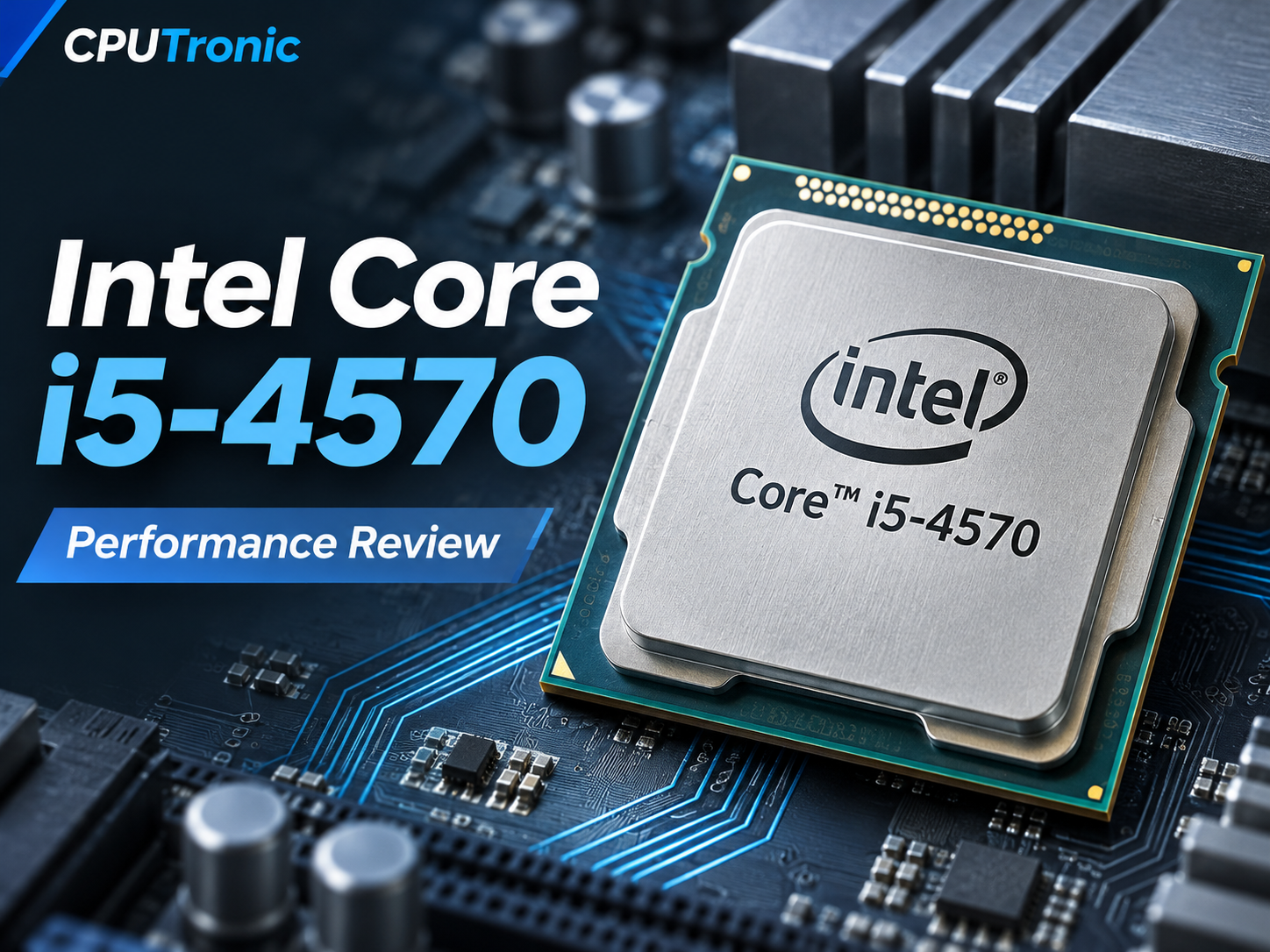
The Intel Core i5-4570 is a desktop quad-core Haswell processor released in June 2013. It is manufactured using a 22 nm process, operates at up to 3.6 GHz, and uses the LGA1150 socket.
In 2026, its performance is sufficient for office applications, web browsing, and undemanding games. Its main limitations are its four processing threads, outdated integrated graphics, and lack of official Windows 11 support.
Comparison with Other Processors
| Processor | Architecture | Cores / Threads | Clocks, GHz | L3 Cache | TDP / PBP | Socket |
|---|---|---|---|---|---|---|
| Core i3-4130 | Haswell | 2 / 4 | 3.4 | 3 MB | 54 W | LGA1150 |
| Core i5-4570 | Haswell | 4 / 4 | 3.2-3.6 | 6 MB | 84 W | LGA1150 |
| Core i5-4590 | Haswell | 4 / 4 | 3.3-3.7 | 6 MB | 84 W | LGA1150 |
| Core i7-4770 | Haswell | 4 / 8 | 3.4-3.9 | 8 MB | 84 W | LGA1150 |
| Core i5-6500 | Skylake | 4 / 4 | 3.2-3.6 | 6 MB | 65 W | LGA1151 |
| Core i3-12100 | Alder Lake | 4 / 8 | 3.3-4.3 | 12 MB | 60 W | LGA1700 |
The Core i5-4570 differs from the Core i3-4130 by having four physical cores instead of two. The Core i5-4590 has base and maximum clocks that are 100 MHz higher, while the Core i7-4770 supports Hyper-Threading and has a larger L3 cache.
The Core i5-6500 and Core i3-12100 belong to newer generations and are incompatible with LGA1150 motherboards.
Architecture and Features
The Core i5-4570 supports AVX2, FMA3, SSE4.2, and AES-NI instructions, as well as Intel VT-x and VT-d hardware virtualization technologies. Its multiplier is locked, so overclocking by increasing it is not available.
The dual-channel memory controller supports DDR3-1333/1600 and DDR3L-1333/1600. The maximum amount of RAM is 32 GB, with a bandwidth of 25.6 GB/s.
Sixteen PCIe 3.0 lanes are available for connecting a discrete graphics card. The TDP is 84 W. The stock Intel cooler is sufficient for operation at standard clocks, provided it is in good working order.
Benchmark Performance
| Processor | Geekbench 6 Single-Core | Geekbench 6 Multi-Core | PassMark CPU Mark |
|---|---|---|---|
| Intel Core i3-4130 | 1027 | 1976 | 3324 |
| Intel Core i5-4570 | 1049 | 2727 | 5222 |
| Intel Core i5-4590 | 1116 | 3143 | 5365 |
| Intel Core i7-4770 | 1225 | 3815 | 7124 |
| Intel Core i5-6500 | 1172 | 3206 | 5634 |
| Intel Core i3-12100 | 2146 | 6894 | 13537 |
In Geekbench 6, the Core i5-4570 outperforms the Core i3-4130 by 38% in the multithreaded test, while delivering virtually identical single-threaded performance.
The Core i7-4770 is 17% ahead of the i5-4570 in Single-Core and 40% ahead in Multi-Core. The additional processing threads are useful for archiving, software-based video encoding, and running several resource-intensive applications simultaneously.
The Core i5-6500 has a 12% and 18% advantage, respectively. Such an increase is unlikely to justify the cost of replacing the motherboard.
The Core i3-12100 scores approximately twice as many points in the single-threaded test and 2.5 times as many in the multithreaded test. Despite having the same number of physical cores, the difference is explained by its more powerful architecture, higher clocks, larger cache, and Hyper-Threading support.
Gaming Performance
The gaming test results for a system with a Core i5-4570 and GeForce GTX 1070 were obtained using the following configuration:
- Processor: Intel Core i5-4570.
- Motherboard: MSI H81M.
- Graphics card: NVIDIA GeForce GTX 1070 8 GB.
- RAM: 16 GB DDR3-1600.
- Resolution: 1920 × 1080.
| Game | Graphics Settings | Average FPS | 1% Low FPS |
|---|---|---|---|
| Counter-Strike 2 | Low, FSR Off | 169 | 86 |
| Fortnite | Low, Performance Mode | 127 | 23 |
| GTA V (Story Mode) | Very High | 79 | 40 |
| GTA Online | Very High | 45 | 31 |
In Counter-Strike 2, the test system delivers an average of 169 FPS. In Fortnite, the average is 127 FPS, but the 1% Low figure is just 23 FPS, indicating significant frame-rate drops.
In a multiplayer GTA Online session with 27 players, the system produced 45 FPS, compared with 79 FPS in GTA V's story mode.
The four processing threads limit the Core i5-4570's capabilities in CPU-intensive games. However, frame-rate stability also depends on the graphics card, game engine, and resource load.
For a budget gaming PC, the GeForce GTX 1050 Ti, GTX 1650, or Radeon RX 570 can be considered. When installing a more powerful graphics card, the processor's limitations, the power supply's capabilities, and the case dimensions must be taken into account.
Intel HD Graphics 4600 Integrated Graphics
Intel HD Graphics 4600 contains 20 execution units (EUs), operates at 350-1150 MHz, and uses system RAM.
Its performance is sufficient for office applications and video playback with hardware H.264 decoding. Intel Quick Sync Video technology is supported.
Full hardware decoding of HEVC, VP9, and AV1 is not available. Playing video in these formats increases the load on the processor, which can lead to dropped frames, especially at high resolutions.
DisplayPort supports output at a resolution of 3840 × 2160 at 60 Hz if the motherboard is equipped with the corresponding video output.
HD Graphics 4600 does not provide sufficient performance for modern 3D games.
Compatibility and Upgrades
The Core i5-4570 is compatible with LGA1150 motherboards using the H81, B85, H87, Z87, H97, and Z97 chipsets, provided the processor is supported by the BIOS.
The main upgrade options are:
- Installing a SATA SSD instead of a mechanical hard drive.
- Increasing the amount of RAM to 16 GB using dual-channel mode.
- Replacing the processor with a Core i7-4770 or Core i7-4790.
- Installing a discrete graphics card for gaming or hardware decoding of modern video formats.
The ability to boot the operating system from an NVMe SSD depends on the motherboard and BIOS version.
Upgrading from the Core i5-4570 to the Core i5-4590 is not worthwhile because of the small difference in specifications. Replacing it with a Core i7-4770 provides a noticeable increase in multithreaded performance without changing the platform.
Standard Windows 10 support ended on October 14, 2025. Participants in the consumer ESU program can receive security updates until October 12, 2027. The Core i5-4570 is not officially supported by Windows 11. Modern Linux distributions remain an alternative.
Advantages and Disadvantages
Advantages
- Low cost on the used market.
- Support for AVX2 instructions.
- Sufficient performance for office tasks.
- Upgrade path to an eight-thread Core i7.
Disadvantages
- Limited performance in multithreaded workloads.
- Low integrated graphics performance.
- No hardware decoding for modern video formats.
- No official Windows 11 support.
Is the Intel Core i5-4570 Worth Buying in 2026?
Buying a Core i5-4570 makes sense primarily for repairing or inexpensively upgrading an existing LGA1150 computer. Combined with an SSD and 16 GB of RAM, it is suitable for working with documents, browsing the web, and playing undemanding games.
When building a computer from scratch, more modern platforms are preferable. Even the Core i3-12100, with four physical cores, provides significantly higher performance, supports DDR4 or DDR5, offers modern interfaces, and is officially compatible with Windows 11.
CPU Comparison
Compare Core i5-4570 with other CPUs
Basic
CPU Specifications
Memory Specifications
GPU Specifications
Benchmarks
Compared to Other CPU
Related CPU Comparisons


Share in social media
Or Link To Us
<a href="https://cputronic.com/cpu/intel-core-i5-4570" target="_blank">Intel Core i5-4570</a>