Intel Core 5 220H

Intel Core 5 220H: Core i5-13600H Returns with a 100 MHz Boost
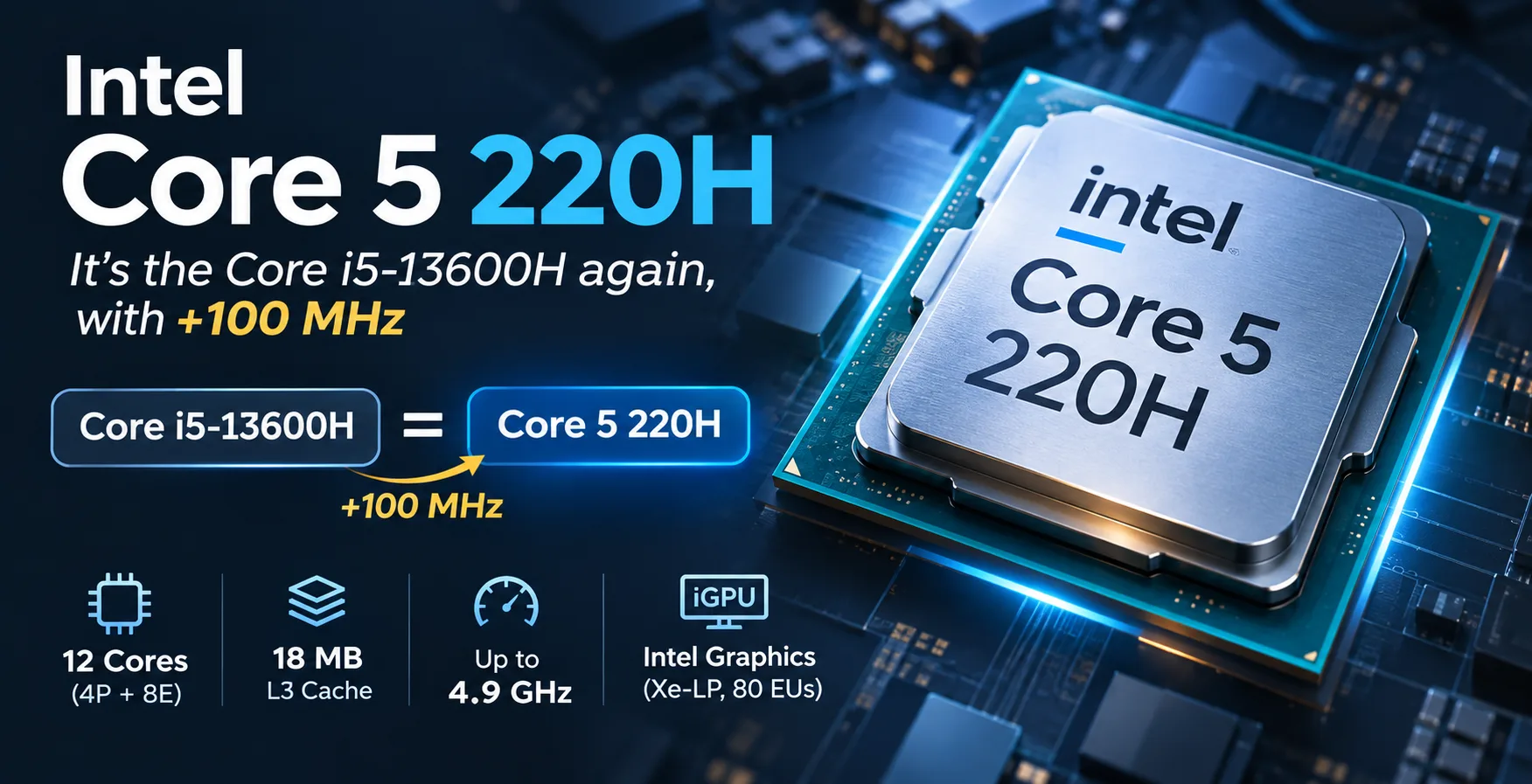
The Intel Core 5 220H was released at the end of 2024, but it did not receive a new architecture. The processor is based on Raptor Lake, which was also used in 13th-generation Core i5 processors. In terms of specifications, it is almost identical to the 2023 Core i5-13600H: the same 12 cores, 16 threads, and integrated graphics with 80 execution units. The main change is a 100 MHz increase in maximum clock speeds.
In Geekbench 6, the processor scores around 2500 points in the single-threaded test and 11300 in the multi-threaded test. That level of performance is sufficient for programming, photo editing, and everyday tasks. However, when choosing a laptop, the processor’s new name matters less than its price, cooling, and overall equipment.
What Changed Compared with the Core i5-13600H
The core count, 18 MB of L3 cache, and Intel 7 process technology remain unchanged. Only the clock speeds are different.
| Specification | Core 5 220H | Core i5-13600H |
|---|---|---|
| Max. P-core frequency | 4.9 GHz | 4.8 GHz |
| Max. E-core frequency | 3.7 GHz | 3.6 GHz |
| P-core base frequency | 2.7 GHz | 2.8 GHz |
| E-core base frequency | 2.0 GHz | 2.1 GHz |
| Release year | 2024 | 2023 |
Both processors have 4 performance P-cores and 8 efficiency E-cores. Base power is 45 W, while maximum turbo power is 115 W. Supported memory includes DDR5-5200, LPDDR5x-6400, and DDR4-3200.
A 100 MHz increase is too small to have a significant effect on performance. Under sustained load, the laptop’s power limits and cooling matter more.
Benchmarks: How Fast Is the Core 5 220H?
For comparison, the table includes Geekbench 6 results from specific laptops, along with a separately published result for the Core i5-13600H.
| Device and processor | Geekbench 6 Single | Geekbench 6 Multi |
|---|---|---|
| Xiaomi RedmiBook 14 2025, Core 5 220H | 2501 | 11280 |
| Core i5-13600H, 32 GB RAM* | 2423 | 11880 |
| Xiaomi RedmiBook Pro 14 2024, Core Ultra 7 155H | 2369 | 13417 |
| Lenovo IdeaPad 5 2-in-1 14AHP9, Ryzen 7 8845HS | 2617 | 12263 |
| Lenovo Yoga Slim 6 14APU8, Ryzen 5 7540U | 2519 | 8971 |
For the Core i5-13600H, the published result comes from a test configuration without the laptop model being specified. The other figures were obtained on the listed devices.
In Geekbench 6, the Core 5 220H and i5-13600H deliver similar results. The newer model is slightly faster in the single-threaded test, but falls behind its predecessor under an all-core load. This difference may be explained by power and cooling settings rather than by the capabilities of the processors themselves.
The Ryzen 7 8845HS is approximately 4% faster than the Core 5 220H in the single-threaded test and 9% faster in the multi-threaded test. The Core Ultra 7 155H is nearly 19% faster under an all-core load, although it falls slightly behind in the single-core test.
The Core 5 220H is more than adequate for programming, office work, and multitasking. However, it offers practically no advantage over processors from the previous generation.
Integrated Graphics: The Processor’s Main Weakness
The Core 5 220H uses Intel Graphics based on the Xe-LP architecture, with 80 execution units and a clock speed of up to 1.5 GHz. In terms of its design, it is the same graphics solution used by the Core i5-13600H.
| Laptop and processor | Time Spy Graphics | Dota 2, FPS | Cyberpunk 2077, FPS |
|---|---|---|---|
| RedmiBook 14 2025, Core 5 220H | 1576 | 65.7 | 17.2 |
| RedmiBook Pro 14 2024, Core Ultra 7 155H | 3671 | 74.0 | 36.4 |
| IdeaPad 5 2-in-1 14AHP9, Ryzen 7 8845HS | 2777 | 70.5 | 40.4 |
| Yoga Slim 6 14APU8, Ryzen 5 7540U | 1699 | 58.9 | 20.5 |
The games were tested at 1920 × 1080: Dota 2 at Ultra settings and Cyberpunk 2077 at Low settings without FSR. The figures apply to the specific laptops with integrated graphics.
In Time Spy Graphics, the Core Ultra 7 155H’s graphics chip is more than twice as fast. The Radeon 780M in the Ryzen 7 8845HS also has a significant advantage.
The difference is smaller in Dota 2: the RedmiBook with the Core 5 220H delivers around 66 FPS at Ultra settings. However, Cyberpunk 2077 runs at just 17.2 FPS even at the lowest settings. For modern games, it is better to choose a laptop with Radeon 780M, Intel Arc, or a discrete graphics card.
Integrated graphics are more useful for video processing than for gaming. They support Intel Quick Sync and hardware AV1 decoding, reducing the load on the CPU during video playback.
Power Consumption, Heat, and Battery Life
Although Intel specifies base power of 45 W and maximum power of 115 W, laptop manufacturers can set lower limits.
In the Xiaomi RedmiBook 14 2025, the processor consumes up to 43 W for short periods and 32 W under sustained load. As a result, the Core 5 220H may perform faster during extended workloads in laptops with more capable cooling.
The tested RedmiBook has two fans. Noise under load does not exceed approximately 34 dB(A), while battery life during web browsing is around 9 hours and 47 minutes. These are results for a specific laptop, not for the platform as a whole.
The processor does not have a dedicated NPU like Core Ultra models. CPU and integrated graphics are available for local AI tasks.
Is It Worth Buying a Laptop with the Core 5 220H?
A representative example is two Xiaomi laptops with 32 GB of RAM and a 1 TB SSD from the same importer.
| Laptop | Processor | Price, USD |
|---|---|---|
| RedmiBook 14 2025 | Core 5 220H | ~$980 |
| RedmiBook Pro 14 2025 | Core Ultra 5 225H | ~$1080 |
Approximate TradingShenzhen prices for November 2026, converted to USD. Taxes and shipping are not included.
For an additional $100, the buyer gets the more modern Core Ultra 5 225H with Arc 130T graphics, an NPU, a 165 Hz display, and a higher-capacity battery. If the laptop is going to be used for several years, the extra cost seems justified.
The Core 5 220H makes sense if:
- The laptop is significantly cheaper than models with Core Ultra or Ryzen 7 processors.
- The main tasks involve programming, web browsing, and office applications.
- RAM capacity, display quality, and build quality matter more than integrated graphics performance.
- Gaming is limited to older and less demanding titles.
Conclusion: The Intel Core 5 220H remains a good work processor, but it is practically no different from the Core i5-13600H. It is not worth paying extra for it solely because of its new name. At the same price, it is better to choose a laptop with a higher-quality display, cooling system, and overall equipment.
If the Core Ultra 5 225H model costs only $100 more, the extra payment is justified primarily by its more powerful integrated graphics and newer platform. The Core 5 220H should mainly be considered when offered at a discount.
CPU Comparison
Compare Core 5 220H with other CPUs
Basic
CPU Specifications
Memory Specifications
GPU Specifications
Interfaces and Ports
Benchmarks
Compared to Other CPU
Related CPU Comparisons


Share in social media
Or Link To Us
<a href="https://cputronic.com/cpu/intel-core-5-220h" target="_blank">Intel Core 5 220H</a>