AMD Ryzen 7 170
vs
AMD Ryzen AI 5 330
CPU Comparison Result
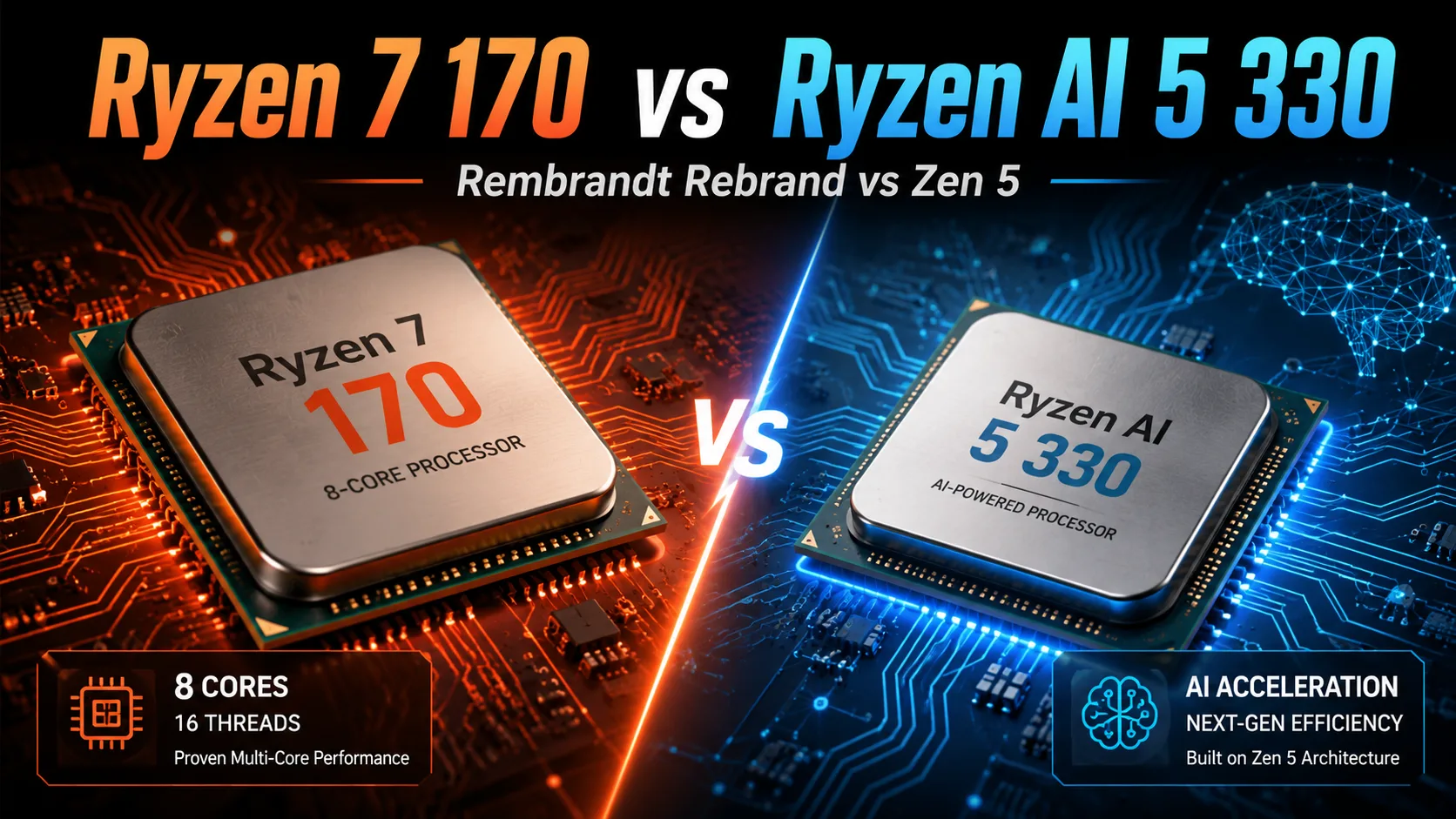
AMD Ryzen 7 170 vs Ryzen AI 5 330: Rembrandt under a new name against Zen 5
The name Ryzen 7 170 gives the impression of a new model, but technically, the processor is very similar to the Ryzen 7 7735HS: it features the same eight Zen 3+ cores, Rembrandt architecture, and Radeon 680M. The Ryzen AI 5 330 is built on Krackan Point with Zen 5/Zen 5c cores and a dedicated NPU.
Essentially, this is an eight-core Rembrandt from the Ryzen 6000 era versus a modern four-core Zen 5. The Ryzen AI 5 330 is faster on a single core and supports newer interfaces and memory, but the Ryzen 7 170 maintains an advantage in multi-threaded workloads and especially in integrated graphics.
Key Differences
| Specification | AMD Ryzen 7 170 | AMD Ryzen AI 5 330 |
|---|---|---|
| Architecture | Zen 3+ | 1× Zen 5 + 3× Zen 5c |
| Codename | Rembrandt | Krackan Point |
| Cores / Threads | 8 / 16 | 4 / 8 |
| Base Frequency | 3.2 GHz | 2.0 GHz |
| Max Frequency | 4.75 GHz | 4.5 GHz |
| Fabrication Process | TSMC 6 nm | TSMC 4 nm |
| L3 Cache | 16 MB | 8 MB |
| TDP | 45 W | 28 W |
| Configurable TDP | 35-54 W | 15-28 W |
| Integrated Graphics | Radeon 680M, 12 CU | Radeon 820M, 2 CU |
| iGPU Frequency | up to 2.2 GHz | up to 2.8 GHz |
| NPU | No | up to 50 TOPS |
| Total AI Performance | - | up to 56 TOPS |
| Memory | DDR5-4800 / LPDDR5 | DDR5-5600 / LPDDR5X-8000 |
| USB4 | No native support | 2× 40 Gbps |
The Ryzen 7 170 has twice as many CPU cores and significantly more powerful integrated graphics. The Ryzen AI 5 330 responds with a new architecture, faster memory, AVX-512, USB4, and an NPU.
Ryzen 7 170 Almost Mirrors Ryzen 7 7735HS
In key parameters, the Ryzen 7 170 is almost identical to the Ryzen 7 7735HS: 8 cores / 16 threads, frequencies of 3.2-4.75 GHz, 16 MB L3, a 6 nm fabrication process, and Radeon 680M.
The close relationship between the models is indicated by the matching tray-IDs 100-000000985 and 100-000000989.
The Rembrandt platform has been around since the Ryzen 6000 series: the Ryzen 7 6800H from 2022 already featured Zen 3+, 8 cores / 16 threads, 16 MB L3, and Radeon 680M. The Ryzen 7 170 has slightly adjusted frequencies and positioning, but the foundation remains the same.
What’s new here is primarily the name, not the architecture.
CPU Performance
The advantage of Zen 5 in single-threaded performance is also evident in specific laptop results.
| Laptop | Processor | Geekbench 6 Single-Core | Geekbench 6 Multi-Core |
|---|---|---|---|
| ASUS TUF Gaming A16 FA607NUQ | Ryzen 7 170 | 2036 | 8165 |
| Lenovo IdeaPad Slim 3 15ARP10 | Ryzen 7 170 | 1923 | 7307 |
| ASUS Vivobook 16 M1607KA | Ryzen AI 5 330 | 2537 | 7264 |
| Dell 14 DC14255 | Ryzen AI 5 330 | 2572 | 7341 |
In the ASUS TUF Gaming A16, the Ryzen 7 170 scored 2036 in Single-Core and 8165 in Multi-Core. In the Lenovo IdeaPad Slim 3 15ARP10, the scores were 1923 and 7307 respectively.
The Ryzen AI 5 330 shows scores of 2537/7264 in the ASUS Vivobook 16 M1607KA, and 2572/7341 in the Dell 14 DC14255. In these tests, the Ryzen AI 5 330 outperforms the Ryzen 7 170 by about a quarter in Single-Core performance.
In Multi-Core, the difference depends more on the specific laptop. In the Lenovo IdeaPad Slim 3, the Ryzen 7 170 performs at a level comparable to the Ryzen AI 5 330, while in the ASUS TUF, its eight cores yield a significantly higher score.
Thus, it is important to consider cooling and power limits when comparing results of mobile CPUs.
Radeon 680M vs Radeon 820M
In terms of integrated graphics, the advantage of the Ryzen 7 170 is much greater. The Radeon 680M contains 12 compute units, while the Radeon 820M of the Ryzen AI 5 330 has only two.
The Radeon 820M has a higher frequency - up to 2.8 GHz versus 2.2 GHz, but this does not compensate for the sixfold difference in the number of CUs.
Therefore, in a laptop without a discrete graphics card, the Ryzen 7 170 is significantly better suited for gaming and GPU-intensive tasks. The Radeon 680M remains a sufficiently powerful integrated graphics solution, while the Radeon 820M with its two CUs is designed for basic graphics workloads.
Advantages of the Ryzen AI 5 330 Platform
The Ryzen AI 5 330 supports DDR5-5600, LPDDR5X-8000, USB4, and AVX-512.
The processor also features an NPU with a performance of up to 50 TOPS, and the total claimed AI performance reaches 56 TOPS. The Ryzen 7 170 does not have a dedicated NPU.
The NPU is utilized in local AI functions and applications that support neural acceleration. Its presence does not directly impact the performance of regular CPU tasks.
Which Laptops Feature These Processors
The Ryzen 7 170 is found in both gaming models like the ASUS TUF Gaming A16 and thinner models like the Lenovo IdeaPad Slim 3. The Ryzen AI 5 330 is more commonly installed in versatile models such as the ASUS Vivobook 16 and Dell 14.
Therefore, when comparing results, it's essential to consider not only the CPU but also the class of the laptop, cooling, and power limits.
Which One to Choose
If the laptops are roughly the same price and lack a discrete graphics card, the Ryzen 7 170 is better suited for heavy CPU tasks and gaming on integrated graphics. Eight cores provide greater headroom for rendering, compiling, and multitasking, and the Radeon 680M is significantly more powerful than the Radeon 820M.
The Ryzen AI 5 330 is better suited for a thin work laptop, where single-core speed, modern memory, USB4, and NPU are more critical.
The limitation of four cores is particularly noticeable in prolonged multi-threaded tasks.
Conclusion
The Ryzen 7 170 is primarily a new model by name: technically, it is very close to the Ryzen 7 7735HS and is based on the Rembrandt architecture of the Ryzen 6000 era. However, the age of the platform does not hinder it from remaining stronger in multi-threaded tasks and significantly faster in integrated graphics due to its eight cores and the Radeon 680M.
The Ryzen AI 5 330 is faster on a single core and noticeably modern in its platform capabilities: Zen 5/Zen 5c, faster memory, USB4, and a 50-TOPS NPU. For heavy tasks and gaming without discrete graphics, the Ryzen 7 170 is more advantageous; for a modern thin work laptop, the Ryzen AI 5 330 is preferable.
Advantages
- More Total Cores: 8 (8 vs 4)
- Higher Max Turbo Frequency: Up to 4.75 GHz (Up to 4.75 GHz vs Up to 4.5 GHz)
- Larger L3 Cache: 16 MB (16 MB vs 8 MB)
- Newer Launch Date: October 2025 (October 2025 vs July 2025)
- Higher Technology: TSMC 4nm FinFET (TSMC 6nm FinFET vs TSMC 4nm FinFET)
Basic
CPU Specifications
Memory Specifications
GPU Specifications
Miscellaneous
Benchmarks
Related CPU Comparisons



Share in social media
Or Link To Us
<a href="https://cputronic.com/cpu/compare/amd-ryzen-7-170-vs-amd-ryzen-ai-5-330" target="_blank">AMD Ryzen 7 170 vs AMD Ryzen AI 5 330</a>