AMD Ryzen AI Max+ PRO 495
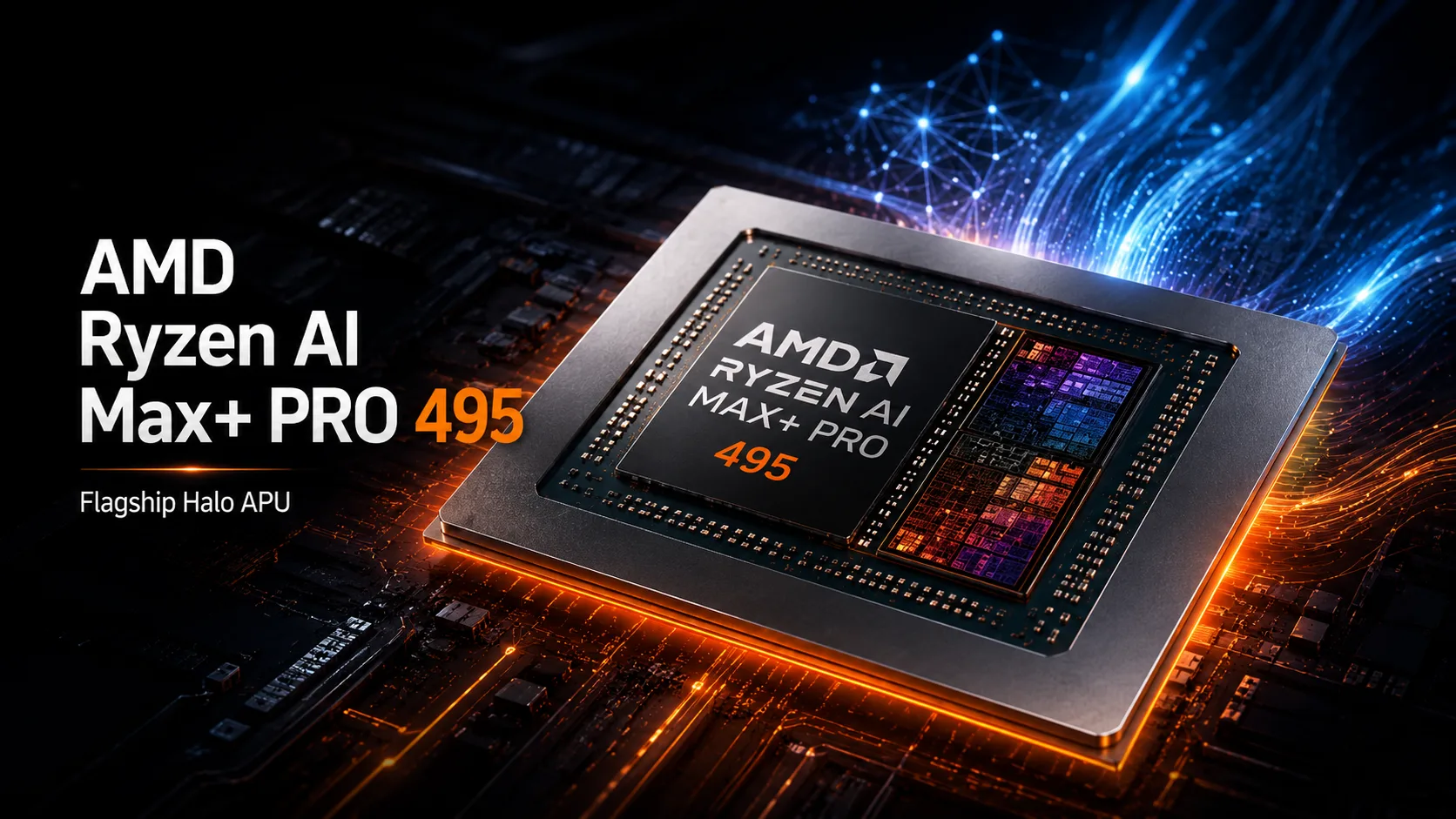
AMD Ryzen AI Max+ PRO 495: the pinnacle of the Halo platform without a discrete graphics card
The AMD Ryzen AI Max+ PRO 495 is the flagship of the Ryzen AI Max PRO 400 series. While the Ryzen AI Max PRO 485 serves as an entry-level option into the Halo platform, and the Ryzen AI Max PRO 490 offers a balanced configuration, the 495 represents the maximum realization of this concept: 16 Zen 5 cores, 32 threads, Radeon 8065S, 256-bit LPDDR5x memory, up to 192 GB of RAM, and an NPU with up to 55 TOPS.
The main idea behind the Ryzen AI Max+ PRO 495 is not compromise, but a complete configuration of Halo-class performance. This is no longer just a powerful mobile processor with good integrated graphics; it's an APU for compact workstations, powerful mini-PCs, and professional systems, where the CPU, GPU, NPU, and a large unified memory pool must operate together without the need for a discrete graphics card.
A flagship not just by CPU
The Ryzen AI Max+ PRO 495 utilizes 16 Zen 5 cores and 32 threads. For a mobile or compact workstation format, this is a very robust configuration. This processor is designed not only for standard multitasking but also for compiling, rendering, editing, working with virtual machines, handling large projects, and running heavy professional applications.
Compared to the Ryzen AI Max PRO 490, the increase in performance is evident: 16 cores compared to 12, and 32 threads compared to 24. In tasks that scale efficiently across threads, this is a key advantage of the higher-end model. However, the 495 is distinguished not only by its CPU capabilities; unlike the 485 and 490 models, it features more powerful integrated graphics with the Radeon 8065S.
Therefore, the Ryzen AI Max+ PRO 495 should not be viewed simply as a "slightly faster 490," but rather as the full version of the Halo platform. Here, the maximum CPU capabilities are combined with the highest iGPU in this series.
Radeon 8065S: the main difference from 485 and 490
The most significant difference of the Ryzen AI Max+ PRO 495 from its lower-tier models is the Radeon 8065S. The Ryzen AI Max PRO 485 and 490 use the Radeon 8050S with 32 compute units (CUs), while the 495 is equipped with the Radeon 8065S featuring 40 CUs and a frequency of up to 3000 MHz. Thus, the higher model outperforms not only on the CPU front but also in graphics.
This is an important consideration in the decision-making process. If the need is solely for the Halo platform with a significant unified memory pool, but graphics are not critical, the Ryzen AI Max PRO 490 might be a more rational choice. However, if the workload depends heavily on iGPU performance-graphics, 3D, GPU acceleration, games, or local AI computations-then the Ryzen AI Max+ PRO 495 becomes notably more appealing.
The Radeon 8065S remains integrated graphics, but conceptually, it is no longer a standard iGPU. It doesn’t have its own GDDR memory like a discrete graphics card, yet it has access to the large LPDDR5x subsystem and a substantial unified memory pool. For compact workstations, this is the key idea: to obtain a powerful GPU block without needing a standalone graphics card.
Unified memory: an old idea at maximum scale
Integrated graphics have long utilized system RAM, so unified memory itself is not a new technology. A standard iGPU also accesses RAM.
The distinction of the Ryzen AI Max+ PRO 495 is in its scale. Many mobile Ryzen and Core processors organize memory in a dual-channel configuration-meaning 2 × 64 bits. In contrast, the Ryzen AI Max uses a 256-bit LPDDR5x subsystem, comparable to four 64-bit channels. This is particularly important for the Radeon 8065S: 40 CUs at frequencies up to 3000 MHz require significantly more bandwidth than standard integrated graphics.
The second aspect is capacity. The Ryzen AI Max+ PRO 495 supports up to 192 GB of LPDDR5x-8533. While this doesn’t mean every device will have this amount, the limit itself indicates the platform's intended applications. Such memory is not designed for web browsing and office tasks, but for local AI, graphics work, development, visualization, editing, engineering projects, and scenarios where the GPU can utilize a large unified memory pool.
PyTorch and local AI
The Ryzen AI Max+ PRO 495 fits well into local AI scenarios. Here, the focus is not on abstract "AI," but on a more specific combination: PyTorch via ROCm for Ryzen APUs, robust integrated graphics, and a large unified memory pool.
In this context, the 495 outperforms the lower-tier models. The Ryzen AI Max PRO 485 has fewer CPU cores, and the Ryzen AI Max PRO 490 has weaker integrated graphics, while the 495 combines maximum CPU and maximum iGPU within a single Halo platform. The 16 cores assist in data preparation, parallel processes, compilation, and overall system performance, while the Radeon 8065S provides additional graphical resources for GPU-accelerated tasks.
The PRO suffix enhances this positioning. For businesses, it signifies AMD's enterprise features: manageability, data protection, and a more predictable platform lifecycle. While this may not be a primary argument for regular consumers, it makes sense for workstations and enterprise systems.
Estimated performance
The performance of the Ryzen AI Max+ PRO 495 heavily depends on the specific device. The platform has a wide cTDP range-ranging from 45 to 120 watts-meaning the same processor can behave differently in a mini-PC, laptop, or well-cooled workstation.
| CPU Test | Estimated Range | How to interpret results |
|---|---|---|
| Geekbench 6 Single-Core | 2700-3200 | high single-core performance for Zen 5 |
| Geekbench 6 Multi-Core | 21000-26000 | performance level of a strong 16-core mobile/workstation chip |
| PassMark Single Thread | 4100-4500 | high responsiveness in work applications |
| PassMark CPU Mark | 52000-59000 | maximum for the Halo line, highly dependent on TDP |
When it comes to the CPU, the Ryzen AI Max+ PRO 495 should not be perceived as a dramatic leap compared to the Ryzen AI Max+ PRO 395. Architecturally, they are close, and the main differences in the new PRO 400 series are noticeable in memory, frequencies, and updated graphics. Therefore, the main significance of the 495 lies not in "a CPU revolution," but in maximizing the Halo platform configuration.
The Radeon 8065S should be evaluated as the higher-end 40-CU Halo-class graphics. It has more blocks than the Radeon 8050S and operates at up to 3000 MHz, but overall performance still depends on TDP, cooling, and the specific device implementation. This is more of a benchmark for the senior Halo class than a definitive standard for the Radeon 8065S.
| Graphics Test | Estimated Range | How to interpret results |
|---|---|---|
| 3DMark Time Spy Graphics | 10000-11500 | preliminary estimate for high-end integrated graphics in the Halo class |
| Many games at 1080p | high settings | depends on the game, TDP, cooling, and FSR |
| Some games at 1440p | medium settings | possible with reasonable settings and good power limits |
The main distinction from the Ryzen AI Max PRO 490 lies here in graphics. The 490 uses the same Radeon 8050S as the 485, while the 495 boasts the Radeon 8065S. Therefore, the higher model is necessary for those who want maximum performance not only from the CPU, but also from the integrated GPU.
How it differs from the Ryzen AI Max PRO 490
The Ryzen AI Max+ PRO 495 is the higher version of the same Halo concept. It features 16 cores and 32 threads compared to the 12 cores and 24 threads of the Ryzen AI Max PRO 490. In multi-threaded tasks, this is the main advantage.
But graphics are even more critical. The Ryzen AI Max PRO 490 uses the Radeon 8050S with 32 CUs, whereas the Ryzen AI Max+ PRO 495 employs the Radeon 8065S with 40 CUs. Thus, the differences extend beyond just the CPU. If 490 can be seen as the most balanced option, the 495 represents the maximum configuration for those looking to extract everything from the Halo platform.
However, the memory remains serious for both: a 256-bit LPDDR5x up to 192 GB. Therefore, the choice between the 490 and 495 hinges not on memory volume, but rather on the question of whether additional CPU cores and more powerful integrated graphics are needed.
How it differs from the Ryzen AI Max+ PRO 395
The Ryzen AI Max+ PRO 495 does not represent a completely new architecture compared to the Ryzen AI Max+ PRO 395. Both models use 16 Zen 5 cores and substantial integrated graphics with 40 CUs. However, the 495 brings higher CPU boost rates, the Radeon 8065S with frequencies of up to 3000 MHz, and most importantly, support for up to 192 GB LPDDR5x-8533, as opposed to the previous limit of 128 GB found in the Ryzen AI Max 300.
This is a vital nuance. The Ryzen AI Max+ PRO 495 should not be presented as a revolution in CPU technology. Its significance lies in adapting the Halo platform to a larger memory/AI/workstation format. If a user already possesses a device with the Ryzen AI Max+ PRO 395, the difference may not be dramatic. However, for new systems, the 495 appears as a more mature and capable version of the same concept.
Who is the Ryzen AI Max+ PRO 495 suited for
The Ryzen AI Max+ PRO 495 is best suited for compact workstations, powerful mini-PCs, professional laptops, and systems aimed at local AI. This is an option for those who find not only the 8 cores of the Ryzen AI Max PRO 485 inadequate but also the 12 cores of the Ryzen AI Max PRO 490 insufficient.
It is suitable for development, working with local models, editing, 3D, visualization, engineering tasks, virtual machines, GPU-accelerated workflows, and corporate systems, especially where a discrete graphics card is undesirable due to size, noise, power consumption, or limited VRAM capacity.
For a standard home laptop, such a processor may be excessive. In a purely gaming system, a discrete graphics card is often still more practical. But if a compact system with maximum integrated graphics, a large memory pool, and a strong CPU component is needed, the Ryzen AI Max+ PRO 495 is the leading candidate in this lineup.
Conclusion
The AMD Ryzen AI Max+ PRO 495 is the pinnacle of the Ryzen AI Max PRO 400 series. It doesn’t aim to be the most rational option; that role is better played by the Ryzen AI Max PRO 490. The task of the 495 is to deliver the entire Halo platform without compromises: 16 Zen 5 cores, Radeon 8065S, 256-bit LPDDR5x, up to 192 GB of memory, and an NPU capable of up to 55 TOPS.
Its value lies not in a single figure but in the combination. The Ryzen AI Max+ PRO 495 unites a strong CPU, the Radeon 8065S-the most powerful integrated GPU in this Halo lineup-a large unified memory pool, and a complete base for local AI and workstation tasks. If the Ryzen AI Max PRO 490 is the most sensible work option, then the Ryzen AI Max+ PRO 495 is the choice for those who need the maximum Halo platform in a compact format.
CPU Comparison
Compare Ryzen AI Max+ PRO 495 with other CPUs
Basic
CPU Specifications
Memory Specifications
GPU Specifications
Miscellaneous
Benchmarks
Compared to Other CPU
Related CPU Comparisons



Share in social media
Or Link To Us
<a href="https://cputronic.com/cpu/amd-ryzen-ai-max-plus-pro-495" target="_blank">AMD Ryzen AI Max+ PRO 495</a>