AMD Ryzen 7 5825U
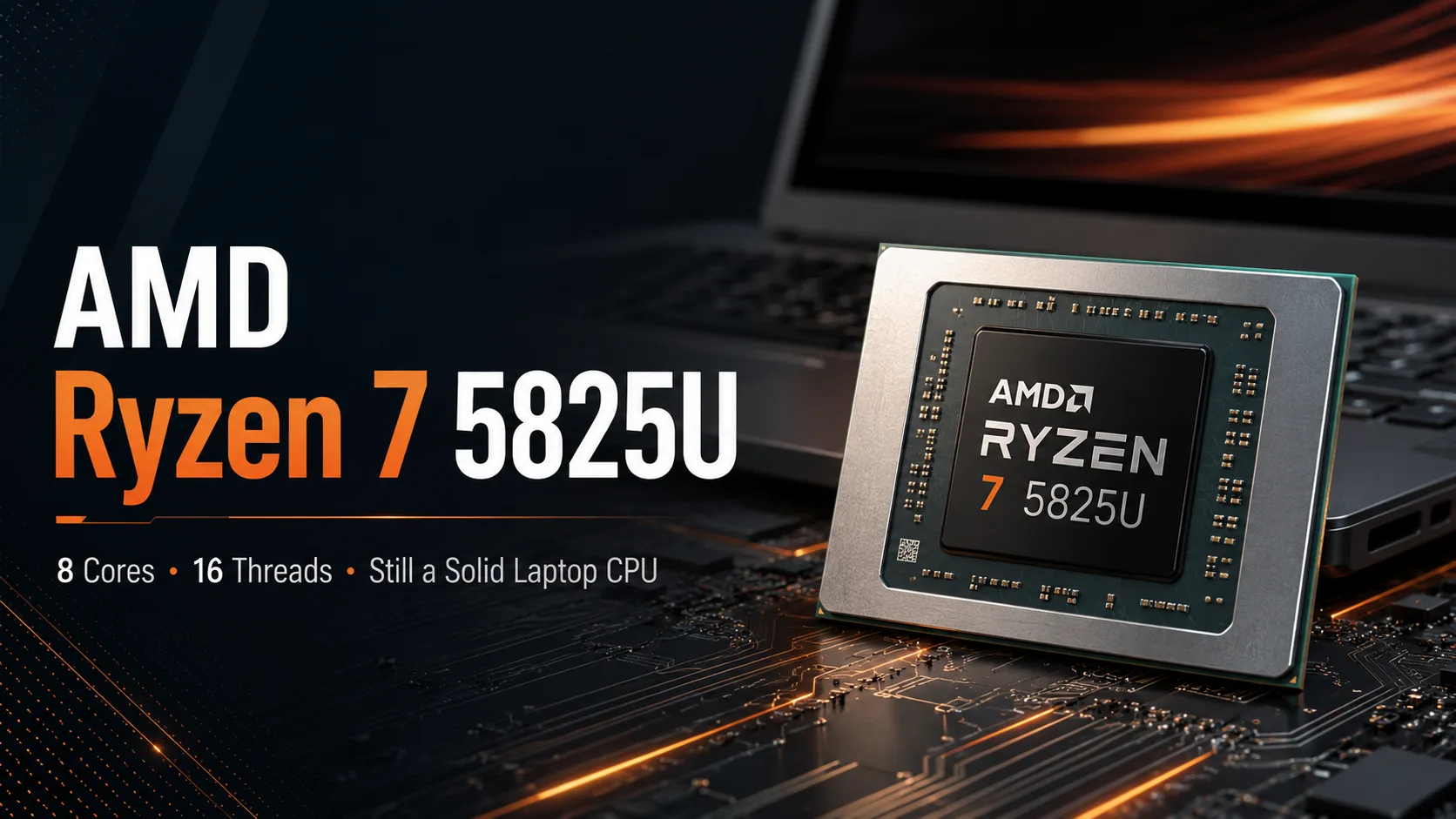
AMD Ryzen 7 5825U in 2026: Eight Cores Still in Operation
The AMD Ryzen 7 5825U was released in January 2022 as the flagship model of the budget Barcelo-U series. Today, the platform appears outdated: it is limited to DDR4 memory, PCIe 3.0 interface, and Vega integrated graphics. However, the eight full Zen 3 cores and 16 threads still provide solid performance in multitasking, programming, and data processing.
Choosing a laptop with the Ryzen 7 5825U should not be about the processor name but rather the price and quality of the overall configuration. With the same case, display, and memory capacity, the price premium for the Ryzen 7 7730U is usually unjustified: technically, these processors are nearly indistinguishable.
How Ryzen 7 5825U Differs from Neighboring Models
| Processor | Cores and Threads | Frequencies | Main Difference |
|---|---|---|---|
| Ryzen 7 5800U | 8 / 16 | 1.9-4.4 GHz | Previous version with slightly lower frequencies |
| Ryzen 7 5825U | 8 / 16 | 2.0-4.5 GHz | Updated Barcelo-U |
| Ryzen 7 7730U | 8 / 16 | 2.0-4.5 GHz | Essentially the same processor under a new name |
The Ryzen 7 5825U did not receive a new architecture or revised graphics compared to the Ryzen 7 5800U. AMD merely increased the base and maximum frequencies by 100 MHz. Therefore, the difference in performance is typically a few percentage points and can easily be mitigated by the specific laptop settings.
The Ryzen 7 7730U represents a re-release of the same platform: the architecture, frequencies, cache size, and integrated graphics remain unchanged. When choosing between laptops with the 5825U and 7730U, it is more important to compare cooling, display, battery, memory configuration, and upgrade options.
Performance Depends on the Laptop
The nominal TDP of the Ryzen 7 5825U is 15W, but manufacturers can significantly alter the working power limits. In a spacious chassis, the processor can maintain high frequencies for a longer time, while in a thin model, it may quickly hit temperature limits or power constraints.
Examples of Ryzen 7 5825U Performance in Different Laptops
| Laptop | Power Limit | Cinebench R23, single core | Cinebench R23, all cores |
|---|---|---|---|
| HP Envy x360 15-ey0023dx | Not specified | 1460 | 10,904 |
| Lenovo ThinkPad E14 Gen 4 | Up to 30W | 1433 | 10,395 |
| LG UltraPC 14 | About 25W | 1452 | 10,152 |
These results cannot be considered direct comparisons of models: different memory configurations, power modes, and firmware versions were tested. However, the table illustrates the overall character of the Ryzen 7 5825U. Single-thread performance varies little, while sustained multi-threaded loads are significantly affected by the chassis and cooling.
For a browser with many tabs, office applications, virtual machines, code compilation, and light video editing, the processor's capabilities are still sufficient. The limitation often comes not from the CPU itself, but from 8 GB of RAM or a slow storage device. In 2026, it is better to choose a configuration with 16 GB of RAM or with upgrade possibilities.
Vega 8 and Memory Impact
The integrated Radeon Vega 8 utilizes system RAM, making a dual-channel configuration particularly important for it. A laptop with two memory modules can significantly outperform a similar model with a single module.
Vega 8 is suitable for Windows interface, video playback, older games, and less demanding network applications. For modern heavy games, 3D modeling, and video editing with active graphical effects, its performance is no longer sufficient.
The Radeon 680M and newer integrated GPUs based on RDNA architecture are significantly faster than Vega 8. Therefore, for a similar price, a laptop on a more modern platform would be preferable, especially if gaming or graphics work is important.
Platform Limitations
The age of the Ryzen 7 5825U is evident not only from its integrated graphics. The processor supports PCIe 3.0 and DDR4 or LPDDR4X memory, whereas newer mobile platforms have transitioned to PCIe 4.0 and DDR5.
The processor also lacks a dedicated NPU. For regular office work, this is not significant, but modern local AI functionalities will be executed by the CPU cores or integrated graphics.
In everyday tasks, these limitations are not always noticeable. A quality SSD with PCIe 3.0 remains fast enough, and DDR4 does not hinder the operation of browsers, office programs, or development environments. The problem arises only when an older laptop is sold at the price of a more modern model.
Should You Buy a Laptop with Ryzen 7 5825U?
The Ryzen 7 5825U makes sense in an affordable work laptop with 16 GB of dual-channel memory, an IPS display, and cooling that does not drastically reduce frequencies under prolonged load. An additional advantage would be the ability to replace the SSD or upgrade the RAM.
It is not worth overpaying solely for the Ryzen 7 label. The six-core Ryzen 5 5625U and 7530U hardly lag behind it in everyday work, while the Ryzen 7 7730U nearly replicates its specifications.
Conclusion: The Ryzen 7 5825U remains a capable eight-core processor for office use, study, programming, and multitasking work. The purchase is justified if there is a significant discount. If a laptop with a newer platform and RDNA graphics is only slightly more expensive, opting for the Ryzen 7 5825U makes little sense.
CPU Comparison
Compare Ryzen 7 5825U with other CPUs
Basic
CPU Specifications
Memory Specifications
GPU Specifications
Miscellaneous
Benchmarks
Compared to Other CPU
Related CPU Comparisons





Share in social media
Or Link To Us
<a href="https://cputronic.com/cpu/amd-ryzen-7-5825u" target="_blank">AMD Ryzen 7 5825U</a>