AMD Ryzen 5 5500U
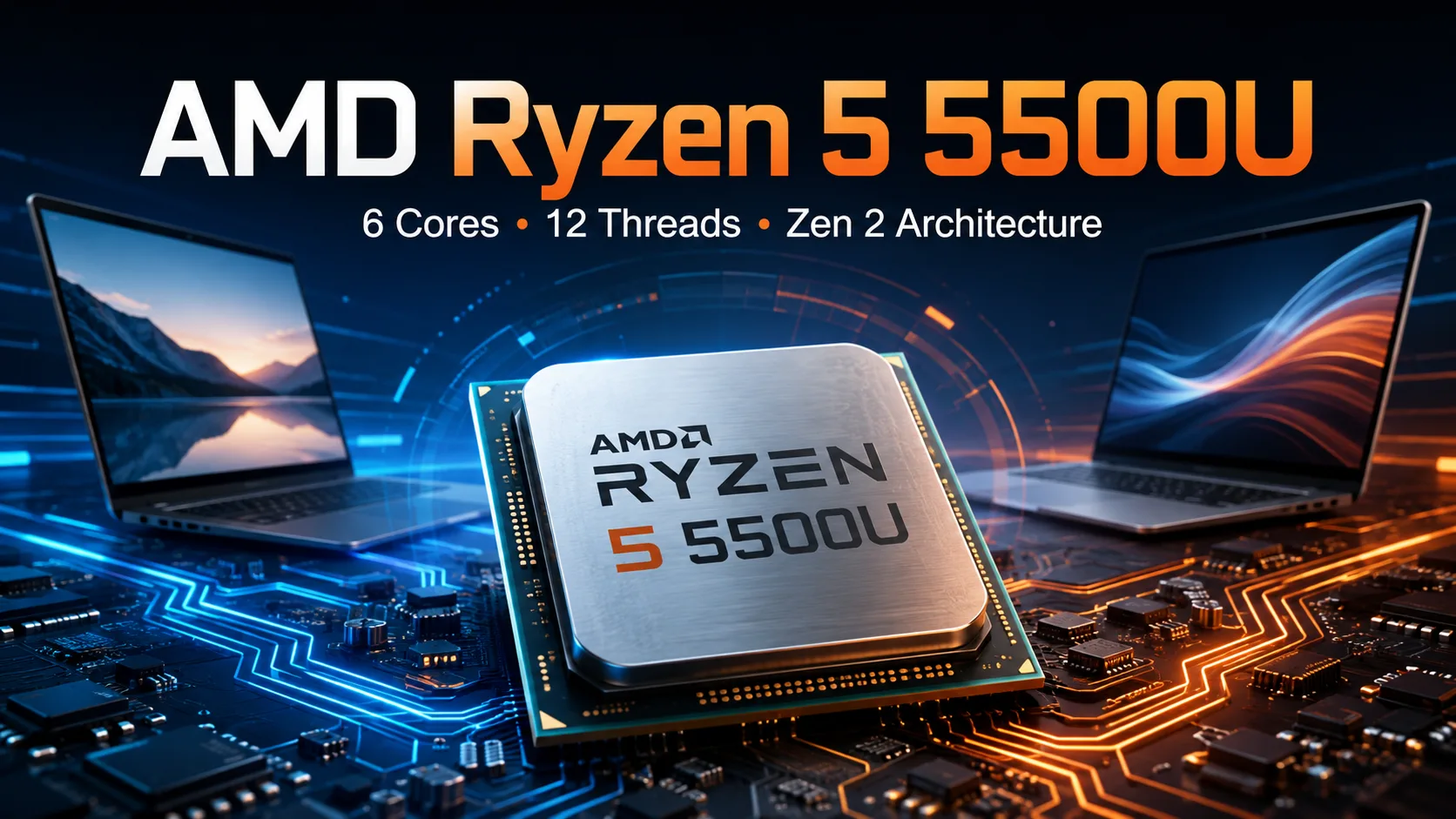
AMD Ryzen 5 5500U: Six Zen 2 Cores Under the Ryzen 5000 Banner
The AMD Ryzen 5 5500U debuted back in 2021, but it can still be found in budget laptops and on the second-hand market. Six cores and twelve threads are still sufficient for typical multitasking. However, the Ryzen 5000 designation hides an important detail: the Ryzen 5 5500U is built on Zen 2, not the newer Zen 3.
Ryzen 5000, but Not Zen 3
The mobile Ryzen 5000 series combined two architectures-Zen 2 and Zen 3. The Ryzen 5 5500U, codenamed Lucienne, features Zen 2, while its neighbor, the Ryzen 5 5600U, has already switched to Zen 3.
| Model | Architecture | Codename | Cores / Threads | L3 |
|---|---|---|---|---|
| Ryzen 3 5300U | Zen 2 | Lucienne | 4 / 8 | 4 MB |
| Ryzen 5 5500U | Zen 2 | Lucienne | 6 / 12 | 8 MB |
| Ryzen 5 5600U | Zen 3 | Cezanne | 6 / 12 | 16 MB |
| Ryzen 7 5700U | Zen 2 | Lucienne | 8 / 16 | 8 MB |
| Ryzen 7 5800U | Zen 3 | Cezanne | 8 / 16 | 16 MB |
Thus, the number "5000" here tells us little about the architecture. The Ryzen 5 5600U is not just a slightly higher-clocked version of the 5500U: it has Zen 3 and twice the L3 cache.
Although both processors have six cores, the Ryzen 5 5600U is noticeably faster in single-threaded workloads. At similar laptop prices, the model with the 5600U is preferred.
In terms of architecture, the Ryzen 5 5500U is similar to the mobile Ryzen 4000 series, but unlike the Ryzen 5 4500U, it supports SMT and processes twelve threads. For a 15-watt mobile processor, six cores and twelve threads still look good in multi-threaded tasks.
What Real Laptops Show
The performance of a mobile processor depends on cooling, power settings, and memory configuration. Therefore, the results from specific laptops are more informative than a single average score.
Geekbench 6
| Laptop | Geekbench 6 | Single-Core | Multi-Core |
|---|---|---|---|
| Lenovo IdeaPad 3 15ALC6 (82KU) | 6.3 | 1526 | 5630 |
| ASUS VivoBook X513UA / M513UA | 6.4 | 1530 | 5472 |
| HP Laptop 15s-eq2xxx | 6.4 | 1507 | 5454 |
| Acer Aspire A515-45 | 6.3 | 1514 | 5430 |
In specific laptops, the Ryzen 5 5500U scores about 1500 points in single-threaded tests and 5400-5600 points in multi-threaded tests.
Multi-threaded performance remains good for a processor of this age. In single-threaded performance, the age of the platform is already noticeable: modern mobile processors are significantly faster.
Integrated Graphics Is Still Suitable for Basic Tasks
The processor is equipped with integrated Radeon Graphics with seven compute units and a frequency of up to 1.8 GHz. For 2021, such integrated graphics were decent, but today its capabilities are modest.
Radeon Graphics is suitable for video playback, simple graphics tasks, and older or less demanding games. Dual-channel RAM is particularly important since the integrated GPU utilizes system memory.
For modern heavy games, the integrated graphics of the Ryzen 5 5500U significantly limit performance. The Ryzen 6000 series with RDNA 2 and newer platforms offer notably faster integrated graphics.
15W Does Not Mean the Same Speed in All Laptops
The nominal TDP of the Ryzen 5 5500U is 15W, but the manufacturer allows for tuning in the range of 10-25W. Therefore, two laptops with the same processor can vary significantly in performance under sustained loads.
In a thin chassis, a manufacturer may limit power consumption for the sake of temperature and noise. A laptop with better cooling can maintain high frequencies longer and perform better under prolonged load.
When choosing a laptop with the 5500U, the processor is not the only consideration. It is important to take into account the cooling system, memory configuration, and the possibility of upgrades.
For What Tasks the Ryzen 5 5500U Is Still Suitable
For browsing with many tabs, handling documents, spreadsheets, video conferencing, and watching videos, the processor has enough power.
It can handle photo processing, programming, and occasionally encoding videos. For simple content work, six cores and twelve threads are still sufficient.
The limitations become more apparent in tasks dependent on high single-threaded performance, modern 3D graphics, and heavy video editing. For such workloads, it is better to choose a more modern platform.
What to Look For When Buying a Laptop with Ryzen 5 5500U
In 2026, it is no longer worth choosing a laptop solely for the Ryzen 5 5500U. The condition and configuration of the specific device are more important.
It is advisable to choose a configuration with at least 16GB of RAM, as dual-channel mode is especially beneficial for the integrated Radeon Graphics. A fast SSD and a quality display are more important than a slight performance difference between two laptops with the same 5500U.
If a model with a Ryzen 5 5600U, Ryzen 5 5625U, or a newer processor is available at a similar price, it should be prioritized. Zen 3 offers higher performance per core, and subsequent generations provide significantly faster integrated GPUs.
Conclusion
Five years after the release of the Ryzen 5 5500U, it still does not look like an obsolete budget processor. Six cores and twelve threads allow it to operate well in office tasks, education, programming, and everyday multitasking.
However, the Ryzen 5000 name can be misleading: the 5500U is built on Zen 2. That’s why the Ryzen 5 5600U from the same series is noticeably faster on a per-core basis.
In 2026, the Ryzen 5 5500U should primarily be considered for inexpensive laptops. If a model with Zen 3 or a newer platform is only slightly more expensive, there is no longer a reason to economize on the 5500U.
CPU Comparison
Compare Ryzen 5 5500U with other CPUs
Basic
CPU Specifications
Memory Specifications
GPU Specifications
Benchmarks
Compared to Other CPU
Related CPU Comparisons


Share in social media
Or Link To Us
<a href="https://cputronic.com/cpu/amd-ryzen-5-5500u" target="_blank">AMD Ryzen 5 5500U</a>