AMD Ryzen AI 5 430
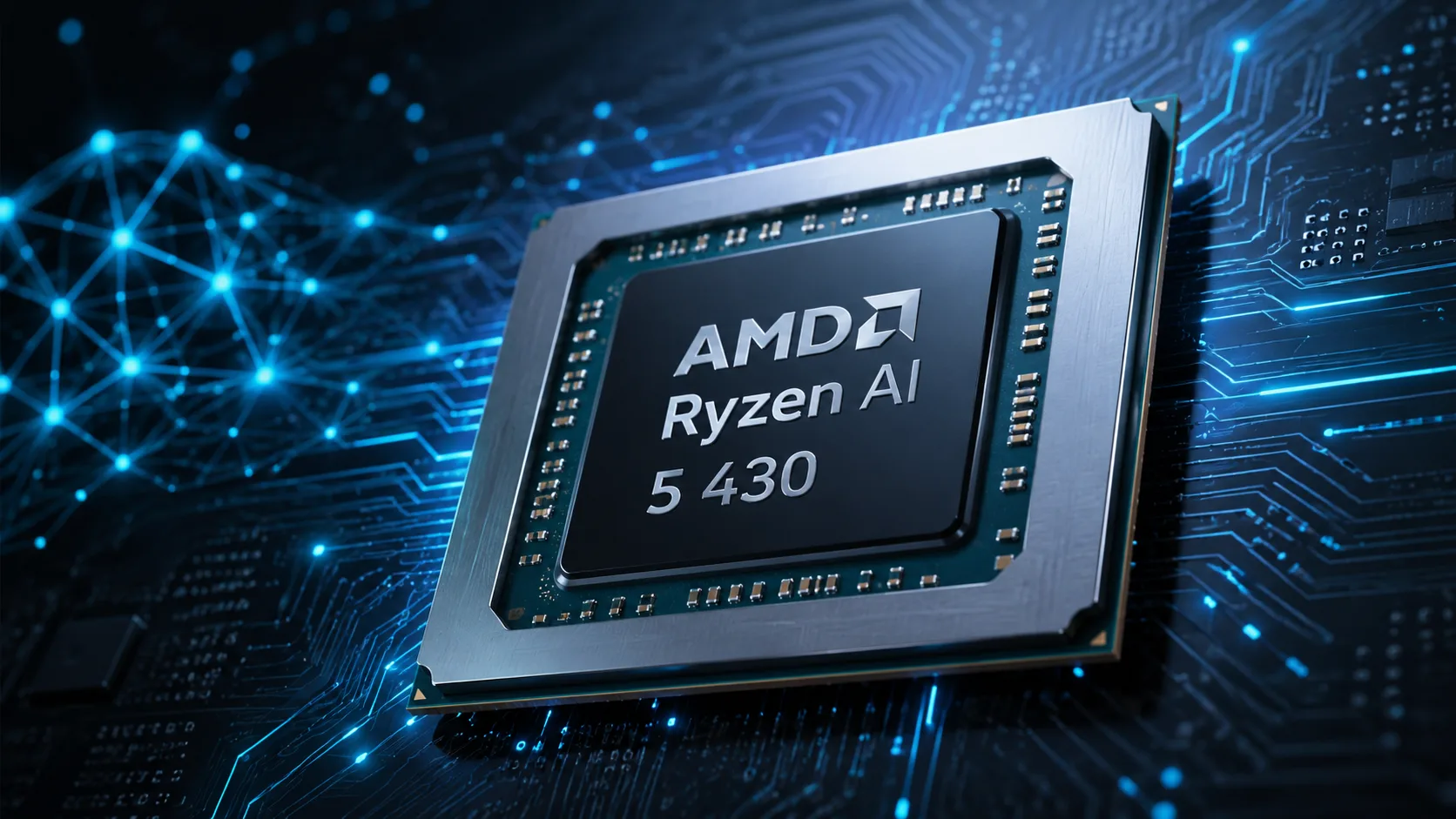
AMD Ryzen AI 5 430: The Entry-Level Ryzen AI 400 with a Strong NPU and Modest CPU
The AMD Ryzen AI 5 430 can be easily misunderstood by its name. On one hand, it belongs to the fresh Ryzen AI 400 series, features Zen 5 architecture, Radeon 840M graphics, modern memory, and an NPU with up to 50 TOPS. On the other hand, in terms of computational capabilities, it is a lower-end 4-core APU that does not have four full Zen 5 cores, but rather it utilizes a configuration of 1x Zen 5 + 3x Zen 5c.
This is what defines it. The Ryzen AI 5 430 is not a “new powerful Ryzen 5,” but an accessible entry into AMD's modern AI platform. It is designed for laptops and compact systems where fresh interfaces, local AI functionalities, integrated graphics, and good energy efficiency are important. If one expects it to perform at the level of higher-end Ryzen AI 5 models, disappointment may ensue. However, if its place in the lineup is understood, the processor appears quite logical.
Architecture: One Fast Core and Three Compact Ones
The Ryzen AI 5 430 is built on TSMC's 4nm process and belongs to the Gorgon Point family. It features 4 cores and 8 threads, a base frequency of 2.0 GHz, and can boost up to 4.5 GHz for the main Zen 5 core. The compact Zen 5c cores operate more modestly-up to 3.4 GHz. The L3 cache is 8 MB, and the TDP ranges from 15 to 28 watts.
This arrangement works well for common tasks. The fast Zen 5 core helps keep the system responsive while browsing, working in office applications, using messaging apps, studying, and lightly editing photos. The three Zen 5c cores assist in background tasks and multitasking but do not turn the chip into a fully-fledged 6-core Ryzen.
Thus, it is not fair to compare the Ryzen AI 5 430 with higher models based solely on the name. The Ryzen AI 5 340 and Ryzen AI 5 435, with 6 cores, will handle heavier tasks-especially video editing, compilation, virtual machines, or prolonged multithreading-more confidently.
NPU - The Main Reason to Consider This Chip
The Ryzen AI 5 430 features an NPU with performance up to 50 TOPS, with overall AI performance claimed to be up to 58 TOPS. For a lower-end processor, this is a significant detail: even the basic model covers the modern AI PC class and is suitable for local AI functions in Windows, camera effects, noise cancellation, background image processing, and other tasks that are gradually shifting from the CPU to a dedicated neural block.
However, the NPU does not speed up everything indiscriminately. It will not accelerate ordinary rendering, compiling large projects, archiving, or heavy photo processing unless the specific application utilizes the neural block. It is a separate accelerator for AI scenarios, not a replacement for a powerful CPU.
This is why the “AI” in the name is not entirely empty marketing but also not a magical button for performance. The Ryzen AI 5 430 is interesting in that a full NPU appears even in the entry-level model of the lineup.
Radeon 840M - Not a Gaming Graphics Card, But Useful
The Radeon 840M is one of the reasons why the Ryzen AI 5 430 appears more appealing than a regular entry-level CPU. The integrated graphics feature 4 graphics cores and a frequency of up to 2800 MHz. It is not a substitute for a discrete graphics card, but for a thin laptop or mini-PC, this graphics performance is sufficient for everyday tasks.
The Radeon 840M is suitable for the Windows interface, multimedia tasks, hardware video decoding and encoding, old games, simple online projects, and undemanding titles at lower settings. It supports AV1, HDMI 2.1, DisplayPort 2.1, and working with multiple displays.
Compared to the Ryzen AI 5 330, this is a noticeable improvement. The latter utilizes the Radeon 820M, while the Ryzen AI 5 430 has a significantly stronger graphics block. Therefore, in a real laptop, the difference between these chips may be more apparent in graphics and multimedia than in CPU performance.
Performance: Quick for Everyday Tasks, Limited in Heavy Tasks
According to early benchmarks, the Ryzen AI 5 430 appears as a solid modern 4-core APU. Single-thread performance is sufficiently high, so the laptop should not feel weak in everyday operations. However, multithreaded results are limited by the number of cores.
| Test | AMD Ryzen AI 5 430 | What This Means |
|---|---|---|
| Geekbench 6 Single-Core | around 2500-2600 | good responsiveness in everyday tasks |
| Geekbench 6 Multi-Core | around 7700-8000 | reasonable for 4 cores, but below higher Ryzen AI 5 levels |
| Cinebench R23 Single-Core | around 1800 | strong point of Zen 5 architecture |
| Cinebench R23 Multi-Core | around 8100 | clear emphasis on number of cores |
| PassMark Single Thread | around 3780 | decent single-thread level |
| PassMark CPU Mark | around 13500 | level of a good everyday laptop, not a workstation |
These figures illustrate the character of the processor well. The Ryzen AI 5 430 is suitable for browsing with numerous tabs open, documents, video calls, studying, multimedia, and light creative workloads. However, for continuous video editing, heavy coding, virtual machines, and working on large projects, it is better to look at 6-core and 8-core models.
Where Ryzen AI 5 430 Will Be Appropriate
This processor performs best in devices where a modern set of features is needed without overpaying for unnecessary CPU power:
- a thin laptop for studying, office work, and browsing;
- an affordable AI PC with an NPU up to 50 TOPS;
- a compact mini-PC without discrete graphics;
- a home laptop for video, documents, video calls, and streaming;
- a system for light gaming and multimedia using integrated graphics.
However, the Ryzen AI 5 430 shouldn't be perceived as a “jack of all trades” processor. It’s modern, but entry-level. If there’s a similarly priced laptop with a Ryzen AI 5 435, Ryzen AI 5 340, or Ryzen AI 7 nearby, the higher model would be a wiser choice for a long-term purchase.
The Main Question - The Price of a Specific Laptop
The Ryzen AI 5 430 stands logically on its own. AMD needed an entry-level chip in the Ryzen AI 400 lineup, and it fulfills this role: Zen 5, a good NPU, Radeon 840M, support for DDR5/LPDDR5x, USB4, and modern multimedia capabilities.
However, it is not worth buying a device just because it has the Ryzen AI 5 name. If a laptop with Ryzen AI 5 430 is significantly cheaper than higher configurations, it may be a smart choice. If the price is close to models with 6-core Ryzen AIs, the lower chip quickly loses its appeal. The difference in CPU power will be felt longer than the pretty “AI” label on the box.
Conclusion
The AMD Ryzen AI 5 430 is an honest entry-level processor of the new generation. Its strength lies not in record CPU performance but in the combination of a modern platform, an NPU with up to 50 TOPS, Radeon 840M, and good energy efficiency. It is well-suited for an everyday laptop, studying, office work, video, light gaming, and local AI functionalities.
But it is not a universal chip “with a reserve for everything.” 4 cores and the 1x Zen 5 + 3x Zen 5c configuration immediately set a limit. The Ryzen AI 5 430 should be chosen when the device is genuinely cheaper than higher models. Otherwise, it is better to consider the Ryzen AI 5 435, Ryzen AI 5 340, or Ryzen AI 7-there, the CPU margins will be noticeably better.
CPU Comparison
Compare Ryzen AI 5 430 with other CPUs
Basic
CPU Specifications
Memory Specifications
GPU Specifications
Miscellaneous
Benchmarks
Compared to Other CPU
Related CPU Comparisons




Share in social media
Or Link To Us
<a href="https://cputronic.com/cpu/amd-ryzen-ai-5-430" target="_blank">AMD Ryzen AI 5 430</a>