Samsung Exynos 2600
vs
Qualcomm Snapdragon 8 Elite


SoC Comparison Result
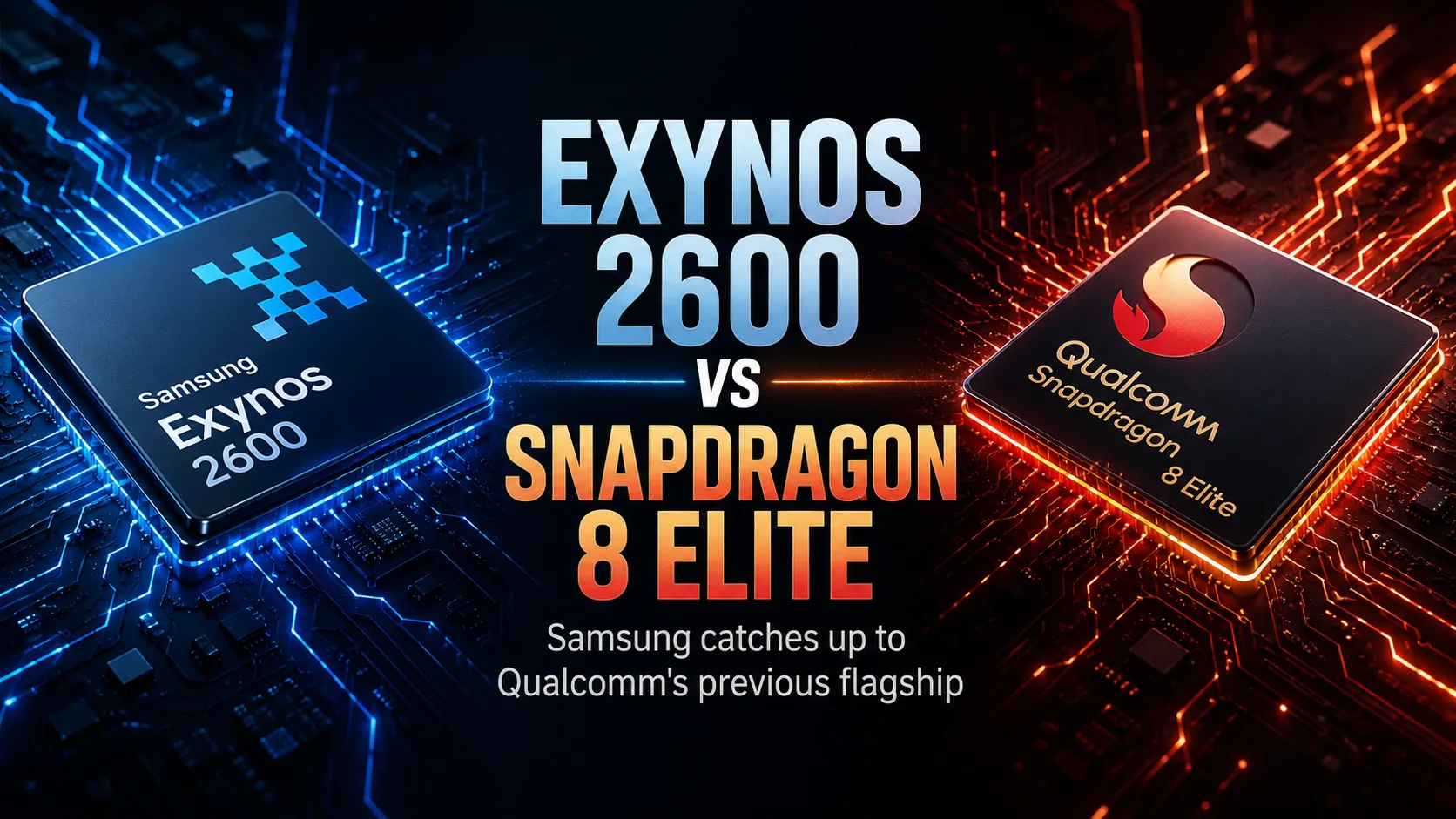
Samsung Exynos 2600 vs Qualcomm Snapdragon 8 Elite: the new Exynos catches up to Qualcomm's flagship
The Exynos 2600 appeared more than a year after the Snapdragon 8 Elite, giving Samsung the advantage of a newer manufacturing process and architecture. This has produced results: while Snapdragon remains slightly faster in single-threaded Geekbench 6 tests, Exynos wins in multi-threading and performs very confidently in heavy graphical benchmarks. Samsung has not surpassed Qualcomm as a company-Qualcomm has already introduced a newer generation of flagship SoCs-but the older flagship Snapdragon has now been matched and, in some areas, surpassed by the new Exynos.
Key Differences
| Specification | Samsung Exynos 2600 | Qualcomm Snapdragon 8 Elite |
|---|---|---|
| Process Technology | 2 nm GAA, Samsung Foundry | 3 nm, TSMC |
| CPU | 10 cores | 8 Oryon cores |
| Configuration | 1× C1-Ultra + 9× C1-Pro | 2× Oryon Prime + 6× Oryon Performance |
| Max Frequency | up to 3.8 GHz | up to 4.32 GHz |
| GPU | Xclipse 960 | Adreno 830 |
| Memory | LPDDR5X | LPDDR5X |
| Storage | UFS 4.1 | UFS 4.0 |
| Year of Release | 2026 | 2024 |
The difference in CPU design is immediately noticeable. The Exynos 2600 utilizes ten cores: one C1-Ultra up to 3.8 GHz, three C1-Pro up to 3.25 GHz, and six more C1-Pro up to 2.75 GHz. There is no separate cluster of small energy-efficient cores.
The Snapdragon 8 Elite features eight proprietary Oryon cores: two Prime up to 4.32 GHz and six Performance up to 3.53 GHz. Qualcomm's strategy is to use a smaller number of faster cores, while Samsung opts for a ten-core configuration with a newer 2-nm process.
CPU Performance
| Test | Exynos 2600 | Snapdragon 8 Elite | Difference |
|---|---|---|---|
| Geekbench 6 Single-Core | 3150 | 3301 | Snapdragon +5% |
| Geekbench 6 Multi-Core | 11 100 | 9848 | Exynos +13% |
In single-thread performance, the Snapdragon 8 Elite is still ahead. The approximately 5% gap is small but shows that the Oryon cores in the older chip remain very strong.
In multi-thread performance, the picture changes. The Exynos 2600 scores around 11,100 points compared to 9,848 for Snapdragon, giving Exynos an advantage of roughly 13%. Here, Samsung's ten cores provide a significant performance gain.
For web browsing, messaging, and smartphone interface tasks, this difference is practically negligible: both processors are far above the required performance level. It becomes more noticeable in photo and video processing, archiving, computational tasks, and other software capable of utilizing multiple cores simultaneously.
Xclipse 960 vs Adreno 830
Graphics performance is one of the most interesting aspects of the Exynos 2600. The new Xclipse 960 is significantly stronger than previous Samsung GPUs, and it is now capable of competing with the Adreno 830, not just nominally, but according to the results of heavy 3DMark tests.
However, it is incorrect to compare mobile GPUs based on one smartphone alone. Cooling, power limits, and firmware settings can significantly alter the results. Therefore, it is more useful to look at multiple commercial devices at once.
Benchmarks of Specific Smartphones
| Smartphone | Processor | 3DMark Solar Bay | 3DMark Steel Nomad Light | PCMark Work 3.0 |
|---|---|---|---|---|
| Samsung Galaxy S26 | Exynos 2600 | 11 935 | 3109 | 20 423 |
| Honor GT Pro | Snapdragon 8 Elite | 11 993 | 2662 | 19 558 |
| OnePlus 13 | Snapdragon 8 Elite | 11 360 | 2455 | 15 714 |
| Xiaomi 15 | Snapdragon 8 Elite | 10 153 | 2204 | 17 440 |
Solar Bay shows an almost dead heat between the Galaxy S26 and Honor GT Pro: 11,935 vs 11,993 points. This is particularly notable since the Honor GT Pro is certainly not a weak implementation of the Snapdragon 8 Elite.
In Steel Nomad Light, the results are different. The Galaxy S26 scores 3,109 points, while the Honor GT Pro scores 2,662, OnePlus 13 scores 2,455, and Xiaomi 15 scores 2,204. In this test, the Xclipse 960 clearly comes out ahead.
However, the table also shows why one cannot attribute all results solely to the processor. The same Snapdragon 8 Elite scores 2,204 points in the Xiaomi 15 and 2,662 points in the Honor GT Pro-a difference of over 20%. The device's casing, cooling, and power limits play a significant role here.
Gaming
A high 3DMark score does not necessarily translate into an automatic advantage for the Exynos 2600 in all games. Adreno remains a very common mobile graphics architecture, and the optimization of a specific game may prove more critical than the difference in peak performance.
On the other hand, the Xclipse 960 can no longer be dismissed as a weak point of the Exynos. In heavy graphical tests, Samsung's new GPU is at least on par with the Adreno 830, and in Steel Nomad Light, it can significantly outperform it.
For buyers, it is more important to look at tests of specific smartphones: a powerful GPU does little good if the device quickly thermal throttles and reduces frequencies.
Power Consumption and Heating
The Exynos 2600 is produced using Samsung's 2-nm GAA process, while the Snapdragon 8 Elite is manufactured with TSMC's 3-nm technology. Formally, the manufacturing generation advantage lies with Exynos.
However, this does not mean that any Galaxy with Exynos will automatically be cooler than a Snapdragon smartphone. Actual power consumption depends on frequency, voltage, workload, and manufacturer settings.
Samsung has also reworked heat dissipation from the processor itself using a Heat Path Block. This is meant to facilitate heat transfer from the chip to the cooling system, but the final result is still determined by the smartphone's design.
Therefore, battery life and throttling should be compared between specific models rather than between SoC names.
AI and Image Processing
The Exynos 2600 features a new NPU, and Samsung claims to have achieved more than double the performance gain in generative AI compared to the Exynos 2500. New components for image processing, video noise reduction, and local execution of AI functions have also been introduced.
The Snapdragon 8 Elite uses a Hexagon NPU and is also designed for local generative models and multimodal AI.
However, comparing the NPU numbers from different manufacturers directly is difficult. For consumers, it is more important which functions are genuinely implemented by Samsung, Xiaomi, Honor, or OnePlus in their smartphone firmware. The presence of a fast AI block does not automatically mean useful software is available.
What This Comparison Means When Choosing a Smartphone
The Exynos 2600 and Snapdragon 8 Elite rarely compete within the same model. The Exynos 2600 is primarily associated with the Galaxy S26, while the Snapdragon 8 Elite is found in many flagship devices from the previous generation-OnePlus 13, Xiaomi 15, Honor GT Pro, and others.
Thus, in practice, this is more of a comparison between the new Galaxy and smartphones from the past flagship generation.
The Exynos 2600 offers higher multi-threaded performance and a very strong GPU. However, smartphones with Snapdragon 8 Elite have already dropped in price. If the OnePlus 13, Xiaomi 15, or another Qualcomm flagship is significantly cheaper than the new Galaxy, the difference in processors alone does not justify the premium.
It is particularly pointless to switch to a good smartphone with Snapdragon 8 Elite solely for the Exynos 2600. Both SoCs remain so fast that in most day-to-day tasks, the user will simply not notice a difference.
Conclusion
The Exynos 2600 is newer than the Snapdragon 8 Elite, so its advantage is not a sensation in itself. What is more important is that Samsung has finally caught up to Qualcomm's previous flagship and in several tests has already surpassed it. In multi-threaded Geekbench tests, Exynos has a lead of about 13%, and the Xclipse 960 shows that Samsung no longer has to concede in graphics performance to the top Snapdragon.
However, it is also essential not to overrate this result. The Snapdragon 8 Elite is a flagship from the previous generation and not the current primary competitor to the Exynos 2600. Qualcomm has already unveiled a newer Snapdragon 8 Elite Gen 5. Therefore, it is too early to declare that Samsung has overtaken Qualcomm.
It is more accurate to say that the Exynos 2600 has caught up closely: it can now beat the previous flagship Snapdragon, with the next frontier being Qualcomm's current generation.
For buyers, the difference between the Exynos 2600 and Snapdragon 8 Elite is no longer significant enough to choose a smartphone purely based on the processor's name. If a Snapdragon-based model is much cheaper, a few percentage points of advantage from Exynos do not justify the extra cost.
The main takeaway for Samsung is that the Exynos is once again seriously contesting in the flagship SoC race and is not merely trying to keep pace.
Advantages
- Higher Technology: 2 nm (2 nm vs 3 nm)
- Newer Launch Date: January 2026 (January 2026 vs October 2024)
- Higher Frequency: 4320 MHz (3.8 GHz vs 4320 MHz)
Basic
GPU Specifications
Connectivity
Memory Specifications
Miscellaneous
Benchmarks
Comparison of Devices
Related SoC Comparisons




Share in social media
Or Link To Us
<a href="https://cputronic.com/soc/compare/samsung-exynos-2600-vs-qualcomm-snapdragon-8-elite" target="_blank">Samsung Exynos 2600 vs Qualcomm Snapdragon 8 Elite</a>