Qualcomm Snapdragon 8 Elite Gen 5
vs
MediaTek Dimensity 8500

SoC Comparison Result
Snapdragon 8 Elite Gen 5 vs Dimensity 8500: flagship vs upper mid-range
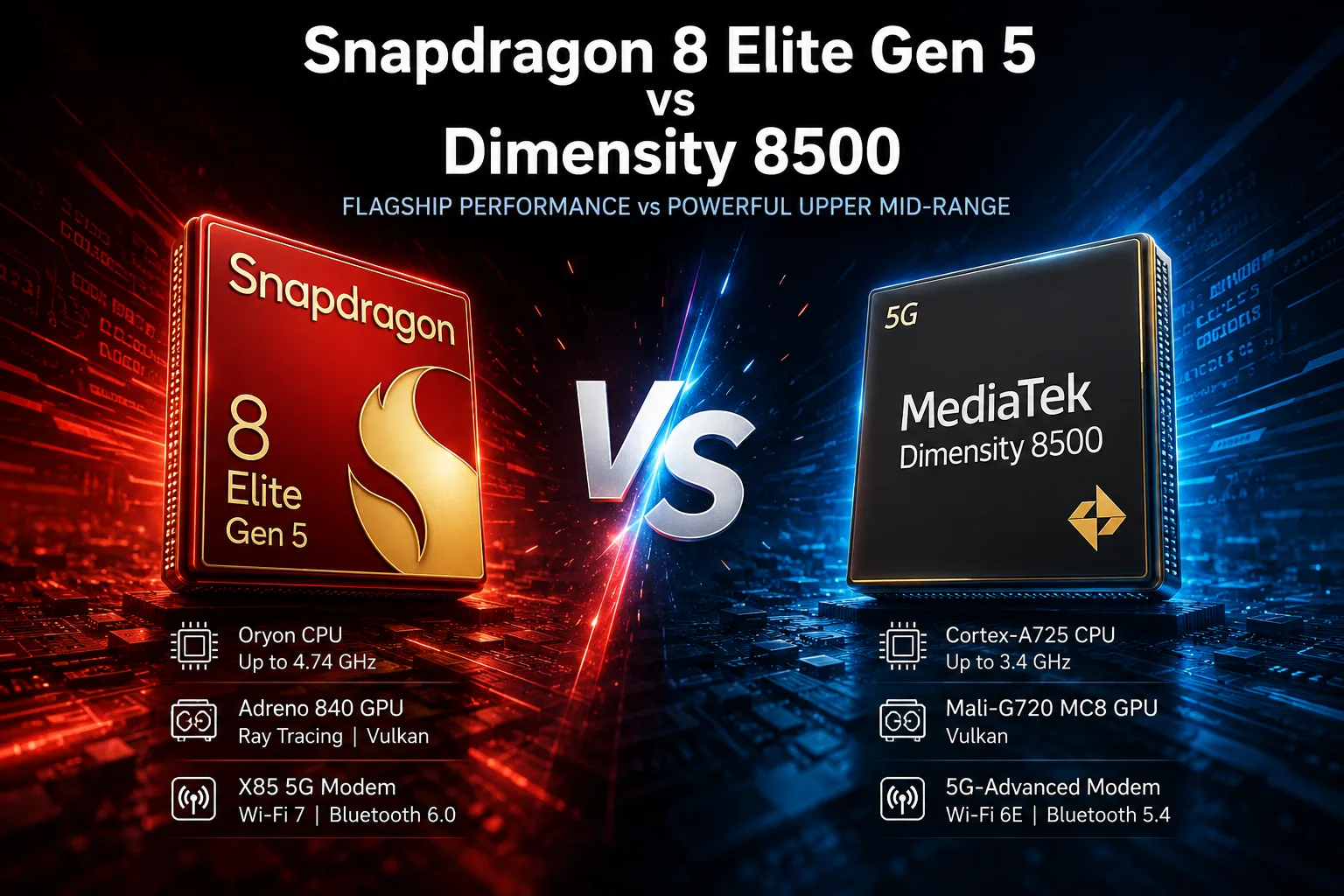
Snapdragon 8 Elite Gen 5 and Dimensity 8500 belong to different weight classes. Qualcomm targets top-tier flagships, whereas MediaTek allows for significantly more affordable high-performance smartphones. Thus, this comparison is not merely about a slight advantage of one platform over another but about a substantial difference in CPU, graphics, and SoC capabilities.
| Snapdragon 8 Elite Gen 5 | Dimensity 8500 | |
|---|---|---|
| CPU | 2× Oryon up to 4.74 GHz + 6× Oryon up to 3.62 GHz | 1× Cortex-A725 3.4 GHz + 3× 3.2 GHz + 4× 2.2 GHz |
| Process Technology | 3 nm | 4 nm |
| GPU | Adreno 840 | Mali-G720 MC8 |
| Memory | LPDDR5X | LPDDR5X-9600 |
| Storage | UFS 4.1 | UFS 4 + MCQ |
| Wi-Fi | Wi-Fi 7 | Wi-Fi 6E |
| Bluetooth | 6.0 | 5.4 |
| Max Video Recording | 4K 120 FPS | 4K 60 FPS |
| 5G | X85, sub-6 and mmWave | 5G-Advanced, sub-6 |
Snapdragon employs its own Oryon cores and is manufactured using a 3nm process. The Dimensity 8500 is built entirely on Cortex-A725 and is produced on a 4nm process. The configuration already shows that MediaTek does not attempt to directly replicate Qualcomm's flagship approach.
CPU Performance in Real Smartphones
The results depend on the cooling and power settings of specific smartphones, so it's more useful to compare retail devices rather than just averaged processor metrics.
| Smartphone | Processor | Geekbench 6 Single | Geekbench 6 Multi |
|---|---|---|---|
| OnePlus 15 | Snapdragon 8 Elite Gen 5 | 3647 | 10,549 |
| Honor Magic8 Pro | Snapdragon 8 Elite Gen 5 | 3574 | 10,338 |
| POCO X8 Pro | Dimensity 8500-Ultra | 1708 | 6297 |
| Xiaomi 17T | Dimensity 8500-Ultra | 1704 | 6686 |
In this sample, Snapdragon is more than twice as fast per core. In multi-threaded mode, the gap is smaller but still around 50-65%.
Such an advantage is more important in heavy applications, photo and video processing, emulation, and other tasks that heavily load one or two cores. In normal interface and everyday applications, Dimensity 8500 is already fast enough, so the difference in benchmarks may not always be felt proportionally to the numbers.
Graphics and Gaming
The gap in graphics is also substantial. Snapdragon 8 Elite Gen 5 is equipped with Adreno 840, whereas Dimensity 8500 has Mali-G720 MC8.
| Smartphone | GPU | Geekbench 6 Vulkan |
|---|---|---|
| Honor Magic8 Pro | Adreno 840 | 27,649 |
| OnePlus 15 | Adreno 840 | 27,599 |
| POCO X8 Pro | Mali-G720 MC8 | 14,194 |
| Xiaomi 17T | Mali-G720 MC8 | 13,319 |
In the Vulkan test, Adreno 840 is almost twice as fast as Mali-G720 MC8. This difference holds across multiple smartphones, so it cannot be attributed to the specifics of a single model.
Geekbench Vulkan cannot be directly converted to FPS in specific games, but it effectively shows the available GPU margin. Dimensity 8500 is sufficient for most modern Android games, especially without continually trying to maintain maximum settings.
Snapdragon better suits heavy gaming, high FPS, and emulation, especially if the smartphone is purchased for several years.
Cameras and Video
Both platforms support cameras up to 320 MP, so the maximum sensor resolution says little about shooting quality.
Snapdragon excels specifically in video: the platform supports recording 4K at up to 120 FPS and a more advanced image processing pipeline. Dimensity 8500 is limited to 4K 60 FPS.
This does not mean that every smartphone with Snapdragon takes better photos. The outcome largely depends on the sensors, optics, and manufacturer's algorithms, but Qualcomm offers more capabilities for the cameras of expensive flagships.
Connectivity
Snapdragon is equipped with a more advanced communication system: Wi-Fi 7, Bluetooth 6.0, and support for mmWave.
Dimensity 8500 offers Wi-Fi 6E, Bluetooth 5.4, and sub-6 5G. For most users, this is sufficient, but in terms of maximum capabilities, Qualcomm's platform leads.
Power Consumption and Heat
The 3nm process of Snapdragon compared to 4nm of Dimensity does not inherently mean better battery life.
Snapdragon can achieve much higher performance and may draw more power under maximum load. The end result depends on power limits, cooling system size, battery, and firmware settings.
Therefore, it is not possible to determine battery life or FPS stability solely based on the process technology. Testing specific smartphones under prolonged load is necessary.
What This Difference Means When Buying a Smartphone
Snapdragon 8 Elite Gen 5 is typically found in full-fledged flagships like OnePlus 15 and Honor Magic8 Pro. Dimensity 8500 is used in more affordable high-performance models.
Thus, buyers seldom choose exclusively between the two processors. Along with Snapdragon, one usually pays for cameras, displays, connectivity, and other flagship components.
If two similar smartphones are priced closely, Snapdragon 8 Elite Gen 5 provides a significantly greater CPU and GPU reserve. If the model on Dimensity 8500 is much cheaper, its performance is already sufficient for most applications and modern games, so the extra cost for the flagship platform is not necessary for everyone.
Conclusion
Snapdragon 8 Elite Gen 5 is a processor of a different class. In real smartphones, it is approximately twice as fast in single-threaded and graphical load, while in multi-threaded tests, it maintains a significant lead. Additionally, Qualcomm offers a more powerful video path and more modern wireless interfaces.
Dimensity 8500 is noticeably slower, but its purpose is different. It brings a high level of performance to smartphones that are cheaper than full-fledged flagships. For the interface, applications, and most games, its capabilities are more than sufficient.
If a smartphone with Snapdragon costs significantly more, it makes little sense to choose it solely for higher benchmark scores. However, with a small price difference, Snapdragon 8 Elite Gen 5 is definitely the stronger platform.
Advantages
- Higher Technology: 3 nm (3 nm vs 4 nm)
- Higher Frequency: 4600 MHz / 4740 MHz (4600 MHz / 4740 MHz vs 3400 MHz)
- Newer Launch Date: January 2026 (September 2025 vs January 2026)
Basic
GPU Specifications
Connectivity
Memory Specifications
Miscellaneous
Benchmarks
Comparison of Devices
Related SoC Comparisons


Share in social media
Or Link To Us
<a href="https://cputronic.com/soc/compare/qualcomm-snapdragon-8-elite-gen-5-vs-mediatek-dimensity-8500" target="_blank">Qualcomm Snapdragon 8 Elite Gen 5 vs MediaTek Dimensity 8500</a>