Qualcomm Snapdragon 6s 4G Gen 2
vs
MediaTek Helio G200

SoC Comparison Result
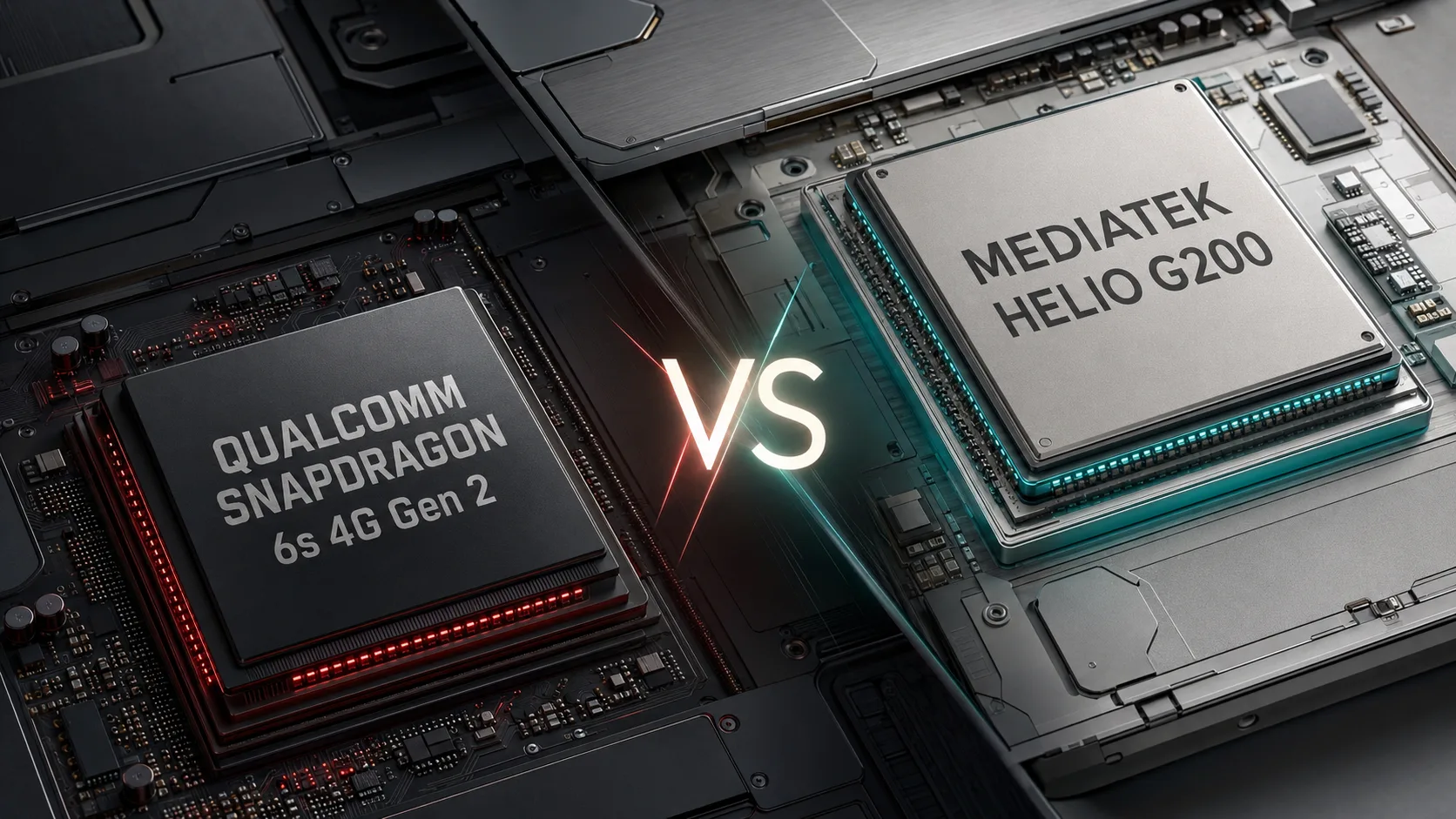
Qualcomm Snapdragon 6s 4G Gen 2 vs MediaTek Helio G200: 2.9 GHz Can't Save Qualcomm
The Snapdragon 6s 4G Gen 2 and Helio G200 are designed for affordable LTE devices, but the differences between them are much greater than their positioning suggests. MediaTek offers more modern CPU cores and significantly faster graphics. Qualcomm counters with a frequency of up to 2.9 GHz; however, overclocking an older platform does not eliminate its architectural limitations.
| Main Difference | Snapdragon 6s 4G Gen 2 | Helio G200 |
|---|---|---|
| Performance Cores | 4 × Cortex-A73, up to 2.9 GHz | 2 × Cortex-A76, up to 2.2 GHz |
| Efficiency Cores | 4 × Cortex-A53, up to 1.9 GHz | 6 × Cortex-A55, up to 2.0 GHz |
| Graphics | Adreno 610 | Mali-G57 MC2, up to 1.1 GHz |
| Maximum Camera Resolution | 108 MP | 200 MP |
| Video Recording | Full HD | Up to 2K at 30fps |
New Names, Familiar Foundations
Both chips are yet another revision of well-known platforms. The Helio G200 retains the Cortex-A76 and Cortex-A55 configuration used in the Helio G99 and G100. The main changes include the frequency of the Mali-G57 MC2, image processing functions, and the LTE modem.
The Snapdragon 6s 4G Gen 2, known as SM6225-AF, continues the lineage of platforms using Cortex-A73, Cortex-A53, and Adreno 610. The older cores received a frequency boost of up to 2.9 GHz, but the architecture is still from 2016. Qualcomm's claimed CPU increase of 51% and GPU increase of 20% refers to comparisons with the Snapdragon 6s 4G Gen 1, not the Helio G200.
Processor: Frequency Doesn't Compensate for Core Age
In Geekbench 6, devices with Snapdragon score around 480 points in single-core mode. Smartphones with Helio G200 typically score around 720-740 points. MediaTek's advantage is close to 50%, even though its performance cores have a 700 MHz lower maximum frequency.
In multi-core tests, the gap is about 35-40%. Two Cortex-A76 cores provide higher performance per core, and six Cortex-A55 cores prove more effective than four Cortex-A53 cores under distributed load.
In everyday tasks, Helio G200 launches heavy applications faster and causes less interface lag during updates or background data processing. Snapdragon handles browsing, messaging, and video playback well, but its performance cushion quickly runs out under active multitasking.
Graphics: The Main Limitation of Snapdragon
Adreno 610 debuted long before the Snapdragon 6s 4G Gen 2 and by the time of this platform's release, it was already significantly lagging behind current budget graphics. Increased frequencies and driver optimizations did not alleviate the limited performance of the GPU itself.
In 3DMark Wild Life, the Redmi Pad 2 9.7 scores about 588 points, while the HONOR X8d reaches around 646. The Infinix HOT 60 Pro+ with Helio G200 scores about 1360 points in the same test. The difference exceeds two times.
The Helio G200 is also not aimed at heavy games with high detail. However, titles like PUBG Mobile, Mobile Legends, and similar games run acceptably at reasonable settings. The Snapdragon 6s 4G Gen 2 significantly limits graphics quality and frame rate stability, especially after prolonged load.
Cameras and Platform Capabilities
The Helio G200 supports cameras with resolutions up to 200 MP, video recording in 2K at 30 fps, and 12-bit DCG processing for dynamic range expansion. The Snapdragon has a declared limit of 108 MP and Full HD recording. The final quality of photos still depends on the sensor, optics, and software processing of a specific device, but MediaTek's capabilities are broader.
Both platforms are manufactured on a 6nm process, operate with LPDDR4X and UFS 2.2, support Full HD+ displays with refresh rates up to 120 Hz, Wi-Fi 5, and Bluetooth 5.2. The modems are limited to LTE networks. For the cheapest smartphone, this is an acceptable compromise, but a device without 5G is harder to recommend for use over several years.
Results in Specific Devices
Results are approximate: they are influenced by RAM size, firmware, chassis temperature, and selected performance mode.
| Processor | Device | Geekbench 6, Single-Core | Geekbench 6, Multi-Core | AnTuTu 11 |
|---|---|---|---|---|
| Snapdragon 6s 4G Gen 2 | HONOR X8d | 484 | 1,498 | 521,602 |
| Snapdragon 6s 4G Gen 2 | Redmi Pad 2 9.7 | 483 | 1,348 | 476,045 |
| Helio G200 | Infinix HOT 60 Pro+ | 734 | 2,008 | 613,238 |
| Helio G200 | TECNO Spark 40 Pro+ | 740 | 1,946 | 616,665 |
| Helio G200 | TECNO Spark Slim | 718 | 1,985 | 591,552 |
Which Processor is Better?
The MediaTek Helio G200 confidently wins the comparison. It is about 50% faster in single-core workloads, 35-40% in multi-core tasks, and over twice as powerful in 3DMark Wild Life. An additional advantage is the support for cameras up to 200 MP and 2K video recording.
The Snapdragon 6s 4G Gen 2 is only justified in a significantly cheaper device with a better display, battery, or more memory. At a comparable price, there is no point in choosing it solely for the Snapdragon brand: behind the new name lies a platform whose CPU and GPU architectures are too old to compete with the Helio G200.
Advantages
- Higher Frequency: 2900 MHz (2900 MHz vs 2200 MHz)
- Newer Launch Date: December 2025 (December 2025 vs May 2025)
Basic
GPU Specifications
Connectivity
Memory Specifications
Miscellaneous
- AIFF
- CAF
- MP3
- MP4
- WAV
- H.265
- VP9
Benchmarks
Related SoC Comparisons



Share in social media
Or Link To Us
<a href="https://cputronic.com/soc/compare/qualcomm-snapdragon-6s-4g-gen-2-vs-mediatek-helio-g200" target="_blank">Qualcomm Snapdragon 6s 4G Gen 2 vs MediaTek Helio G200</a>