MediaTek Helio G99
vs
MediaTek Helio G200
SoC Comparison Result
MediaTek Helio G99 vs Helio G200: What Changed in Three Years
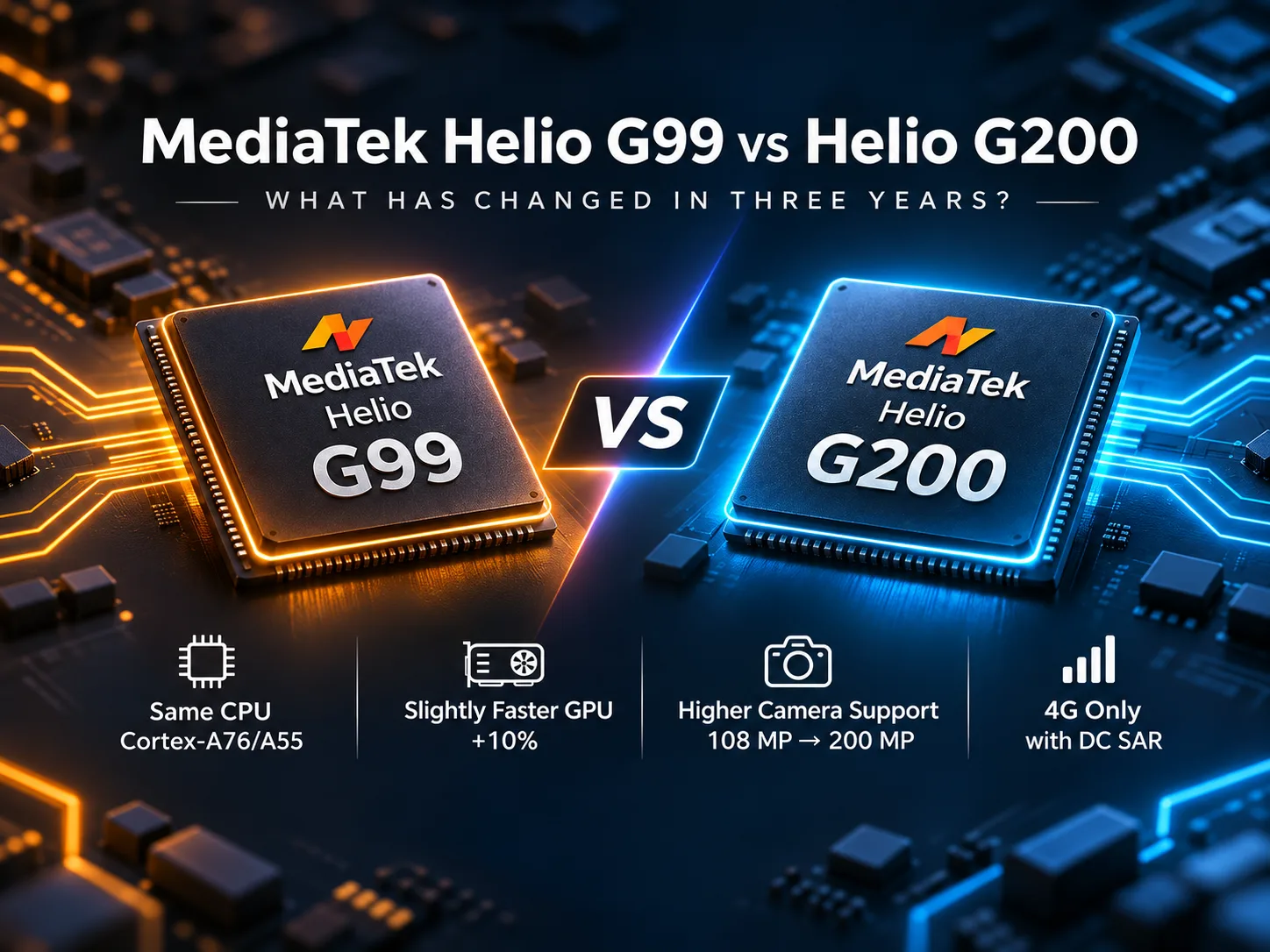
The MediaTek Helio G200 was released in May 2025, three years after the Helio G99, but its CPU performance is almost identical to that of its predecessor. Both chips use the same Cortex-A76 and Cortex-A55 cores, are manufactured using a 6 nm process, and do not support 5G. The main changes in the G200 concern graphics, image processing, and mobile connectivity. The improvement is small in most tests, and some smartphones with different chips produce virtually identical results.
Key Differences Between the Helio G99 and Helio G200
| Feature | Helio G99 | Helio G200 |
|---|---|---|
| Release date | May 2022 | May 2025 |
| Mali-G57 MC2 GPU frequency | Up to 1000 MHz | Up to 1100 MHz |
| Maximum camera resolution | 108 MP | 200 MP |
| 12-bit DCG for HDR video | Not specified | Supported |
| 4G DC SAR technology | Not specified | Supported |
The CPU configuration remains unchanged: two high-performance Cortex-A76 cores run at up to 2.2 GHz, while six Cortex-A55 cores run at up to 2.0 GHz. Both chips are manufactured by TSMC using a 6 nm process.
The main platform capabilities have not changed either:
- LPDDR4X-4266 RAM support.
- UFS 2.2 storage.
- Displays with resolutions of up to 2520 × 1080 and refresh rates of up to 120 Hz.
- 4G LTE Cat. 13 modem.
- Wi-Fi 5 and Bluetooth 5.2.
The G200 does not offer a new CPU architecture, faster memory, or a transition to a modern mobile connectivity standard.
Performance: How Much Faster Is the G200?
Both processors produce similar results in synthetic benchmarks. The table lists reference scores for each chip, based on results from devices with the Helio G99 and G200.
| Benchmark | Helio G99 | Helio G200 | Difference |
|---|---|---|---|
| Geekbench 6 Single-Core | 733 | 755 | +3% |
| Geekbench 6 Multi-Core | 1994 | 2038 | +2% |
| AnTuTu 10 | 423 470 | 435 929 | +3% |
| AnTuTu 11 | 554 590 | 603 568 | +9% |
In Geekbench 6, the G200’s advantage in this sample is 2-3%. In other sets of results, the G99 is sometimes slightly faster, especially in the multithreaded test. Given the identical cores and clock speeds, no substantial difference in CPU performance should be expected.
In AnTuTu 11, the gap reaches 9%, but the overall score includes CPU, GPU, memory, and user-scenario tests. The result is also affected by the smartphone’s configuration and software version.
Therefore, the G200’s higher scores in some tests do not indicate a comparable acceleration in applications.
Graphics: Comparison on Real Devices
Both processors use the Mali-G57 MC2. The Helio G200’s GPU frequency has increased from 1000 to 1100 MHz, or by 10%. However, the advantage does not always appear in tests of specific devices.
Below are the median results of smartphones and tablets in 3DMark Steel Nomad Light.
| Device | Processor | 3DMark Steel Nomad Light |
|---|---|---|
| Samsung Galaxy Tab A11 | Helio G99 | 148 |
| Infinix Zero 30 4G | Helio G99 | 147 |
| Infinix Note 30 | Helio G99 | 145 |
| Tecno Camon 50 | Helio G200 | 165 |
| Xiaomi Redmi Note 15 Pro 4G | Helio G200 | 160 |
| Infinix Hot 60 Pro+ | Helio G200 | 148 |
In this sample, G99 devices score 145-148 points, while G200 devices score 148-165. At the same time, the Samsung Galaxy Tab A11 and Infinix Hot 60 Pro+ produce the same result despite using different chips.
The difference is also small in 3DMark Wild Life: the Oppo Reno8 T with the G99 scores 1363 points, the Redmi Note 15 Pro 4G with the G200 scores 1407, and the Tecno Camon 50 scores 1421. The advantage of the latter two devices is approximately 3-4%.
Results depend on cooling, drivers, power-consumption settings, and other characteristics of the smartphone. Therefore, a 10% increase in GPU frequency does not guarantee a comparable improvement in graphics performance.
Gaming: Should You Expect Higher FPS?
Both processors are suitable for relatively undemanding games, including Mobile Legends and PUBG Mobile, with appropriate graphics settings.
In more demanding titles such as Genshin Impact and Wuthering Waves, the Mali-G57 MC2 does not provide enough performance for high frame rates at high settings. The additional 100 MHz in the G200 does not change this limitation.
3DMark results show that moving from the G99 to the G200 does not provide a significant improvement in graphics performance. During extended gaming sessions, the difference also depends on the cooling system and power-consumption limits of the particular smartphone.
Cameras: The Most Noticeable Upgrade
One of the main changes in the Helio G200 is support for cameras with resolutions of up to 200 MP, compared with 108 MP for the G99.
The G200 also adds support for 12-bit Dual Conversion Gain (DCG), which can expand the dynamic range of video capture when used with a compatible sensor.
However, camera resolution alone does not determine photo quality. A smartphone with the G99 and a good sensor may take better photos than a device with the G200 and a 200 MP camera. Optics, stabilization, and image-processing algorithms are also important.
Both processors support H.264 and H.265 video encoding, including 2K at 30 FPS and Full HD at 60 FPS. The G200’s HDR video capabilities must be implemented by the smartphone manufacturer and supported by the installed sensor.
Connectivity and Power Consumption
Both chips are equipped with a 4G LTE Cat. 13 modem and offer similar mobile connectivity capabilities.
The G200 adds 4G DC SAR technology, designed to improve data transmission under weak signal conditions. According to MediaTek, it can reduce latency and improve connection stability in difficult reception conditions.
The practical effect depends on the implementation of the smartphone’s radio subsystem and the characteristics of the carrier’s network. The presence of the G200 alone does not guarantee better reception.
A significant improvement in battery life should not be expected either. Both chips use the same process technology and CPU architecture, so battery life is more appropriately compared at the level of individual smartphones.
Which Processor Should You Choose in 2026?
The Helio G99 remains a sensible choice if the smartphone using it is significantly cheaper and offers a good display, battery, and sufficient memory. Its capabilities are adequate for browsing, messaging, navigation, video playback, and undemanding games.
The Helio G200 is preferable at a comparable price. It has a higher GPU frequency, supports additional camera capabilities, and includes 4G DC SAR technology. However, its advantage in tests is small, so paying a substantial premium for the processor alone is not justified.
Those who are buying a smartphone for several years and plan to play demanding games should consider more powerful platforms with 5G.
Conclusion
The MediaTek Helio G200 is a minor update to the Helio G99, not a completely new generation. Over three years, the CPU architecture and process technology have not changed. Graphics performance has increased slightly, while the main new features concern cameras and mobile connectivity.
In everyday tasks, it will be difficult to notice a difference between the two processors. When choosing a smartphone, it is more important to assess the device’s specifications as a whole than to favor the G200 solely because of its newer name.
Advantages
- Newer Launch Date: May 2025 (May 2022 vs May 2025)
Basic
GPU Specifications
Connectivity
Memory Specifications
Miscellaneous
- AIFF
- CAF
- MP3
- MP4
- WAV
- H.265
- VP9
Benchmarks
Comparison of Devices
Related SoC Comparisons



Share in social media
Or Link To Us
<a href="https://cputronic.com/soc/compare/mediatek-helio-g99-vs-mediatek-helio-g200" target="_blank">MediaTek Helio G99 vs MediaTek Helio G200</a>