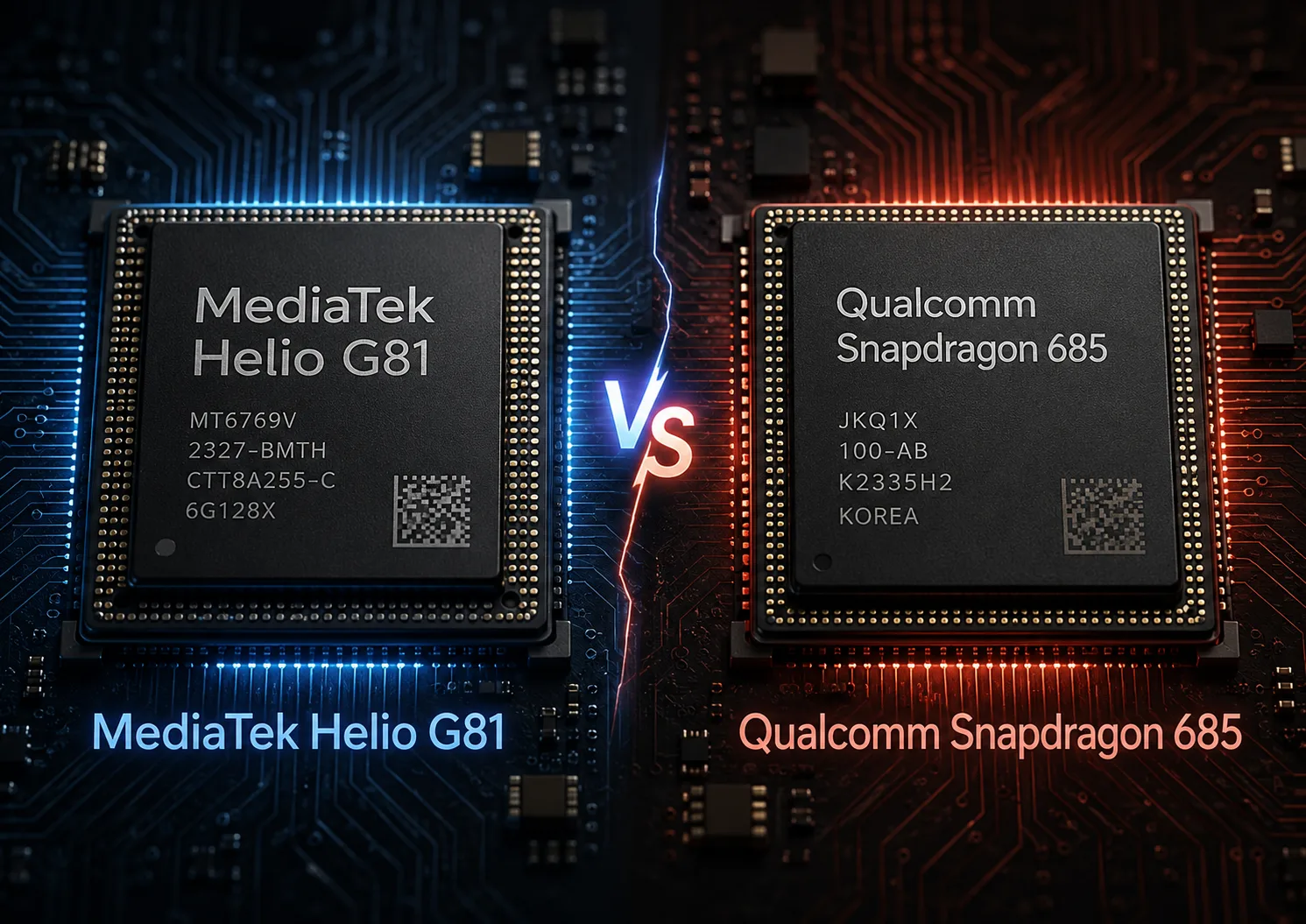
MediaTek Helio G81
vs
Qualcomm Snapdragon 685
SoC Comparison Result
MediaTek Helio G81 vs Qualcomm Snapdragon 685: Which Budget 4G Chip is Better?
MediaTek Helio G81 and Qualcomm Snapdragon 685 are platforms for affordable smartphones without 5G support. Both chips are designed for basic tasks: messaging, browsing, YouTube, navigation, social media, and casual gaming. However, they cannot be considered equal. The Snapdragon 685 typically stands out as a more appealing option, provided that a smartphone based on it does not cost significantly more.
The Helio G81 is a straightforward budget chip featuring two powerful Cortex-A75 cores, six energy-efficient Cortex-A55 cores, and Mali-G52 MC2 graphics. The Snapdragon 685 also does not utilize a new CPU architecture but benefits from a more refined 6nm manufacturing process, higher clock speeds, and Adreno 610 graphics. As a result, it often feels faster and more stable in real-world smartphones.
Key Differences
| Parameter | MediaTek Helio G81 | Qualcomm Snapdragon 685 |
|---|---|---|
| Class | basic 4G | stronger budget 4G |
| CPU | 2x Cortex-A75 + 6x Cortex-A55 | Kryo 265 up to 2.8 GHz |
| Process Technology | 12 nm | 6 nm |
| GPU | Mali-G52 MC2 | Adreno 610 |
| Camera | up to 48 MP or 16+16 MP | up to 108 MP |
| Display | Full HD+ | Full HD+ up to 120 Hz |
| Connectivity | 4G, Wi-Fi 5, Bluetooth 5.0 | 4G, Wi-Fi 5, Bluetooth 5.1 |
| AnTuTu 10 Benchmark | around 250-260k | around 340-350k |
Performance
In everyday tasks, the Snapdragon 685 should provide a better experience. It opens applications faster, performs better in browsers, handles multiple messaging apps more confidently, and generally offers more headroom for future use. This is not at the level of mid-range chips, but the difference is noticeable for a budget smartphone.
The Helio G81 is suitable for basic use, but it has less headroom. If a smartphone is purchased solely for calls, video, navigation, and simple applications, it will suffice. However, under heavy websites, multiple background applications, and prolonged use, it will quickly run into limitations.
According to benchmark tests, the Snapdragon 685 takes the lead. In AnTuTu 10, the difference can be about 30-35%. In Geekbench 6, the gap is usually smaller: approximately 470 points in single-core and 1500 in multi-core for the Snapdragon 685 compared to about 420 and 1390 for the Helio G81. Exact figures depend on the specific smartphone, memory, cooling, and firmware.
For a budget smartphone, the amount of RAM is just as vital as the chip itself. If a model has only 4 GB of RAM, even the Snapdragon 685 may not fully conceal multitasking limitations. It is more optimal to look for versions with 6 GB, or preferably with 8 GB of RAM, especially if the smartphone is intended for several years of use.
Gaming and Graphics
Both chips are suitable only for light gaming. Simple arcade games, MOBAs, casual games, and popular online projects will run adequately, but high settings in heavy games are not their forte.
The Snapdragon 685 is preferable in this regard. The Adreno 610 graphics typically perform better in the budget segment, and the platform itself has greater CPU headroom. The Helio G81 can also run many games but often requires lowering settings and does not maintain stability as well under prolonged load.
Camera and Multimedia
In terms of camera capabilities, the Snapdragon 685 is stronger: the platform supports sensors up to 108 MP. The Helio G81 specifies a more modest level-up to 48 MP or a dual-camera setup of 16+16 MP.
This does not mean that every smartphone with the Snapdragon 685 will take better photos. Photo quality depends on the sensor, optics, and processing algorithms. However, when comparing the platforms, Qualcomm has more headroom for cameras and image processing.
Conclusion
Qualcomm Snapdragon 685 is the stronger and safer choice. It is faster, built on a more refined manufacturing process, has better graphics, wider camera capabilities, and is generally better suited for a smartphone intended for several years.
The MediaTek Helio G81 should only be considered for very cheap models where price is the deciding factor. For calls, messaging, video, and simple gaming, it is adequate, but it falls short in performance headroom. If the price difference is minimal, it is better to choose a smartphone with the Snapdragon 685, especially in a version with sufficient RAM.
Advantages
- Newer Launch Date: August 2024 (August 2024 vs March 2023)
- Higher Technology: 6 nm (12 nm vs 6 nm)
- Higher Frequency: 2800 MHz (2000 MHz vs 2800 MHz)
Basic
6x 1.8 GHz – Cortex-A55
GPU Specifications
Connectivity
Memory Specifications
Miscellaneous
Benchmarks
Related SoC Comparisons



Share in social media
Or Link To Us
<a href="https://cputronic.com/soc/compare/mediatek-helio-g81-vs-qualcomm-snapdragon-685" target="_blank">MediaTek Helio G81 vs Qualcomm Snapdragon 685</a>