MediaTek Dimensity 7360
vs
Qualcomm Snapdragon 7s Gen 3

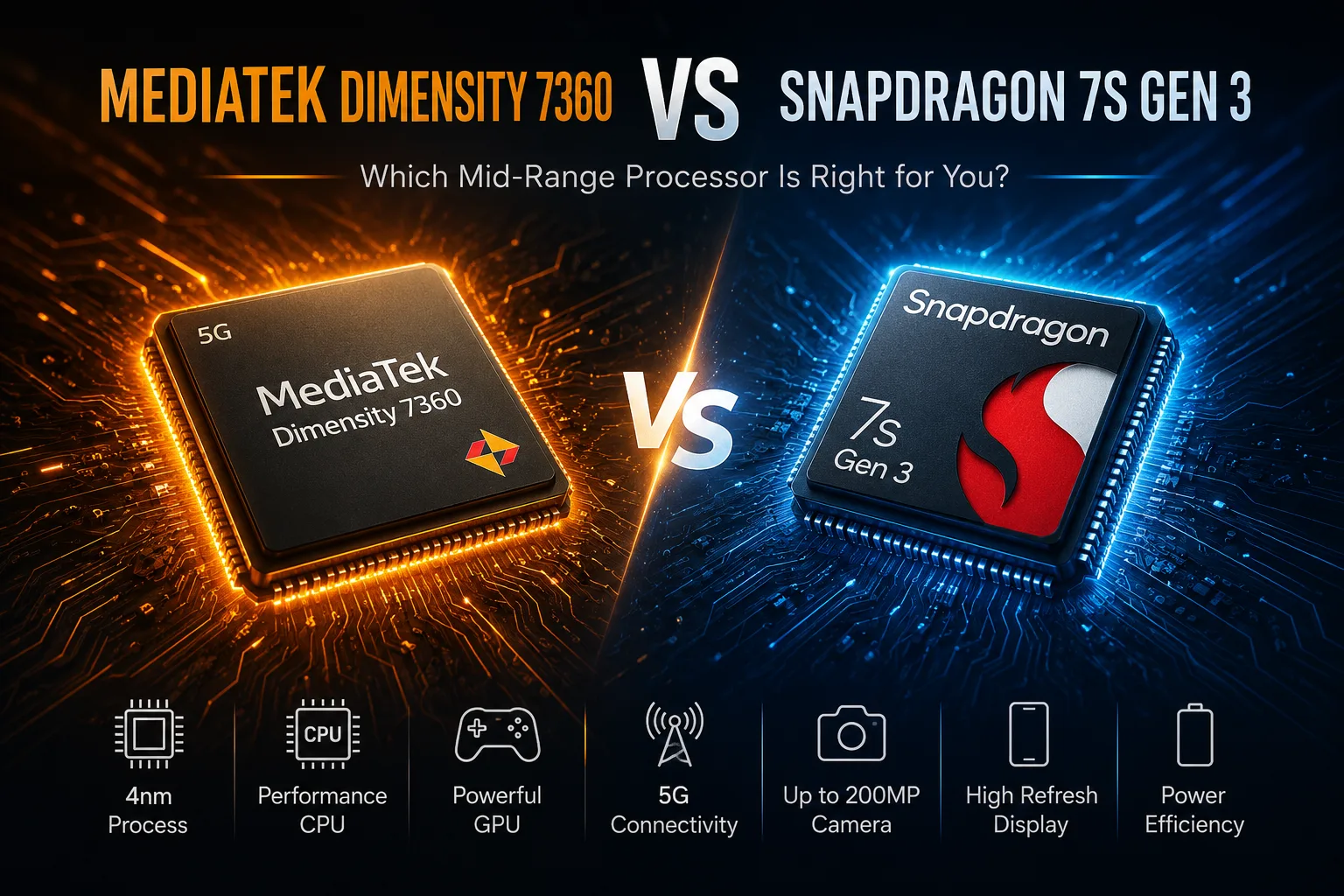
SoC Comparison Result
MediaTek Dimensity 7360 vs Snapdragon 7s Gen 3: Qualcomm is stronger in CPU and graphics
MediaTek Dimensity 7360 and Qualcomm Snapdragon 7s Gen 3 are formally classified in the same category: they are 4nm platforms for mid-range smartphones featuring 5G connectivity, fast displays, and support for cameras up to 200 MP. The difference begins in the computational part. Snapdragon 7s Gen 3 utilizes newer Cortex-A720/A520 cores and Adreno graphics, whereas Dimensity 7360 sticks to the Cortex-A78/A55 combination. Therefore, the question is simpler: does a cheaper smartphone powered by Dimensity 7360 justify the loss in CPU and graphics performance?
At the same price point, Snapdragon 7s Gen 3 is preferable. Dimensity 7360 is interesting in other scenarios: when the smartphone itself is cheaper or excels in aspects like display, battery, camera, and memory.
Key Differences
| Parameter | MediaTek Dimensity 7360 | Snapdragon 7s Gen 3 | Practical Implication |
|---|---|---|---|
| CPU | 4× Cortex-A78 up to 2.5 GHz + 4× Cortex-A55 | 1× Cortex-A720 up to 2.5 GHz + 3× Cortex-A720 up to 2.4 GHz + 4× Cortex-A520 up to 1.8 GHz | Snapdragon is more modern in architecture |
| GPU | Mali-G615 MC2 | Adreno 810 | Qualcomm is stronger in gaming and GPU tasks |
| 5G | Sub-6, downlink up to 3.27 Gbps | Sub-6/mmWave, downlink up to 2.9 Gbps | MediaTek claims higher speed in sub-6, Qualcomm has mmWave |
| Wi-Fi | Wi-Fi 6E | Wi-Fi 6/6E | No significant gap exists |
| Camera | Up to 200 MP, 4K30 | Up to 200 MP, 4K30 HDR | Depends on the specific smartphone |
| Display | FHD+ up to 144 Hz / WFHD+ up to 120 Hz | FHD+ up to 144 Hz | For typical FHD+ smartphones, the difference is not significant |
In terms of memory, storage, and Bluetooth, there is no serious gap: both chips support LPDDR5, UFS 3.1, and Bluetooth 5.4. Therefore, the comparison hinges not on the list of interfaces but rather on CPU, GPU, and performance under load.
Benchmarks: Snapdragon is Faster Almost Everywhere
| Test | Dimensity 7360 | Snapdragon 7s Gen 3 | Leader |
|---|---|---|---|
| AnTuTu 11 | ~925,409 | ~1,040,961 | Snapdragon 7s Gen 3 |
| AnTuTu CPU | ~329,195 | ~419,057 | Snapdragon 7s Gen 3 |
| AnTuTu GPU | ~123,225 | ~180,147 | Snapdragon 7s Gen 3 |
| Geekbench 6 Single-Core | ~1,025 | ~1,162 | Snapdragon 7s Gen 3 |
| Geekbench 6 Multi-Core | ~2,882 | ~3,315 | Snapdragon 7s Gen 3 |
| Geekbench GPU Compute | ~2,525 | ~4,459 | Snapdragon 7s Gen 3 |
| PCMark 3.0 | ~10,678 | ~13,160 | Snapdragon 7s Gen 3 |
In benchmark tests, the advantage of Snapdragon is immediately apparent: Snapdragon 7s Gen 3 is faster in both CPU and graphics. The largest gap is in GPU tests: Adreno 810 significantly outperforms Mali-G615 MC2.
These results cannot be directly applied to any smartphone. Final performance depends on cooling, memory, firmware, and power limits. However, the overall layout is clear: Snapdragon 7s Gen 3 is more powerful, while Dimensity 7360 is more of a rational choice rather than a bet on maximum speed.
CPU: New Cores vs. Older, Yet Functional Scheme
The main difference lies in the CPU. Dimensity 7360 uses four Cortex-A78 and four Cortex-A55 cores. This is a typical configuration for mid-range devices in recent years: it is sufficient for the interface, browsing, social media, navigation, and general multitasking. However, Cortex-A78 no longer seems like a strong argument against Qualcomm’s newer cores.
Snapdragon 7s Gen 3 is built on Cortex-A720 and Cortex-A520. This configuration is more important for everyday responsiveness: much depends not on the total number of cores but on the speed of the fast clusters. This is evident when launching apps, browsing the web, processing photos, and switching between tasks.
Therefore, Snapdragon is better suited for a smartphone with a longevity of a few years. The difference may not be immediately noticeable on the first day, but over time, the newer architecture becomes more important: apps are becoming heavier, interfaces are becoming heavier, and the number of background processes isn’t decreasing.
Graphics and Gaming: The Main Advantage of Snapdragon 7s Gen 3
The gap in graphics is more noticeable than in CPU. Dimensity 7360 uses Mali-G615 MC2-a suitable GPU for the inexpensive mid-range- but the dual-core version is not designed for heavy gaming at high settings. Casual games, MOBA, and some online shooters will run without serious issues, but demanding projects will require reducing graphics settings.
Adreno 810 in Snapdragon 7s Gen 3 provides a larger headroom. This chip is better suited for gaming, emulators, and graphically demanding applications. In similar conditions, Snapdragon is more likely to maintain a steadier FPS.
There is also the optimization factor: Android games are often well-tuned for Adreno. This does not negate the role of cooling, but when conditions are equal, a smartphone on Snapdragon 7s Gen 3 will be more predictable in gaming.
Where Dimensity 7360 Holds Its Ground
The performance gap in benchmarks does not make Dimensity 7360 a bad platform. In terms of interfaces and multimedia, it has a complete set for modern mid-range devices: 5G, Wi-Fi 6E, Bluetooth 5.4, support for LPDDR5, UFS 3.1, FHD+ displays up to 144 Hz, and cameras up to 200 MP. For an inexpensive mid-range smartphone, this is sufficient.
In the modem, Dimensity 7360 has a strong point: MediaTek claims a downlink of up to 3.27 Gbps in 5G sub-6. Snapdragon 7s Gen 3 has a lower specified rate-up to 2.9 Gbps-but the Qualcomm platform supports mmWave. In practice, this rarely becomes decisive: speed is more affected by the operator, region, frequencies, and signal quality.
The situation with cameras is similar. Both chips support sensors of up to 200 MP and 4K video recording. However, photo quality is not determined by the chip alone. More important are the sensor, optics, stabilization, manufacturer algorithms, and firmware. A smartphone with Dimensity 7360 and a good camera may capture better images than a poorly designed model with Snapdragon 7s Gen 3.
Battery Life and Heating
In typical tasks, the difference in power consumption is unlikely to be significant: both chips belong to the same manufacturing process and segment. Dimensity 7360 can perform well in a smartphone with a large battery and moderate performance settings.
Under prolonged load, the advantage will likely go to Snapdragon 7s Gen 3. It has a newer CPU and a faster GPU, so it has more headroom. However, the final result still depends on the specific smartphone: casing, cooling, firmware, and manufacturer settings.
What to Choose
Snapdragon 7s Gen 3 is better suited for gaming, emulators, demanding applications, and a smartphone that is designed to last several years. At the same price, it is a more logical purchase.
Dimensity 7360 should be considered if the smartphone based on it is significantly cheaper or excels in other parameters: display, battery, camera, charging, memory capacity, or build quality. The chip itself is not weak; buying it makes more sense not for speed but for a more advantageous smartphone overall.
Conclusion
Snapdragon 7s Gen 3 is stronger due to its more modern architecture and Adreno graphics. It is faster in CPU, significantly stronger in GPU, and better suited for a mid-range smartphone purchased for several years.
MediaTek Dimensity 7360 is modern in terms of interfaces and multimedia, but falls short in the most crucial areas: CPU cores and graphics. It is a suitable platform for everyday tasks, connectivity, fast displays, and high-resolution cameras, but not the best choice at equal prices.
If the price is the same, it makes more sense to choose a smartphone based on Snapdragon 7s Gen 3. Dimensity 7360 is justified when the smartphone is significantly more advantageous: cheaper, longer-lasting on battery, or better in terms of display, camera, and memory.
Advantages
- Newer Launch Date: July 2025 (July 2025 vs August 2024)
- Higher Frequency: 2500 MHz (Up to 2.5 GHz vs 2500 MHz)
Basic
3x 2.4 GHz – Kryo Gold
4x 1.8 GHz – Kryo Silver
GPU Specifications
Connectivity
Memory Specifications
Miscellaneous
Benchmarks
Comparison of Devices
Related SoC Comparisons



Share in social media
Or Link To Us
<a href="https://cputronic.com/soc/compare/mediatek-dimensity-7360-vs-qualcomm-snapdragon-7s-gen-3" target="_blank">MediaTek Dimensity 7360 vs Qualcomm Snapdragon 7s Gen 3</a>