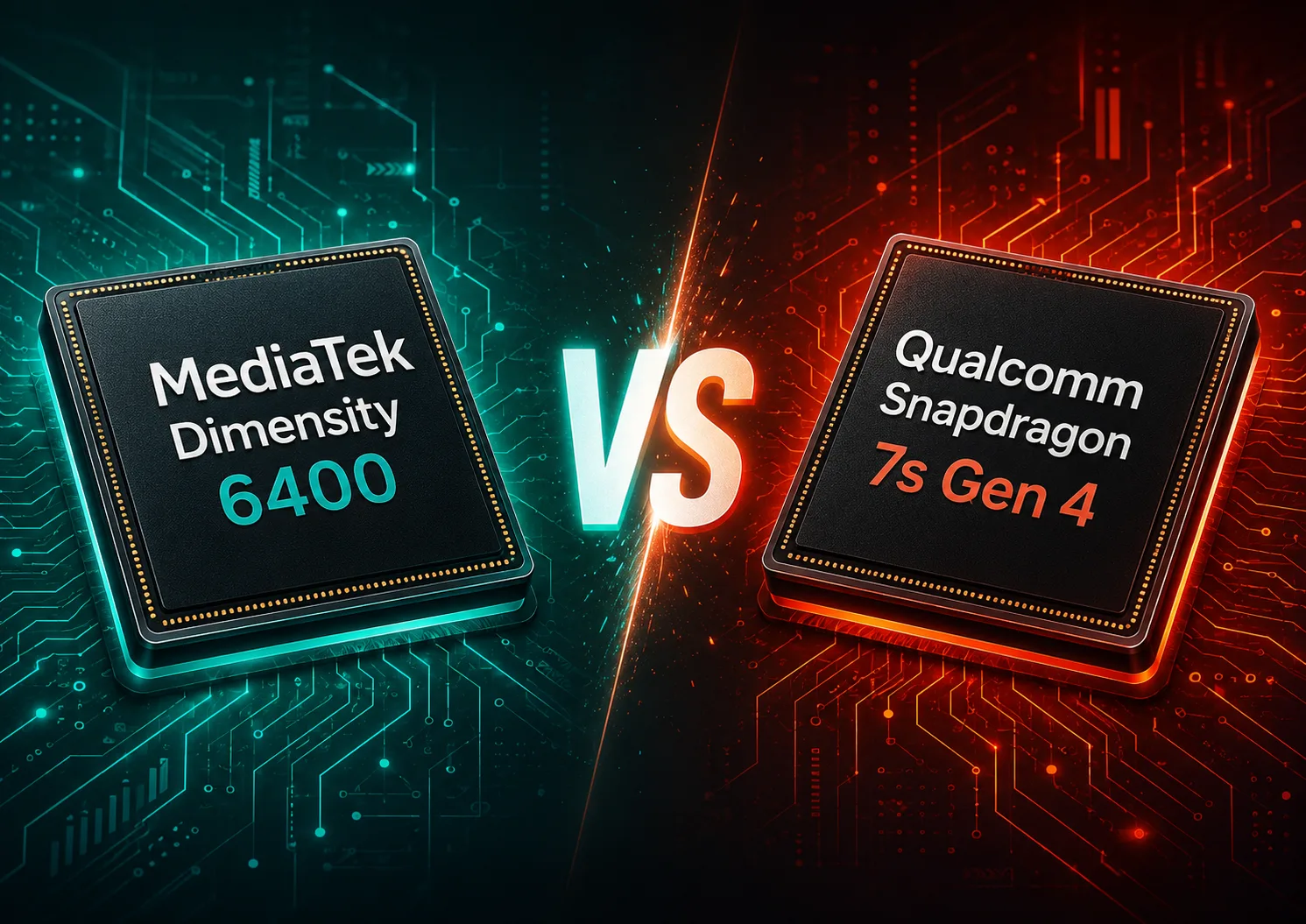
MediaTek Dimensity 6400
vs
Qualcomm Snapdragon 7s Gen 4
SoC Comparison Result
Dimensity 6400 vs. Snapdragon 7s Gen 4: Comparison of Chipsets from Different Classes
Smartphones featuring the Dimensity 6400 and Snapdragon 7s Gen 4 sometimes cost nearly the same, even though the processors belong to different categories. The Dimensity 6400 is designed for budget models, while the Snapdragon 7s Gen 4 is noticeably faster in applications and games, supporting UFS 3.1 and Wi-Fi 6E. MediaTek makes sense to choose only when the smartphone is significantly cheaper or better equipped in other respects.
Key Differences
| Specification | MediaTek Dimensity 6400 | Qualcomm Snapdragon 7s Gen 4 |
|---|---|---|
| Positioning | Budget segment | Mid-range segment |
| Process Technology | 6 nm | 4 nm |
| CPU | 2 × Cortex-A76 and 6 × Cortex-A55 | 1 fast, 3 performance, and 4 efficiency cores |
| Graphics | Mali-G57 MC2 | Adreno |
| RAM | LPDDR4X | LPDDR5 or LPDDR4X |
| Storage | UFS 2.2 | Up to UFS 3.1 |
| Video | Basic capabilities | Up to 4K HDR |
| Wi-Fi | Wi-Fi 5 | Wi-Fi 6E |
Smartphone manufacturers do not always utilize all the capabilities of the processors. For example, a model with Snapdragon 7s Gen 4 may come with the cheaper UFS 2.2 instead of UFS 3.1. Therefore, comparisons should not only be made based on the chips but also on the configuration of specific devices.
Processor Performance
The Dimensity 6400 uses two performance cores Cortex-A76 and six efficiency cores Cortex-A55. For messaging, navigation, and video playback, this configuration is sufficient, but these cores already lag behind newer solutions. The increased frequency helps in short-term loads, but does not eliminate the limitations of the older architecture.
The Snapdragon 7s Gen 4 features newer cores and a three-cluster layout. One fast core, three performance cores, and four efficiency cores handle both short and long workloads better.
Snapdragon launches heavy applications faster and manages multitasking, photo processing, and complex web pages more efficiently. For basic tasks, the Dimensity 6400 is adequate, but its performance limitations will become apparent sooner in demanding applications.
Gaming
The main limitation of the Dimensity 6400 is the Mali-G57 MC2 graphics with two compute units. Simple games run fine, but in demanding ones, you will need to lower the settings and internal resolution.
A 120 Hz display does not guarantee high frame rates. In less demanding games, the high refresh rate is beneficial, but in heavy games, you often have to settle for lower settings and 30-60 frames per second.
The Adreno graphics in Snapdragon 7s Gen 4 are significantly faster. It allows for higher settings and handles emulators better. Additionally, games and emulators are generally better optimized for Adreno.
The Dimensity 6400 is suitable for simple games and low settings. For demanding projects, the Snapdragon 7s Gen 4 is considerably stronger.
Memory and Storage
The Dimensity 6400 supports LPDDR4X and UFS 2.2. For a budget smartphone, this is adequate, but applications and games will install slower than on a device with UFS 3.1.
The Snapdragon 7s Gen 4 can work with LPDDR5 and UFS 3.1. The faster storage speeds up the installation and launch of applications, while LPDDR5 increases memory bandwidth.
However, the advantages of Snapdragon depend on the specific smartphone configuration. If the manufacturer opts for LPDDR4X and UFS 2.2, the chip will still be faster in calculations and gaming, but the difference in application launch speed will be smaller.
Cameras and Video
The Dimensity 6400 supports cameras up to 108 MP and multi-shot noise reduction. The quality of the images therefore depends more on the sensor, lens, and manufacturer algorithms than on the maximum resolution specified in the processor's characteristics.
The Snapdragon 7s Gen 4 supports cameras up to 200 MP, simultaneous data processing from multiple modules, and 4K HDR recording. This allows for simultaneous operation of multiple cameras and smoother switching between them.
A more powerful ISP does not guarantee better image quality on its own. A weak sensor or poor software processing can negate the processor's advantages.
Artificial Intelligence
The Snapdragon 7s Gen 4 is stronger in local AI tasks, but the set of available features depends on the smartphone manufacturer and its software. For most buyers, this is currently less important than the differences in CPU, graphics, and storage.
Connectivity and Wireless Interfaces
Both processors support 5G networks. The Dimensity 6400 has a higher theoretical download speed, but in real networks, this makes little difference. The actual performance depends on the operator, coverage, available bands, and the smartphone's antenna design.
The difference in Wi-Fi is much more noticeable. The Dimensity 6400 is limited to Wi-Fi 5, while the Snapdragon 7s Gen 4 supports Wi-Fi 6E. With a compatible router, it provides higher bandwidth and access to the less congested 6 GHz band.
What to Choose
Choose the Snapdragon 7s Gen 4 for demanding games, heavy applications, emulators, and 4K video recording. It is faster, better equipped, and belongs to a higher class.
A smartphone with the Dimensity 6400 makes sense if it is significantly cheaper or offers a better display, camera, battery, or more memory. For heavy gaming, this chip is a bit weak.
Do not overpay for a model with the Dimensity 6400 simply because of a 120 Hz display, high camera resolution, or the word "gaming" in advertising. These specifications by themselves say nothing about real performance.
At the same price point, the Snapdragon 7s Gen 4 is the obvious choice. The Dimensity 6400 should only be considered in significantly cheaper or better-equipped smartphones.
Advantages
- Higher Technology: 4 nm (6 nm vs 4 nm)
- Higher Frequency: 2700 MHz (2500 MHz vs 2700 MHz)
- Newer Launch Date: August 2025 (February 2025 vs August 2025)
Basic
GPU Specifications
Connectivity
Memory Specifications
Miscellaneous
- AIFF
- CAF
- MP3
- MP4
- WAV
- H.265
- VP9
Benchmarks
Comparison of Devices
Related SoC Comparisons



Share in social media
Or Link To Us
<a href="https://cputronic.com/soc/compare/mediatek-dimensity-6400-vs-qualcomm-snapdragon-7s-gen-4" target="_blank">MediaTek Dimensity 6400 vs Qualcomm Snapdragon 7s Gen 4</a>