Apple A20 Pro
vs
Apple M1 iPad

SoC Comparison Result
Apple A20 Pro vs. Apple M1 iPad: Six Years of Apple Silicon Progress
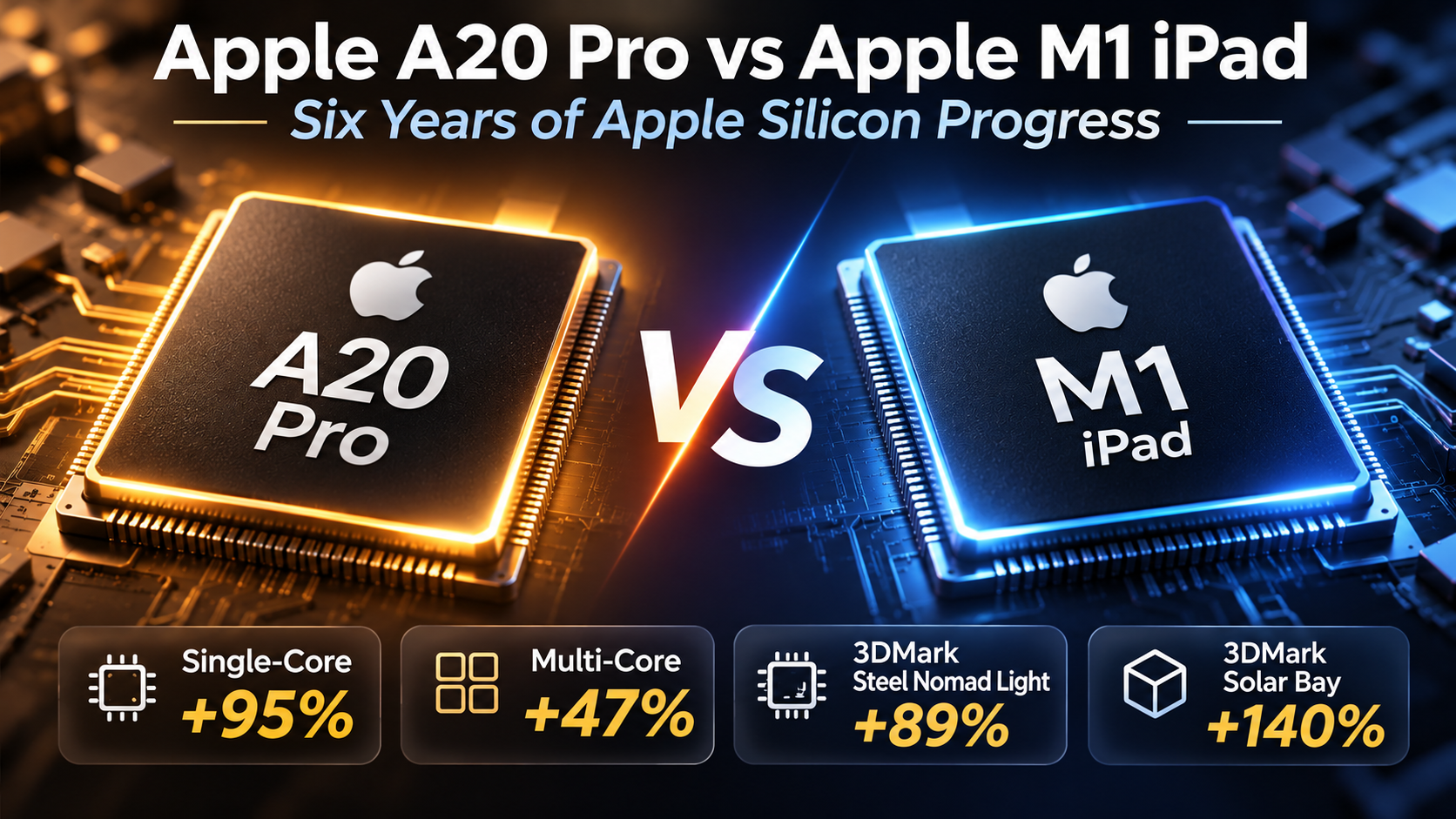
The Apple A20 Pro is almost twice as fast as the Apple M1 iPad in the Geekbench 6 single-core test, despite having six CPU cores versus eight. In the multi-core test, its advantage is about 47%, while in the 3DMark Steel Nomad Light graphics test, it reaches 89%. At the same time, the A20 Pro's theoretical FP32 GPU performance is only 11% higher. The comparison shows how much Apple Silicon performance changed between the 2020 and 2026 generations.
Architecture and Key Differences
The M1 became Apple's first processor for Mac computers in November 2020. It appeared in the iPad Pro in spring 2021, followed a year later by the fifth-generation iPad Air. The A20 Pro was designed for the iPhone 18 Pro and 18 Pro Max, introduced in September 2026, and is also used in the iPad mini.
| Specification | Apple A20 Pro | Apple M1 iPad |
|---|---|---|
| Chip release year | 2026 | 2020 |
| Process technology | TSMC 2 nm | TSMC 5 nm |
| CPU | 6 cores | 8 cores |
| Performance cores | 2 | 4 |
| Efficiency cores | 4 | 4 |
| Maximum CPU frequency | 4.93 GHz | 3.19 GHz |
| GPU | 7 cores | 8 cores |
| FP32, theoretical performance | 2.90 TFLOPS | 2.62 TFLOPS |
| Hardware-accelerated ray tracing | Yes | No |
| Memory type | LPDDR5X | LPDDR4X |
| Neural Engine | 32 cores | 16 cores |
The A20 Pro is shown in its full six-core configuration. In the 2026 iPad mini, the 128/256 GB versions have five CPU cores and a 16-core Neural Engine, while the 512 GB version has six CPU cores and two 16-core Neural Engine blocks. Clock speeds and FP32 figures are based on measurements and calculations rather than Apple's official specifications.
The M1 has four Firestorm performance cores clocked at up to 3.19 GHz and four Icestorm efficiency cores. The A20 Pro uses two next-generation performance cores clocked at up to 4.93 GHz and four efficiency cores.
The A20 Pro's performance-core frequency is approximately 55% higher. However, the single-core test result increased even more, indicating architectural improvements rather than a frequency advantage alone.
Geekbench 6: Nearly Double the Single-Core Performance
The table shows results from specific devices. All figures are from Geekbench 6.
| Device | Processor | Single-Core | Multi-Core |
|---|---|---|---|
| iPhone 18 Pro | A20 Pro | 4 733 | 12 797 |
| iPhone 18 Pro Max | A20 Pro | 4 745 | 12 642 |
| iPad mini (2026, 512 GB) | A20 Pro | 4 651 | 12 602 |
| iPad Pro 12.9 (2021) | M1 | 2 429 | 8 707 |
| iPad Pro 11 (2021) | M1 | 2 431 | 8 789 |
| iPad Air 10.9 (2022) | M1 | 2 420 | 8 746 |
Comparing the iPhone 18 Pro with the iPad Pro 12.9, the A20 Pro's advantages are:
- 95% in Single-Core. The new processor's single-threaded result is almost twice as high.
- 47% in Multi-Core. The A20 Pro is faster even with fewer CPU cores.
The 55% increase in frequency does not fully explain the 95% increase in the single-core result. The difference points to higher per-core efficiency from the A20 Pro when running the Geekbench workload. However, the exact performance-per-clock increase cannot be determined from this test.
The gap narrows in the multi-core test. The M1 has twice as many performance cores, so under full CPU load, it partially offsets the per-core deficit.
The results of the three M1 tablets are close to one another: the iPad Air and iPad Pro use the same eight-core CPU configuration.
GPU: Similar TFLOPS, but Nearly Twice the Performance in 3DMark
The M1 iPad is equipped with an eight-core GPU with a theoretical performance of 2.62 TFLOPS. The seven-core A20 Pro achieves 2.90 TFLOPS, approximately 11% more.
| Test | iPhone 18 Pro Max (A20 Pro) | iPad Pro 12.9 (M1) |
|---|---|---|
| Steel Nomad Light | 3 768 | 1 989 |
| Solar Bay | 15 396 | 6 409 |
In Steel Nomad Light, the A20 Pro is approximately 89% faster. The test shows the difference in graphics performance without ray tracing.
In Solar Bay, the advantage reaches 140%. Hardware-accelerated ray tracing plays an important role here, and the M1 does not support it.
The A20 Pro GPU supports hardware-accelerated ray tracing and uses a next-generation architecture. However, the Steel Nomad Light results do not make it possible to assess the contribution of each individual architectural change separately.
Theoretical FP32 performance reflects the speed of executing certain arithmetic operations, but it does not account for the efficiency of processing graphics commands, caching characteristics, or interaction between the GPU and memory. Therefore, similar TFLOPS figures do not guarantee comparable 3DMark results.
Actual in-game frame rates also depend on resolution, graphics settings, and application optimization. An advantage in synthetic tests cannot be directly applied to all games.
Memory and Artificial Intelligence
The M1 uses unified LPDDR4X memory with bandwidth of approximately 68.2 GB/s. The iPad Pro was available with 8 or 16 GB of RAM, while the 2022 iPad Air had 8 GB.
The A20 Pro uses LPDDR5X and is equipped with 12 GB of RAM in the iPhone 18 Pro. Apple claims a 50% increase in memory bandwidth compared with the A19 Pro.
The full A20 Pro configuration has two 16-core Neural Engine blocks, compared with one 16-core block in the M1. In addition, the new processor has neural accelerators in its GPU cores.
At the same time, the number of compute blocks does not make it possible to directly determine the A20 Pro's advantage in specific AI applications. Such a comparison requires separate tests using the same models and settings.
Conclusion
The Apple A20 Pro significantly outperforms the M1 iPad despite having fewer CPU cores. Over six years, Apple nearly doubled single-threaded performance, while the greater efficiency of the new cores allowed it to surpass the M1 in the multi-core test as well.
The graphics difference is even more pronounced relative to theoretical FP32 performance. The Steel Nomad Light results show how much the GPUs of two generations can differ even with similar TFLOPS figures.
The M1 still handles most iPadOS applications, including photo processing and video editing, but it falls substantially behind the A20 Pro in compute tests. The main result of the comparison is the growth in individual CPU-core performance and graphics-architecture efficiency, rather than an increase in the number of compute blocks.
Advantages
- Higher Technology: 2 nm (2 nm vs 5 nm)
- Newer Launch Date: September 2026 (September 2026 vs November 2020)
- Higher Frequency: 3200 MHz (4.93 GHz vs 3200 MHz)
Basic
4x 3.2 GHz – Icestorm
GPU Specifications
Connectivity
Memory Specifications
Miscellaneous
Benchmarks
Comparison of Devices
Related SoC Comparisons



Share in social media
Or Link To Us
<a href="https://cputronic.com/soc/compare/apple-a20-pro-vs-apple-m1-ipad" target="_blank">Apple A20 Pro vs Apple M1 iPad</a>