Apple A20 Pro
vs
Apple M2 iPad


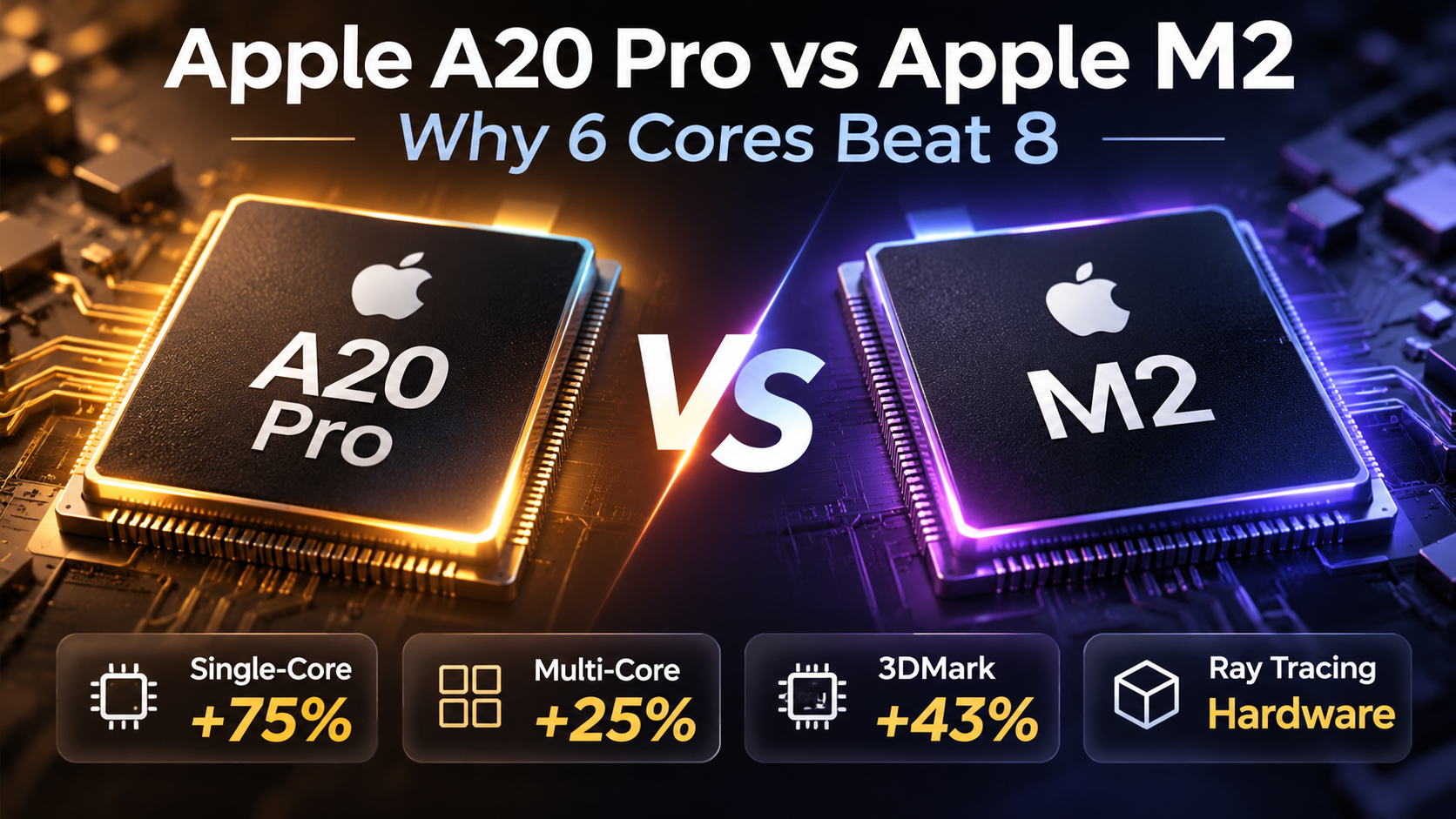
SoC Comparison Result
Apple A20 Pro vs. Apple M2 iPad: Why 6 Cores Are Faster Than 8
The Apple A20 Pro, released in September 2026, outperforms the eight-core Apple M2 iPad in Geekbench 6 despite having only six CPU cores. In the iPhone 18 Pro and iPad Pro 12.9, the difference reaches 75% in the single-threaded test and 25% in the multi-threaded test. The graphics results are even more interesting: the M2 has higher theoretical FP32 performance, but the A20 Pro is faster in 3DMark. The comparison shows how much Apple Silicon architecture has changed over four years.
Architecture and Key Differences
The M2 appeared in 2022 and was initially intended for Mac computers. It was later used in the iPad Pro and iPad Air. The A20 Pro was designed for the flagship iPhone 18 Pro and 18 Pro Max and is also used in the 2026 iPad mini.
| Specification | Apple A20 Pro | Apple M2 iPad |
|---|---|---|
| Release year | 2026 | 2022 |
| Process technology | TSMC 2 nm | TSMC 5 nm |
| CPU | 6 cores | 8 cores |
| Performance cores | 2 | 4 |
| Efficiency cores | 4 | 4 |
| Maximum CPU frequency | 4.93 GHz | 3.49 GHz |
| GPU | 7 cores | 9-10 cores |
| Calculated FP32 performance | 2.903 TFLOPS | 3.221-3.579 TFLOPS |
| Hardware ray tracing | Yes | No |
| Neural Engine | 32 cores | 16 cores |
The full six-core configuration is listed for the A20 Pro. The 128/256 GB iPad mini uses a version with five CPU cores and a 16-core Neural Engine, while the 512 GB model uses six CPU cores and two 16-core Neural Engine blocks. The M2 in the iPad Air has nine GPU cores, while the iPad Pro has ten. CPU frequencies and FP32 figures are based on test results and calculations rather than Apple’s official specifications.
The main change is the performance of an individual CPU core. The A20 Pro runs at up to 4.93 GHz, compared with approximately 3.49 GHz for the M2. That is a 41% difference, but the actual single-core performance gain is even larger thanks to architectural improvements.
The M2 has four performance cores versus two in the A20 Pro. However, the result depends not only on their number but also on the speed of each core, the efficiency of instruction execution, and workload distribution.
The transition from 5 nm to 2 nm allowed Apple to increase transistor density and redesign the CPU, GPU, and AI acceleration blocks. However, a smaller process node alone does not guarantee a proportional increase in performance.
Geekbench 6: Six Cores vs. Eight
Results from specific iPhone and iPad models confirm the A20 Pro’s advantage.
| Device | Processor | Single-Core | Multi-Core |
|---|---|---|---|
| iPhone 18 Pro | A20 Pro | 4 735 | 12 800 |
| iPhone 18 Pro Max | A20 Pro | 4 741 | 12 789 |
| iPad mini (2026, 512 GB) | A20 Pro | 4 651 | 12 602 |
| iPad Pro 12.9 (2022) | M2 | 2 702 | 10 213 |
| iPad Air 13 (2024) | M2 | 2 709 | 10 249 |
Comparing the iPhone 18 Pro with the iPad Pro 12.9, the A20 Pro’s advantage is:
- 75% in Single-Core - a substantial difference in single-core speed.
- 25% in Multi-Core - the A20 Pro is faster even with fewer CPU cores.
High single-threaded performance is especially useful for JavaScript, interface processing, and sequential calculations. The multi-threaded results show that the A20 Pro is also faster in workloads that can be efficiently distributed across multiple cores.
The M2 still provides sufficiently high performance for most iPadOS applications, including photo processing, video editing, and graphics work.
GPU: Fewer TFLOPS, but Higher Performance
The M2 GPU in the iPad Pro has ten cores and a theoretical performance of 3.579 TFLOPS. The seven-core A20 Pro GPU reaches 2.903 TFLOPS. Thus, the M2’s theoretical FP32 performance is approximately 23% higher.
However, FP32 reflects only the speed of performing certain arithmetic operations. It does not account for the efficiency of processing graphics commands, memory access, caching, or specialized hardware blocks.
The difference is shown by the 3DMark results.
| Test | iPhone 18 Pro Max (A20 Pro) | iPad Pro 12.9 (M2) |
|---|---|---|
| Steel Nomad Light | 3 768 | 2 639 |
| Solar Bay | 15 396 | 8 757 |
In Steel Nomad Light, the A20 Pro is approximately 43% faster. This test uses a demanding graphics workload without ray tracing, so its result is better suited for comparing conventional rendering.
In Solar Bay, the A20 Pro’s advantage reaches 76%. The architectural difference is important here: the new GPU supports hardware ray tracing, while the M2 performs the corresponding operations without specialized blocks. Therefore, the Solar Bay result should not be extrapolated to games without ray tracing.
Thus, the M2 GPU has greater theoretical FP32 performance but trails the A20 Pro in both tests. This points to the advantages of a more modern graphics architecture-advantages that cannot be evaluated using a single TFLOPS figure.
Memory and Artificial Intelligence
The M2 provides unified-memory bandwidth of up to 100 GB/s. iPad Pro tablets with this processor were released with 8 or 16 GB of RAM, depending on storage capacity. The M2 iPad Air was equipped with 8 GB of RAM.
The A20 Pro received an updated memory subsystem with bandwidth increased by 50% compared with the A19 Pro. This is important for graphics and workloads that frequently access RAM.
The Neural Engine has also changed. The full A20 Pro configuration has two 16-core blocks, for a total of 32 cores, while the M2 has 16. In addition, the A20 Pro has neural accelerators in its GPU cores.
These changes are intended to support local execution of AI models. However, the number of Neural Engine cores does not directly determine the speed of a specific model: the result depends on the supported operations and software optimization.
Sustained Workloads: Can the M2 Reduce the Gap?
Short Geekbench and 3DMark tests do not show how a processor behaves after half an hour of gaming or during a prolonged video export.
A tablet has more space for heat dissipation, but the M2 iPad Pro uses passive cooling. The A20 Pro in the iPhone 18 Pro and Pro Max operates with an updated vapor chamber that helps remove heat under heavy loads.
During prolonged operation, the frequencies of both processors may drop because of thermal limits. Therefore, it cannot be claimed that the M2 will necessarily reduce the gap or overtake the A20 Pro. Reaching that conclusion would require results from identical sustained workloads.
Conclusion
The A20 Pro outperforms the M2 iPad thanks to higher single-core CPU performance and a more modern graphics architecture. In Geekbench 6, its advantage reaches 75% in the single-threaded test and 25% in the multi-threaded test.
The graphics results are even more striking: the ten-core GPU in the M2 iPad Pro has 23% higher theoretical FP32 performance, but the A20 Pro is 43% faster in Steel Nomad Light and 76% faster in Solar Bay.
The M2 remains a powerful processor for iPadOS workloads, but the comparison shows how much the relationship between core count, theoretical computing performance, and real-world Apple Silicon speed has changed over four years.
Advantages
- Higher Technology: 2 nm (2 nm vs 5 nm)
- Newer Launch Date: September 2026 (September 2026 vs June 2022)
- Higher Frequency: 3500 MHz (4.93 GHz vs 3500 MHz)
Basic
4x 2.4 GHz – Blizzard
GPU Specifications
Connectivity
Memory Specifications
Miscellaneous
Benchmarks
Comparison of Devices
Related SoC Comparisons





Share in social media
Or Link To Us
<a href="https://cputronic.com/soc/compare/apple-a20-pro-vs-apple-m2-ipad" target="_blank">Apple A20 Pro vs Apple M2 iPad</a>