MediaTek Helio X30
MediaTek Helio X30: Why Ten Cores Failed to Outperform the Snapdragon 835
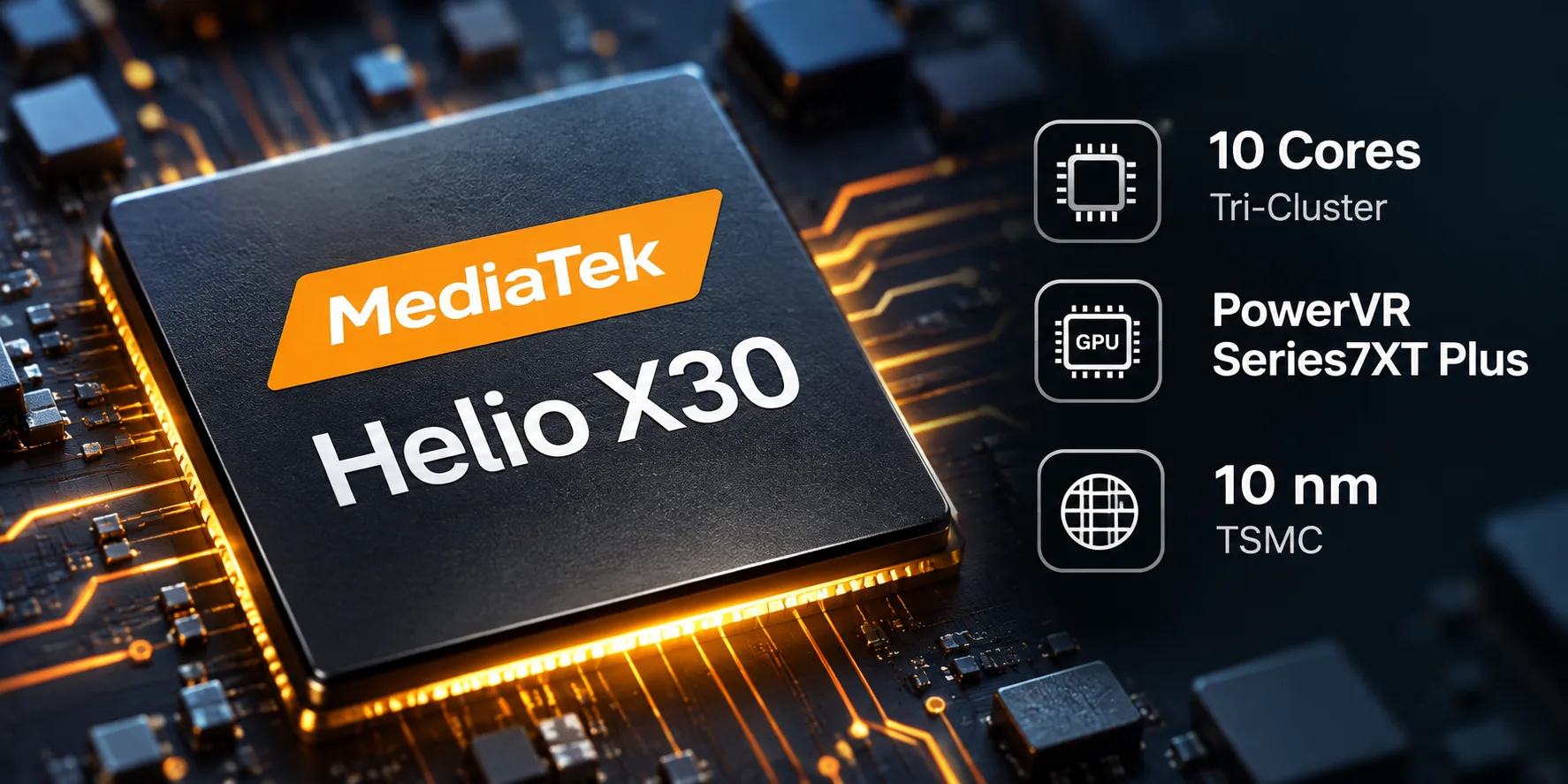
The MediaTek Helio X30 was released in 2017 as a competitor to the Snapdragon 835 and Kirin 970. The processor featured ten cores, TSMC’s 10 nm process technology, and a three-cluster architecture. However, it lagged behind its main competitors in testing, especially in graphics performance. As a result, the X30 appeared in only a few Meizu smartphones and became one of the last flagship chips in the Helio X family.
Specifications and Architecture
The Helio X30 (MT6799) uses three groups of processor cores:
- 2 Cortex-A73 cores clocked at up to 2.6 GHz for demanding workloads.
- 4 Cortex-A53 cores clocked at up to 2.2 GHz for everyday tasks.
- 4 Cortex-A35 cores clocked at up to 1.9 GHz for power efficiency.
CorePilot 4.0 manages workload distribution. The processor supports LPDDR4X RAM, UFS 2.1 storage, 4K video recording, and LTE Cat.10 with download speeds of up to 450 Mbps.
The PowerVR Series7XT Plus graphics accelerator operates at up to 800 MHz. Its performance proved closer to the Adreno 530 in the Snapdragon 821 than to the Adreno 540 in the Snapdragon 835. For a 2017 flagship smartphone, especially one with a high-resolution display, this was a significant drawback.
Benchmark Performance
Smartphone results in historical versions of AnTuTu 6 and Geekbench 4:
| Smartphone / processor | AnTuTu 6 | Geekbench 4 Single | Geekbench 4 Multi |
|---|---|---|---|
| Meizu Pro 7 Plus / Helio X30 | 114 927 | 1 415 | 5 417 |
| Xiaomi Mi Mix / Snapdragon 821 | 122 656 | 1 896 | 4 154 |
| LG V30+ / Snapdragon 835 | 175 633 | 1 925 | 6 347 |
| Huawei Mate 10 Pro / Kirin 970 | 177 720 | 1 894 | 6 737 |
The Snapdragon 835 outperforms the Helio X30 by approximately 53% in AnTuTu 6 and 17% in Geekbench 4 Multi. Even the older Snapdragon 821 achieves a better result in the single-core test, although it falls behind the X30 when multiple cores are used.
In the 3DMark Sling Shot Extreme ES 3.1 graphics test, the Meizu Pro 7 Plus scores 1826 points, compared with 2932 for the LG V30+ with the Snapdragon 835. The difference reaches 61% in Qualcomm’s favor.
Why the Helio X30 Failed to Gain Wider Adoption
The main smartphone based on the Helio X30 was the Meizu Pro 7 Plus, with a 5.7-inch AMOLED display and an additional screen on the rear panel. The processor was also used in the higher-end version of the Meizu Pro 7, while the lower-end configurations used the Helio P25.
The graphics deficit, strong competition from Qualcomm, and limited interest from manufacturers prevented the X30 from gaining wider adoption. At the end of 2017, MediaTek decided to temporarily stop developing flagship processors and focus on the mid-range segment.
Is It Worth Buying in 2026?
Today, smartphones with the Helio X30 make sense primarily as collectible devices. The processor may still provide enough performance for basic applications, but the outdated Android version, lack of current security updates, and graphics performance that is weak by modern standards make these smartphones impractical for everyday use.
SOC Comparison
Compare Helio X30 with other SOCs
Basic
4x 2.2 GHz – Cortex-A53
4x 1.9 GHz – Cortex-A35
GPU Specifications
Connectivity
Memory Specifications
Miscellaneous
Benchmarks
Compared to Other SoC
Related SoC Comparisons



Share in social media
Or Link To Us
<a href="https://cputronic.com/index.php/soc/mediatek-helio-x30" target="_blank">MediaTek Helio X30</a>