Samsung Exynos 9820
vs
MediaTek Helio G99
SoC Comparison Result
Samsung Exynos 9820 vs. MediaTek Helio G99: Why the Older Flagship Chip Is Faster
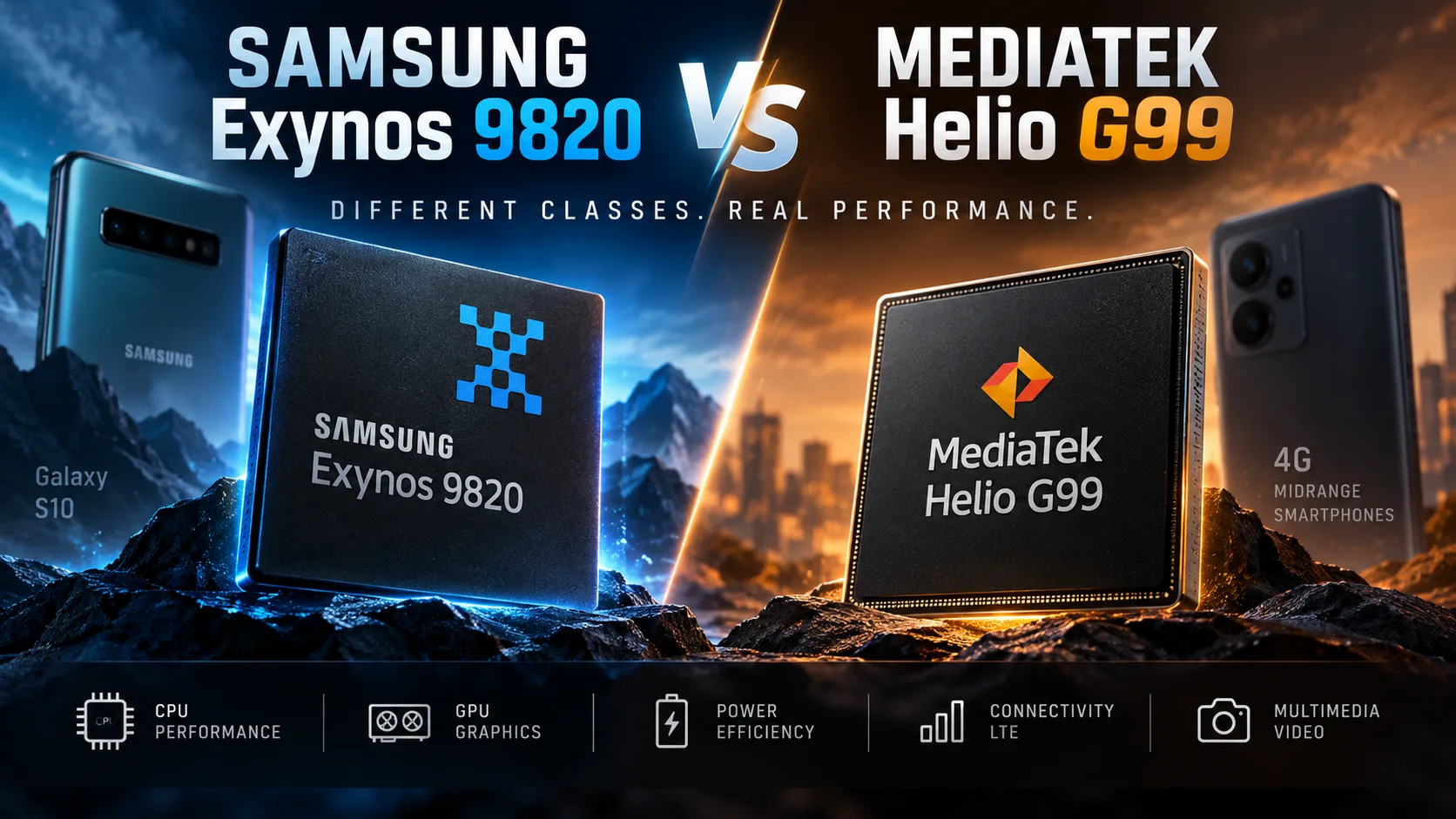
The Samsung Exynos 9820 was released in 2018, while the MediaTek Helio G99 arrived in 2022. But age is misleading here: the Exynos was designed for the flagship Galaxy S10 series, whereas the Helio G99 was built for budget 4G smartphones. That is why Samsung’s older chip remains faster, especially in graphics, while MediaTek’s advantages are its more modern 6-nm process and lower cooling requirements.
Key Differences
| Parameter | Samsung Exynos 9820 | MediaTek Helio G99 |
|---|---|---|
| Class | Flagship | Mid-range |
| Announcement year | 2018 | 2022 |
| CPU | 2x Mongoose M4 + 2x Cortex-A75 + 4x Cortex-A55 | 2x Cortex-A76 + 6x Cortex-A55 |
| Maximum clock speed | 2.73 GHz | 2.2 GHz |
| GPU | Mali-G76 MP12 | Mali-G57 MC2 |
| Process technology | Samsung 8 nm | TSMC 6 nm |
| Memory | LPDDR4X | LPDDR4X |
| Storage | Up to UFS 3.0 | UFS 2.2 |
| Integrated modem | LTE Cat.20 | LTE Cat.13 |
| Positioning | Flagship smartphones | Budget 4G smartphones |
The performance difference is determined by the CPU and, especially, GPU configurations-not clock speeds alone. The Exynos 9820 features two large Samsung Mongoose M4 cores, two Cortex-A75 cores, and a Mali-G76 MP12. The Helio G99 has two Cortex-A76 cores and a Mali-G57 MC2 with far fewer computing resources.
CPU Performance
In the single-core Geekbench 6 test, Galaxy S10 smartphones with the Exynos 9820 score approximately 986-1017 points. Devices powered by the Helio G99 typically score around 714-745 points.
The Exynos advantage is particularly important in applications and web-based tasks that are sensitive to single-core speed.
The Exynos also leads in multi-core performance. The Galaxy S10 scores up to 2961 points, while the Samsung Galaxy A24 4G, Motorola Moto G72, and Infinix Note 30 score approximately 1900-2025 points.
The Helio G99 is slower, but its 6-nm process and simpler CPU reduce cooling requirements.
Real-World Smartphones in Benchmarks
Tests of real smartphones show the gap more clearly than a list of specifications.
| Smartphone | Chip | Geekbench 6 Single | Geekbench 6 Multi | AnTuTu 11 | 3DMark Wild Life Extreme |
|---|---|---|---|---|---|
| Samsung Galaxy S10+ | Exynos 9820 | 1017 | 2593 | 782239 | 952 |
| Samsung Galaxy S10 | Exynos 9820 | 986 | 2961 | 747257 | 949 |
| Motorola Moto G72 | Helio G99 | 730 | 2013 | 562829 | 347 |
| Infinix Note 30 | Helio G99 | 745 | 2025 | 554635 | 348 |
| Samsung Galaxy A24 4G | Helio G99 | 714 | 1906 | 528070 | 344 |
Results depend on the firmware, temperature, memory capacity, and condition of the specific device. With older Galaxy S10 models, the condition of the battery and the smartphone itself may also affect the scores.
Even accounting for variation between devices, the Exynos 9820 remains ahead in CPU tests and AnTuTu 11.
GPU: The Exynos 9820’s Main Advantage
The Mali-G76 MP12 in the Exynos 9820 is significantly more powerful than the Mali-G57 MC2 in the Helio G99.
In 3DMark Wild Life Extreme, the Galaxy S10 and S10+ score around 950 points. Devices powered by the Helio G99 score approximately 344-348 points. The Exynos advantage in this test reaches roughly 2.7 times.
The gap is comparable in Steel Nomad Light: the Galaxy S10+ scores around 367 points, while the Galaxy A24 4G and Moto G72 are approximately level at 132-133 points.
In games, the GPU advantage allows the Exynos 9820 to use higher settings or deliver more FPS. The downside of the older platform is heat: under sustained load, the Galaxy S10 noticeably reduces its clock speeds.
Smartphones with the Helio G99 often show around 97-99% stability in graphics stress tests, while older Galaxy S10 models can drop to approximately 81-82%. However, stability depends not only on the SoC but also on the chassis, cooling system, firmware, and condition of the smartphone.
Why 6 nm Did Not Make the Helio G99 Faster
The Helio G99’s 6-nm process reduces power consumption, but it does not make the chip faster by itself. The Exynos 9820 was designed as a flagship SoC and received more powerful CPU and GPU components.
The Helio G99 targets a different segment-budget 4G smartphones, where moderate power consumption and platform cost are more important.
Connectivity and Multimedia
The Exynos 9820 features an integrated LTE Cat.20 modem. 5G support in the Galaxy S10 5G is implemented through a separate modem, so the Exynos 9820 itself cannot be considered a 5G SoC.
The Helio G99 uses LTE Cat.13 and also does not support 5G.
The Exynos 9820 is significantly stronger in video capabilities: its hardware video block is designed to decode and encode video at up to 8K 30 FPS and 4K 150 FPS. The Helio G99’s video codec capabilities are more limited.
Conclusion
Age and process technology are secondary here: the Exynos 9820 and Helio G99 belong to different classes from the outset.
The Exynos 9820 is older, but it is faster in single-core and multi-core CPU tests, scores higher in AnTuTu, and is approximately 2.7 times more powerful in 3DMark Wild Life Extreme. Its advantage is especially large in graphics.
The Helio G99 is slower, but more power-efficient and used in much newer smartphones. These chips are not equal in performance: the Helio G99 belongs to a different class and price category.
Advantages
- Higher Frequency: 2730 MHz (2730 MHz vs 2200 MHz)
- Higher Technology: 6 nm (8 nm vs 6 nm)
- Newer Launch Date: May 2022 (November 2018 vs May 2022)
Basic
2x 2.31 GHz – Cortex-A75
4x 1.95 GHz – Cortex-A55
GPU Specifications
Connectivity
Memory Specifications
Miscellaneous
Benchmarks
Comparison of Devices
Related SoC Comparisons




Share in social media
Or Link To Us
<a href="https://cputronic.com/index.php/soc/compare/samsung-exynos-9820-vs-mediatek-helio-g99" target="_blank">Samsung Exynos 9820 vs MediaTek Helio G99</a>