Qualcomm Snapdragon 8 Gen 4
vs
Qualcomm Snapdragon 8s Gen 3

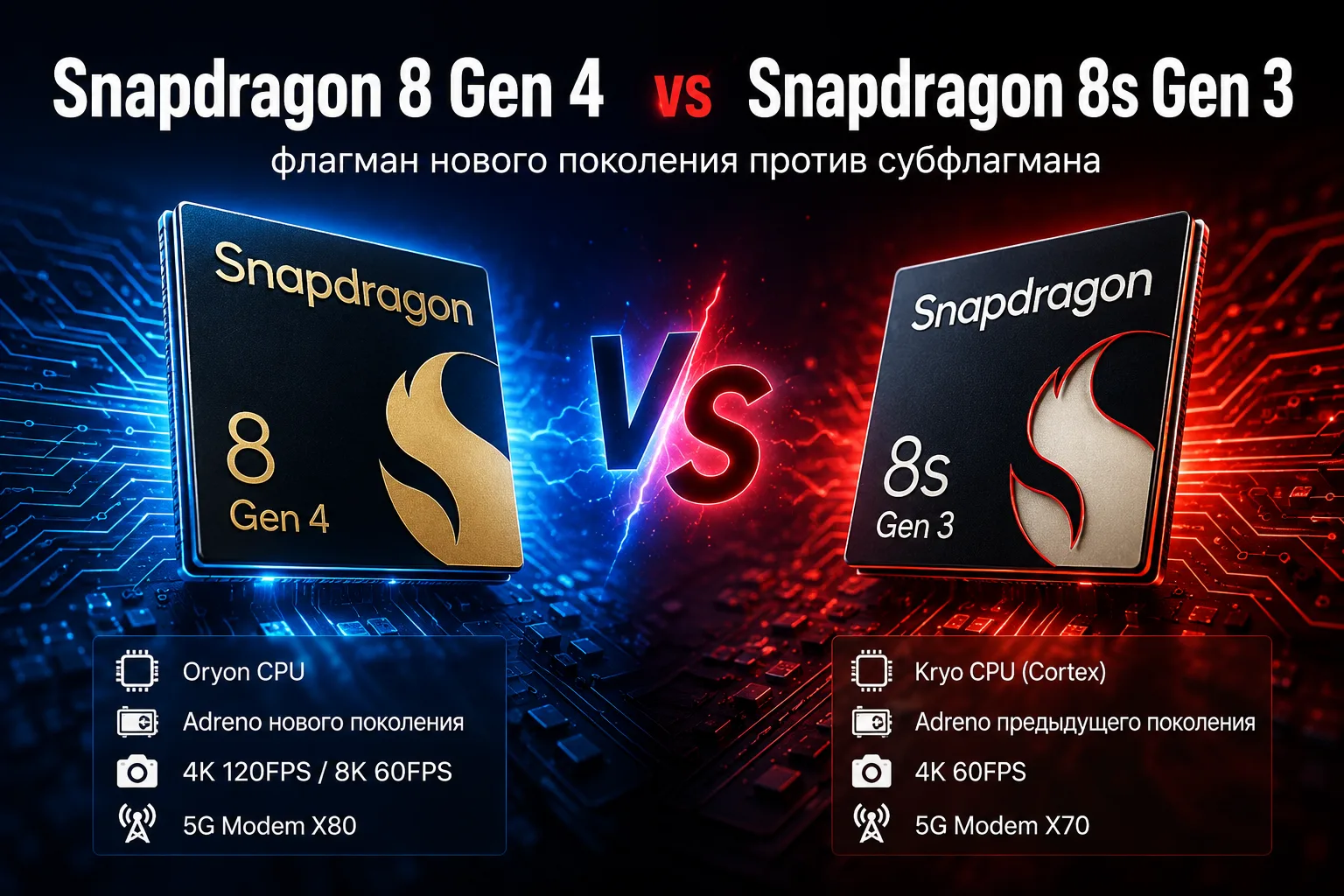
SoC Comparison Result
Qualcomm Snapdragon 8 Gen 4 vs Snapdragon 8s Gen 3: How Much Faster is the Flagship
Snapdragon 8 Elite, originally known as Snapdragon 8 Gen 4, is almost twice as fast as Snapdragon 8s Gen 3 in multi-threaded tasks and noticeably more powerful in gaming. However, the lower-end processor makes sense for smartphones that are significantly cheaper.
Qualcomm has released the higher-end platform under the official name Snapdragon 8 Elite, which will be used henceforth. This is the first mobile Snapdragon with its own Oryon cores, whereas Snapdragon 8s Gen 3 is built on off-the-shelf Arm cores and occupies an intermediate position between the upper mid-range and full-fledged flagships.
Key Differences
| Characteristic | Snapdragon 8 Gen 4 / 8 Elite | Snapdragon 8s Gen 3 |
|---|---|---|
| Positioning | High-end flagship | Sub-flagship |
| Process Technology | 3 nm | 4 nm |
| CPU Architecture | Qualcomm Oryon | Arm Cortex branded as Kryo |
| CPU Configuration | 2 Prime + 6 Performance | 1× Cortex-X4, 4× Cortex-A720, 3× Cortex-A520 |
| Max Clock Speed | Up to 4.32 GHz | Up to 3.0 GHz |
| Graphics | Next-generation Adreno | Previous-generation Adreno |
| Ray Tracing | Yes, including global illumination | Yes |
| Max Video Recording | 4K at 120 FPS | 4K at 60 FPS |
| Modem | Snapdragon X80 | Snapdragon X70 |
| RAM | LPDDR5X up to 5.3 GHz | LPDDR5X up to 4.2 GHz |
| Storage | UFS 4.0 | UFS 4.0 |
Snapdragon 8 Elite is Almost Twice as Fast in CPU
The main difference is not only related to clock speeds but also to architecture. Snapdragon 8 Elite uses Qualcomm's own Oryon cores: two Prime cores run at speeds of up to 4.32 GHz, while six performance cores operate at up to 3.53 GHz. There is no separate cluster of small energy-efficient cores in the main octa-core version.
Snapdragon 8s Gen 3 features a more traditional configuration: one Cortex-X4 core running up to 3.0 GHz, four Cortex-A720 cores up to 2.8 GHz, and three Cortex-A520 cores up to 2.0 GHz.
The gap is clearly visible when comparing actual smartphones:
| Geekbench 6 | OnePlus 13, Snapdragon 8 Elite | Poco F6, Snapdragon 8s Gen 3 |
|---|---|---|
| Single Core | 2873 | 1809 |
| All Cores | 8843 | 4630 |
In this pairing, Snapdragon 8 Elite is about 59% faster in single-core and 91% in multi-core performance.
The advantage is particularly notable in emulators, video processing, decompressing large archives, and applications that can keep all cores busy for extended periods. In browsers, social media, and regular interface tasks, the difference is much less noticeable.
These results pertain to specific smartphones, so absolute values depend on cooling and power limits. However, the overall gap between the platforms remains significant.
The Difference in Graphics is Even More Pronounced
Both processors support hardware ray tracing, Vulkan 1.3, and Snapdragon Game Super Resolution. However, the graphics processor on Snapdragon 8 Elite employs a newer architecture designed for significantly higher performance levels.
The higher platform supports ray tracing global illumination, Nanite in Unreal Engine 5.3, and Adreno Frame Motion Engine 2.1. Snapdragon 8s Gen 3 features Frame Motion Engine 2.0 and a less powerful GPU from the previous generation.
The difference can be seen in Geekbench 6 Vulkan:
| GPU Test | OnePlus 13 | Poco F6 |
|---|---|---|
| Geekbench 6 Vulkan | 23,785 | 9,962 |
In this pairing, the Snapdragon 8 Elite's score is approximately 139% higher, or nearly 2.4 times greater. The Vulkan test does not measure FPS in a specific game, but it effectively reflects the differences in the GPU's computational capabilities.
In most games capped at 60 FPS, the Snapdragon 8s Gen 3 still performs confidently. The advantages of Snapdragon 8 Elite become apparent at frame rates of 90-120 FPS, higher resolutions, demanding emulators, and maximum graphics settings.
The upper chip not only delivers more frames but also retains more headroom for future games.
Heat and Battery Life
Snapdragon 8 Elite is produced using a 3-nm process, while Snapdragon 8s Gen 3 is made using 4-nm technology. The more advanced manufacturing process improves efficiency, but the higher-end platform simultaneously features significantly more powerful CPUs and GPUs.
As such, a smartphone powered by Snapdragon 8 Elite may not necessarily run cooler. Under maximum load, it can consume more power, especially if the manufacturer has set high power limits.
Battery life is better compared across specific models. Battery capacity, display, cooling, and firmware settings often impact runtime more than the transition from 4 nm to 3 nm.
Cameras, AI, and Connectivity
Both platforms feature a triple 18-bit ISP, support local processing by neural networks, Wi-Fi 7, and UFS 4.0 storage.
Snapdragon 8s Gen 3 can work with generative models of up to 10 billion parameters. As a result, object removal, photo processing, speech recognition, and local assistants are available not only to flagship processors.
Snapdragon 8 Elite wins primarily in processing speed and video capabilities. It supports 4K recording at 120 FPS, while Snapdragon 8s Gen 3 is limited to 4K at 60 FPS. The implementation of these modes depends on the cameras, memory, cooling, and software of specific smartphones.
The modem Snapdragon X80 in the upper chip is more advanced than the X70 found in Snapdragon 8s Gen 3. However, for most users, this is a secondary advantage: actual connection speeds are more influenced by the operator, coverage, supported bands, and antenna design.
Is It Worth Paying Extra?
At the same or close price point, Snapdragon 8 Elite is definitely the more preferable option. It is significantly faster in demanding applications, roughly twice as powerful under full CPU load, and more than twice as fast as Snapdragon 8s Gen 3 in the Vulkan test discussed.
Snapdragon 8s Gen 3 is worth considering when the smartphone is significantly cheaper. It remains fast in everyday tasks, supports modern memory and connectivity standards, and confidently handles most Android games.
There’s little sense in paying extra for Snapdragon 8 Elite for browsing, social media, or interface smoothness. Its advantages are revealed in high frame rate gaming, emulation, video editing, and other long-term loads.
Advantages
- Higher Technology: 3 nm (3 nm vs 4 nm)
- Higher Frequency: 4000 MHz (4000 MHz vs 3000 MHz)
- Newer Launch Date: October 2024 (October 2024 vs March 2024)
Basic
6x 0 GHz – Cortex-A730
4x 2.8 GHz – Cortex-A720
3x 2.0 GHz – Cortex-A520
GPU Specifications
Connectivity
Memory Specifications
Miscellaneous
Benchmarks
Related SoC Comparisons



Share in social media
Or Link To Us
<a href="https://cputronic.com/index.php/soc/compare/qualcomm-snapdragon-8-gen-4-vs-qualcomm-snapdragon-8s-gen-3" target="_blank">Qualcomm Snapdragon 8 Gen 4 vs Qualcomm Snapdragon 8s Gen 3</a>