Qualcomm Snapdragon 8 Elite
vs
Qualcomm Snapdragon 8 Elite Gen 5

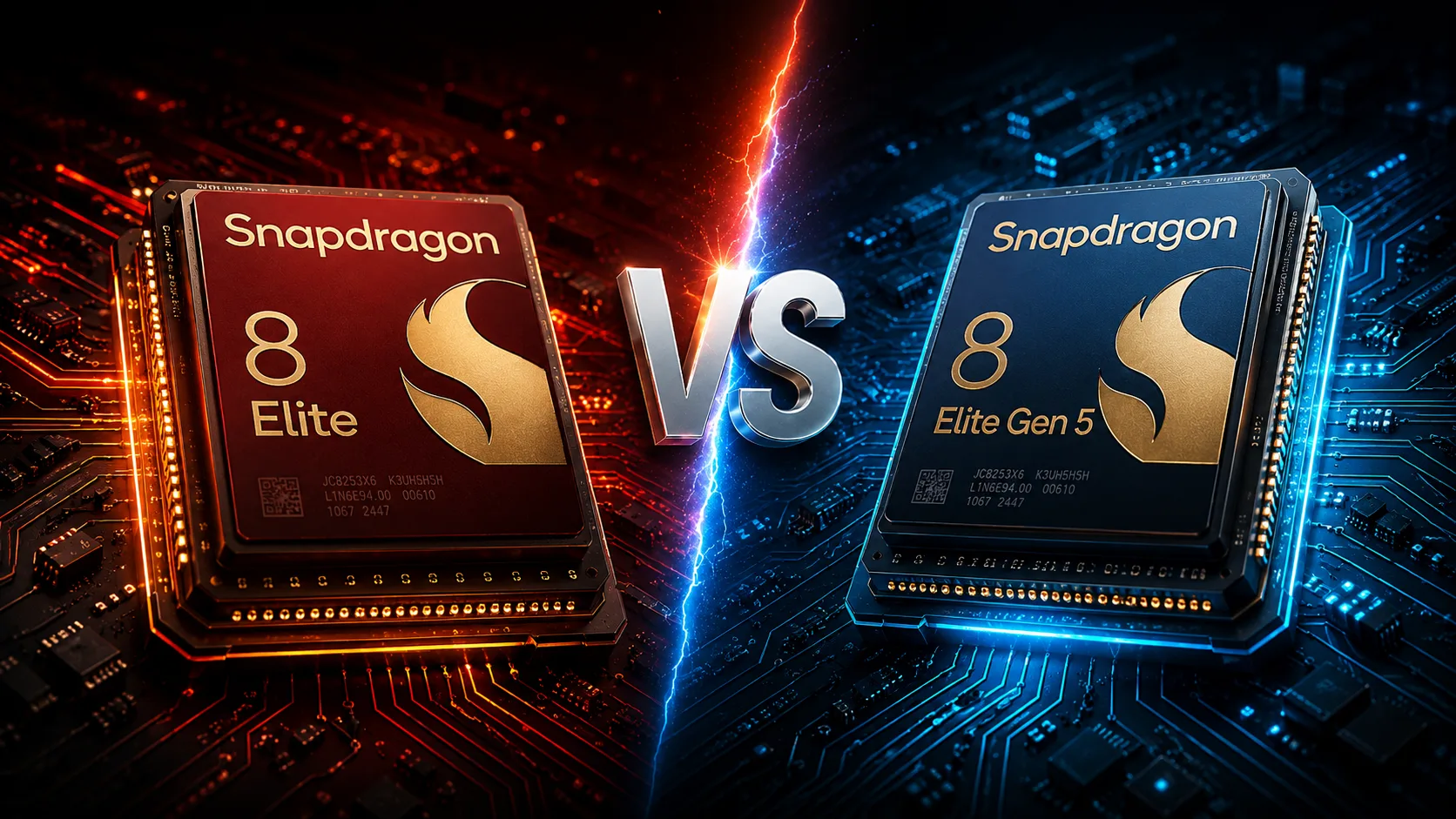
SoC Comparison Result
Snapdragon 8 Elite vs Snapdragon 8 Elite Gen 5: What Has Changed and Which Processor Should You Choose
Snapdragon 8 Elite and Snapdragon 8 Elite Gen 5 are two flagship mobile processors from Qualcomm for Android smartphones. While they have similar names, the difference between them is significant: Gen 5 features newer Oryon cores, higher clock speeds, faster graphics, an enhanced NPU, a modern modem, and improved image processing.
The main question for buyers is simple: is it worth paying extra for a smartphone with Snapdragon 8 Elite Gen 5, or is the Snapdragon 8 Elite still good enough? The short answer is: Gen 5 is better in almost every way, but the regular Snapdragon 8 Elite is not outdated and remains a very strong choice at a good price.
Brief Overview of the Main Differences
Snapdragon 8 Elite Gen 5 is not just a rebranding of the older chip. It has received a 3rd generation Oryon CPU, a higher clock ceiling, a new X85 modem, a 20-bit ISP, and an enhanced Hexagon NPU. Snapdragon 8 Elite uses a 2nd generation Oryon CPU, an X80 modem, and an 18-bit ISP.
Both processors fall into the true flagship category. In everyday tasks like browsing, messaging, YouTube, maps, and social networks, the difference between them will be small. It becomes apparent in gaming, emulation, video editing, local AI features, prolonged loads, and smartphones with good cooling.
| Parameter | Snapdragon 8 Elite | Snapdragon 8 Elite Gen 5 |
|---|---|---|
| Class | flagship SoC | new flagship SoC |
| CPU | Qualcomm Oryon 2nd generation | Qualcomm Oryon 3rd generation |
| Maximum Frequency | up to 4.47 GHz | up to 4.74 GHz |
| Alternative Versions | up to 4.32 GHz | up to 4.6 GHz |
| Process Technology | 3 nm | 3 nm |
| GPU | flagship-level Adreno | faster and more efficient Adreno |
| NPU | Hexagon NPU | faster Hexagon NPU |
| Modem | Snapdragon X80 5G | Qualcomm X85 5G |
| ISP | Qualcomm Spectra, 18-bit | Qualcomm Spectra, 20-bit |
| Main Advantage | good flagship at reduced price | better future-proofing |
What has actually changed in Snapdragon 8 Elite Gen 5
The main improvements in Gen 5 affect not just one specification but the whole platform. Qualcomm has strengthened the CPU, graphics, AI unit, image processing, and connectivity. Hence, Snapdragon 8 Elite Gen 5 is interesting not just as a faster chip but as a more modern foundation for next-generation flagships.
| Component | Main change in Snapdragon 8 Elite Gen 5 |
|---|---|
| CPU | Oryon 3rd generation and higher clock speeds |
| GPU | higher performance and better energy efficiency |
| NPU | faster for local AI tasks |
| ISP | 20-bit image processing instead of 18-bit |
| Modem | X85 instead of X80 |
| Video | more capabilities for advanced shooting |
| Future-proofing | better for gaming, AI, and long-term use |
It's important not to overrate the dry numbers. Maximum frequency and claimed percentage increases are not always fully apparent in a real smartphone. Overall speed depends on cooling, casing, firmware, power limits, and manufacturer settings.
CPU Performance
Snapdragon 8 Elite was already a significant leap for Qualcomm. The move to custom Oryon cores provided a noticeable boost in CPU performance compared to previous Snapdragon models. This processor handles heavy applications, a browser with many tabs, photo editing, video editing, gaming, and multitasking without any issues.
Snapdragon 8 Elite Gen 5 has become faster thanks to the Oryon 3rd generation and higher maximum frequency. In its best version, it reaches 4.74 GHz, while Snapdragon 8 Elite is rated up to 4.47 GHz. However, both chips have versions with different frequencies, so when purchasing, it's better to look at the specifications of the specific smartphone rather than just the processor name.
In typical usage, the difference will be moderate. Opening applications, scrolling through the interface, and switching between messengers are already very fast on Snapdragon 8 Elite. The advantage of Gen 5 is more apparent in heavy tasks: video processing, generative functions, emulators, large games, and prolonged loads.
Gaming and Graphics
Both processors are excellent for gaming. Snapdragon 8 Elite runs modern Android games at high settings, performs well at high frame rates, and remains a strong choice for gaming smartphones. If the device has decent cooling, its power will last long into the future.
Snapdragon 8 Elite Gen 5 is more interesting for those purchasing a smartphone with a view to future proofing for several years. It has a faster graphics unit, higher energy efficiency, and better potential in demanding scenes. This is important for games with maximum settings, long sessions, ray tracing, and emulators.
However, there is a nuance: gaming results depend not only on the SoC. A smartphone with Snapdragon 8 Elite Gen 5 with a thin body and poor cooling may throttle faster. Conversely, a gaming device with Snapdragon 8 Elite with an extensive cooling system can maintain stable FPS for longer.
| Gaming Scenario | What to Choose |
|---|---|
| Casual Mobile Games | both processors are suitable |
| Maximum Graphics Settings | Snapdragon 8 Elite Gen 5 |
| Long Gaming Sessions | Gen 5, if cooling is adequate |
| Emulators | Snapdragon 8 Elite Gen 5 |
| Discounted Gaming Smartphone | Snapdragon 8 Elite may be more cost-effective |
AI and NPU
Both chips are designed for local AI tasks: photo processing, video enhancement, speech recognition, generative functions, assistant operations, and device personalization. However, Snapdragon 8 Elite Gen 5 places a greater emphasis on such scenarios.
The faster NPU can be beneficial for local speech transcription, generative photo editing, video enhancement, object removal, intelligent camera processing, and assistants that perform part of the tasks directly on the smartphone. As more such functions emerge in Android flagships, the importance of AI performance headroom will grow.
That said, it is not advisable to choose a smartphone solely based on the NPU. Having a powerful AI unit does not guarantee that the manufacturer will indeed add useful features to the firmware. One phone might have rich AI capabilities, while another with the same chip may have them barely noticeable. Therefore, Snapdragon 8 Elite Gen 5 is better regarded as a more forward-looking platform rather than a guarantee of immediately beneficial AI features.
Camera and Video
In cameras, the processor is important, but it does not determine everything. The sensor, optics, stabilization, processing algorithms, and firmware quality often have a stronger influence on the result than the name of the SoC. Therefore, a smartphone with Snapdragon 8 Elite may shoot better than one with Snapdragon 8 Elite Gen 5 if it has a superior camera module and better processing.
But from a technical perspective, Snapdragon 8 Elite Gen 5 gives manufacturers more capabilities. The main distinction is the transition from an 18-bit ISP to a 20-bit ISP. This can help with HDR, complex lighting, night shooting, skin, sky, shadow processing, and real-time video.
Gen 5 is particularly interesting for advanced video recording. If the manufacturer effectively implements the platform's capabilities, smartphones with this new chip can better handle HDR video, computational processing, and professional recording modes.
For the average user, the conclusion is straightforward: to evaluate camera quality, compare specific smartphones rather than just the processors. However, other things being equal, Snapdragon 8 Elite Gen 5 offers a more modern base for camera-focused phones.
Connectivity and Modem
Snapdragon 8 Elite uses the Snapdragon X80 5G modem, while Snapdragon 8 Elite Gen 5 has received the newer Qualcomm X85 5G. On paper, this is an advantage for Gen 5: the new modem is better prepared for modern 5G networks and further connectivity development.
In real life, the difference may not always be noticeable. Mobile internet speed is often limited by the operator, coverage, frequencies, tariffs, and network load. Therefore, X85 is more of a reserve for the future rather than a guaranteed daily difference.
For buyers, it is more important to verify other factors: does the specific smartphone support the required bands in your region, does it maintain a good network connection, and does it overheat during active 5G use.
In Which Smartphones Are They Found
Snapdragon 8 Elite is used in many flagships of 2025, including the Samsung Galaxy S25 series, OnePlus 13, Xiaomi 15, Honor Magic7 Pro, Asus ROG Phone 9 Pro, and other models.
Snapdragon 8 Elite Gen 5 is used in new next-generation flagships. Among known devices on this platform are the Samsung Galaxy S26, Galaxy S26+, and Galaxy S26 Ultra in versions with Snapdragon 8 Elite Gen 5 for Galaxy. It's worth noting that the same smartphone may be released with different processors depending on the country and version, so it's best to check the specific modification before buying.
Where Users Will Notice The Difference
In basic tasks, both processors will feel very fast. Snapdragon 8 Elite Gen 5 is not necessarily needed for quicker access to a messenger, but rather for heavier scenarios and a future cushion.
| Task | Will the difference be noticeable |
|---|---|
| Messengers, browser, YouTube | almost none |
| Android Interface | minimal |
| Photos in standard mode | depends on the smartphone |
| HDR Video and complex processing | Gen 5 may be better |
| Gaming at high settings | yes |
| Emulators | yes |
| Video Editing | yes |
| Local AI Functions | yes, if they are implemented |
| Prolonged Load | yes, but cooling is important |
| Usage for 3-4 years | Snapdragon 8 Elite Gen 5 is preferable |
What to Choose
Opt for Snapdragon 8 Elite Gen 5 if smartphone prices are similar, you want maximum performance headroom, often game, use the camera and video, are interested in local AI features, and plan to keep the phone for several years.
Consider Snapdragon 8 Elite if the smartphone with it is significantly cheaper. It is still a very powerful flagship processor that will suffice for most users. At a good price, with a high-quality display, decent battery, strong camera, and good cooling, such a smartphone could be more cost-effective than a pricier model on Gen 5.
| Purchase Scenario | Best Choice |
|---|---|
| Prices are nearly the same | Snapdragon 8 Elite Gen 5 |
| Need maximum future-proofing | Snapdragon 8 Elite Gen 5 |
| Want a powerful flagship for less | Snapdragon 8 Elite |
| Primary focus is on gaming and emulators | Snapdragon 8 Elite Gen 5 |
| Primary focus is on camera | compare specific smartphones |
| Need a phone for 1-2 years | Snapdragon 8 Elite will suffice |
| Need a phone for 3-4 years | Snapdragon 8 Elite Gen 5 is better |
| Stability under load is crucial | check tests of specific models |
Conclusion
Snapdragon 8 Elite Gen 5 is a faster, more modern, and forward-looking processor. It excels in CPU, graphics, local AI, image processing, and connectivity. If smartphones are similarly priced, it makes more sense to choose a model with Snapdragon 8 Elite Gen 5.
However, Snapdragon 8 Elite is not weak. It remains a flagship SoC with ample performance headroom. In everyday tasks, the difference between it and Gen 5 will be minimal, while in gaming and heavy applications, much depends on the specific smartphone's cooling.
The correct logic is simple: Snapdragon 8 Elite Gen 5 is for maximum power and longevity, while Snapdragon 8 Elite is for a cost-effective purchase of a flagship without extra overpaying.
Advantages
- Higher Frequency: 4600 MHz / 4740 MHz (4320 MHz vs 4600 MHz / 4740 MHz)
- Newer Launch Date: September 2025 (October 2024 vs September 2025)
Basic
GPU Specifications
Connectivity
Memory Specifications
Miscellaneous
Benchmarks
Comparison of Devices
Related SoC Comparisons




Share in social media
Or Link To Us
<a href="https://cputronic.com/index.php/soc/compare/qualcomm-snapdragon-8-elite-vs-qualcomm-snapdragon-8-elite-gen-5" target="_blank">Qualcomm Snapdragon 8 Elite vs Qualcomm Snapdragon 8 Elite Gen 5</a>