Qualcomm Snapdragon 6 Gen 1
vs
MediaTek Helio G100


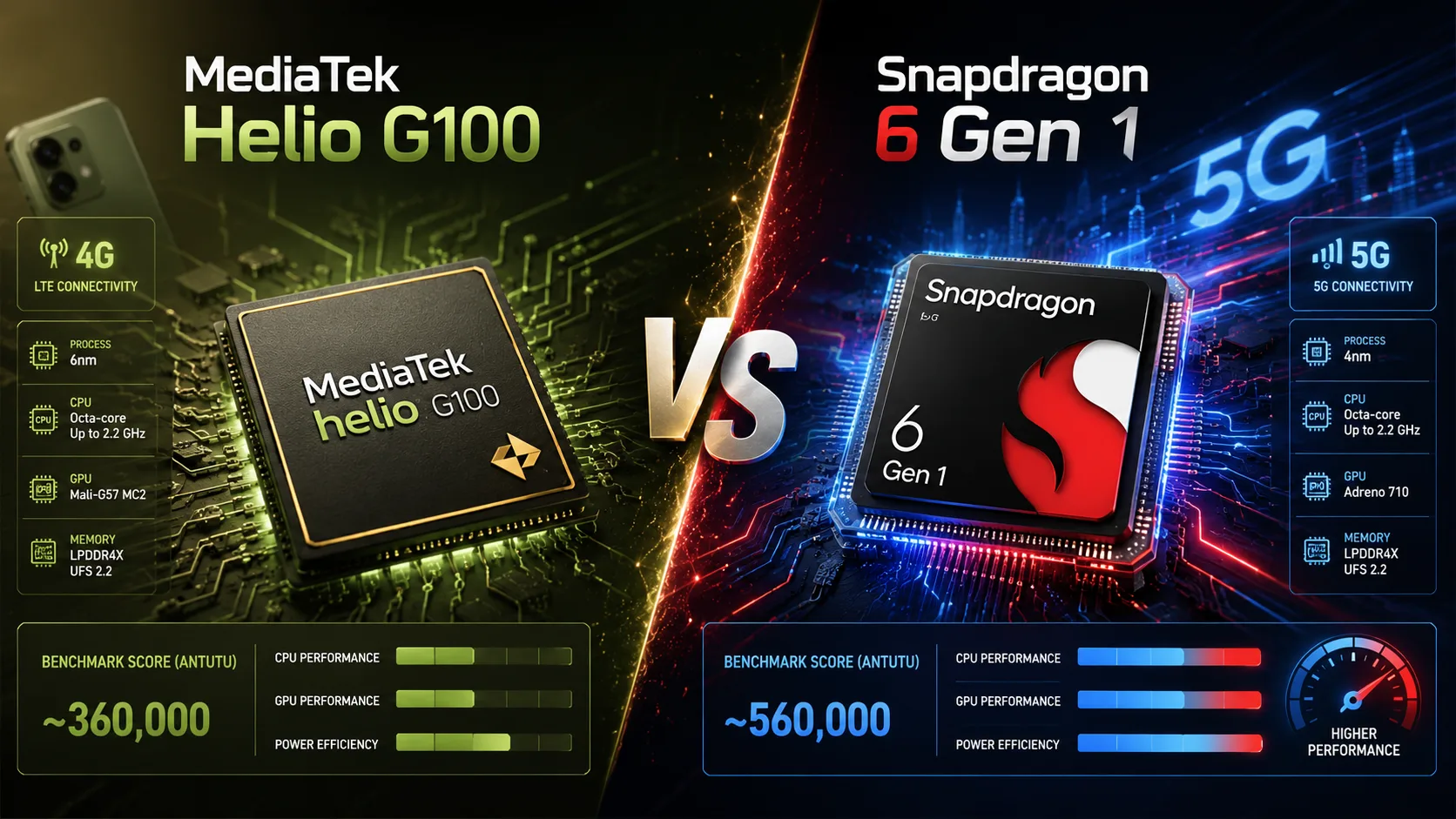
SoC Comparison Result
MediaTek Helio G100 vs Snapdragon 6 Gen 1: Two Years Newer but Noticeably Slower
The MediaTek Helio G100 was released nearly two years after the Snapdragon 6 Gen 1, but the newer launch date did not give it a performance edge. The Snapdragon features four Cortex-A78 cores, more powerful graphics, a 4nm manufacturing process, and a 5G modem. The Helio G100 still belongs to the budget 4G category and significantly lags behind its competitor in processor benchmarks and gaming.
Nevertheless, the Helio G100 is commonly found in affordable smartphones. It handles browsing, social media, video, and less demanding games without issues. The Snapdragon 6 Gen 1 is the better choice for those who need a faster CPU, considerably stronger graphics, and 5G support.
Key Differences
| Feature | MediaTek Helio G100 | Qualcomm Snapdragon 6 Gen 1 |
|---|---|---|
| Manufacturing Process | 6nm TSMC | 4nm |
| Performance Cores | 2x Cortex-A76 up to 2.2 GHz | 4x Cortex-A78 up to 2.2 GHz |
| Efficiency Cores | 6x Cortex-A55 up to 2.0 GHz | 4x Cortex-A55 up to 1.8 GHz |
| Graphics | Mali-G57 MC2 | Adreno 710 |
| Memory | LPDDR4X | up to LPDDR5 |
| Mobile Network | 4G LTE | 5G + 4G |
| Wi-Fi | Wi-Fi 5 | Wi-Fi 6E |
| Video Recording | up to 2K 30 FPS | up to 4K HDR 30 FPS |
| Cameras | up to 200 MP | up to 200 MP |
The Helio G100 has only two performance Cortex-A76 cores. In contrast, the Snapdragon 6 Gen 1 utilizes four newer Cortex-A78 cores. Both have a maximum frequency of 2.2 GHz, but the Snapdragon pulls ahead thanks to its newer architecture and four fast cores instead of two.
The Snapdragon 6 Gen 1 also boasts more capabilities in terms of memory, connectivity, and multimedia. It supports LPDDR5, Wi-Fi 6E, 5G, and 4K HDR video recording. The Helio G100 is limited to LPDDR4X, Wi-Fi 5, LTE, and video up to 2K at 30 frames per second.
Benchmarks in Real Smartphones
In practice, the difference is better illustrated by the results from specific smartphones. Memory, cooling, and manufacturer's settings influence the final scores.
The table uses results from five models. For AnTuTu, version 11 is specified, so these results should not be directly compared with AnTuTu 10 in the main CPUTronic comparison. Prices are provided as estimates for new devices based on available offers as of September 2026. Due to regional differences and shrinking stock, actual prices may vary significantly.
| Smartphone | Chip | AnTuTu 11 | Geekbench 6 Single | Geekbench 6 Multi | 3DMark Steel Nomad Light | Price, approx. |
|---|---|---|---|---|---|---|
| Infinix Hot 50 Pro Plus 4G | Helio G100 | 585,490 | 740 | 1,971 | 146 | $170-210 |
| Tecno Camon 30S | Helio G100 | 576,539 | 732 | 1,975 | 146 | $165-220 |
| Sony Xperia 10 VI | Snapdragon 6 Gen 1 | 712,424 | 948 | 2,882 | 200 | $300-430 |
| Vivo T3x 5G | Snapdragon 6 Gen 1 | 733,620 | 930 | 2,700 | 198 | $140-185 |
| Realme 12 Pro 5G | Snapdragon 6 Gen 1 | 812,803 | 866 | 2,494 | 199 | $350-430 |
Current offers illustrate the variance between markets. The Infinix Hot 50 Pro Plus is currently priced around $170-210, while the Tecno Camon 30S is approximately $165-220. Global offers for the Xperia 10 VI start at around $300, though many retailers maintain prices closer to $430.
The Vivo T3x is particularly interesting in this context. In India, versions with 4/128 and 8/128 GB were listed for around $140-170 at the current exchange rate, while Vivo's official store indicates a higher MRP. However, availability is unstable, so the quoted price should be seen as a guideline.
Among the selected smartphones, the Snapdragon 6 Gen 1 scores about 30% higher on average in AnTuTu 11. In Geekbench 6, the lead is around 24% in the single-core test and 36% in the multi-core test.
On CPUTronic, the ratio is roughly the same: 946 versus 718 points in Geekbench 6 Single-Core, and 2750 versus 2069 in Multi-Core. The Helio G100 falls short in both single-core and multi-core tests.
Price does not always align with performance. The Vivo T3x with Snapdragon 6 Gen 1 is cheaper in certain markets than some smartphones with Helio G100. Thus, paying a premium for Snapdragon is not always necessary. The Sony Xperia 10 VI and Realme 12 Pro are significantly more expensive, but buyers are paying not only for the processor but also for the display, cameras, build quality, and other features of the smartphone.
Gaming and Graphics
The Mali-G57 MC2 in the Helio G100 is the chip's weak point. It can handle less demanding games, but in heavier titles, settings must be lowered.
The Adreno 710 in the Snapdragon 6 Gen 1 is significantly faster. In 3DMark Sling Shot, the Tecno Camon 30S with Helio G100 scores around 3647 points, while the Motorola Moto G Stylus 5G (2024) with Snapdragon 6 Gen 1 scores about 5585. The difference exceeds 50%.
Steel Nomad Light confirms this gap: around 146 points for models on Helio G100 compared to roughly 198-200 for Snapdragon 6 Gen 1.
For demanding games, Snapdragon does not provide a substantial performance buffer but allows for a longer retention of acceptable frame rates at higher settings.
Connectivity and Multimedia
The Helio G100 supports only LTE with a claimed download speed of up to 650 Mbps. There is no 5G support for this platform.
The Snapdragon 6 Gen 1 features the Snapdragon X62 modem with 5G support and download speeds of up to 2.9 Gbps. It also includes Wi-Fi 6E and 4K HDR video recording.
When smartphones are similarly priced, the advantages of Snapdragon become particularly evident: buyers get faster CPUs, stronger GPUs, and 5G instead of LTE.
Which Processor is Better
The Snapdragon 6 Gen 1 is approximately one-third faster than the Helio G100 in processor tests and pulls even further ahead in graphics. Additionally, it offers 5G, LPDDR5, Wi-Fi 6E, and 4K HDR recording. Despite the earlier release date, this chip is a class above in terms of capabilities.
The prices of real smartphones make the situation for the Helio G100 even more challenging. Models featuring it can indeed be cheap, but the low price is no longer an advantage of the processor itself. The Vivo T3x demonstrates that a smartphone with Snapdragon 6 Gen 1 can also fit in a similar price range.
The Helio G100 should be considered if a specific smartphone featuring it is significantly cheaper than alternatives with Snapdragon or offers other compelling features. At comparable prices, Snapdragon 6 Gen 1 provides substantially more performance and additionally offers 5G.
Advantages
- Higher Technology: 4 nm (4 nm vs 6 nm)
- Newer Launch Date: August 2024 (September 2022 vs August 2024)
Basic
4x 1.8 GHz – Cortex-A55
GPU Specifications
Connectivity
Memory Specifications
Miscellaneous
Benchmarks
Comparison of Devices
Related SoC Comparisons




Share in social media
Or Link To Us
<a href="https://cputronic.com/index.php/soc/compare/qualcomm-snapdragon-6-gen-1-vs-mediatek-helio-g100" target="_blank">Qualcomm Snapdragon 6 Gen 1 vs MediaTek Helio G100</a>