MediaTek Helio G200
vs
MediaTek Dimensity 8300 Ultra
SoC Comparison Result
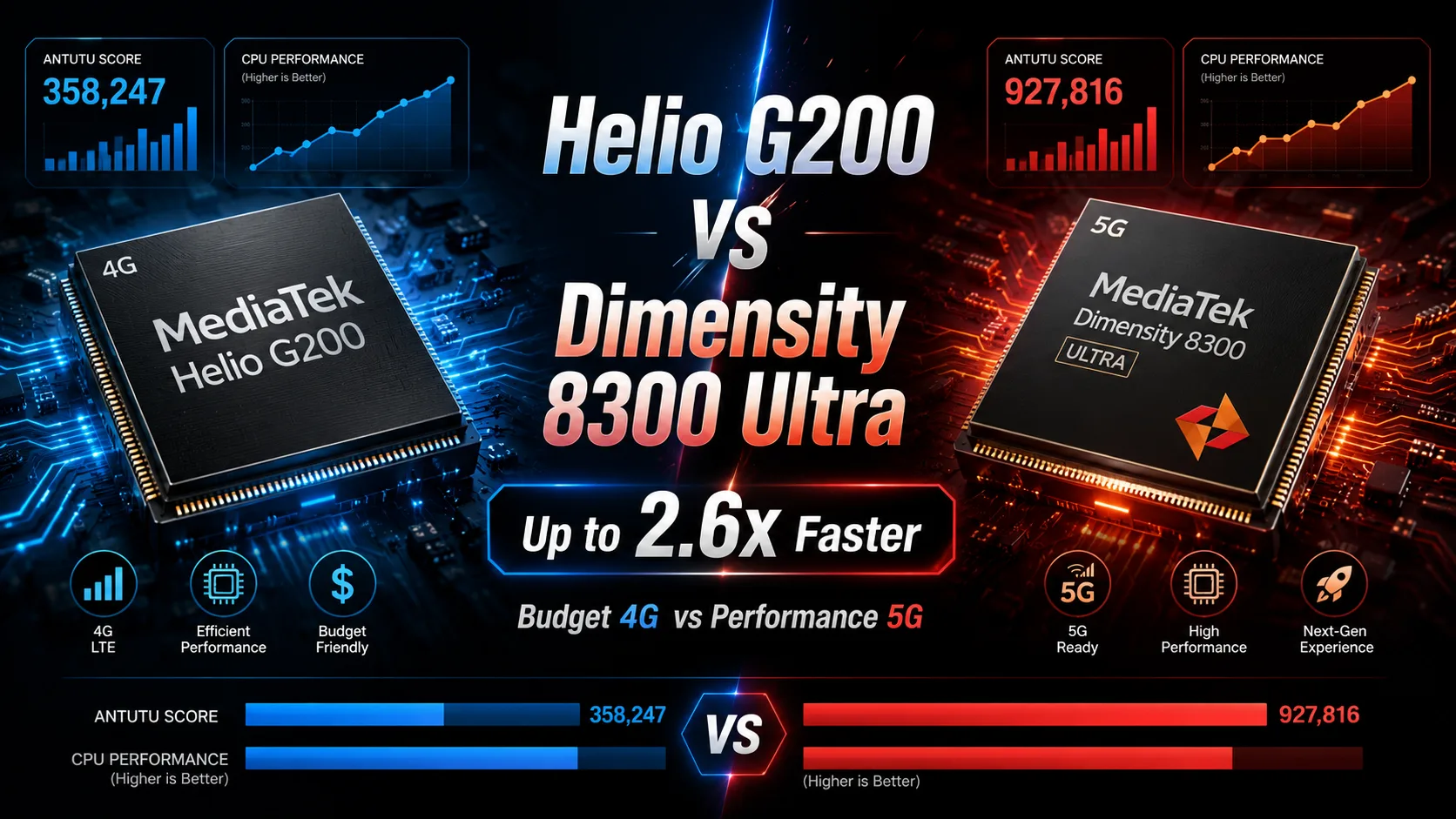
MediaTek Helio G200 vs Dimensity 8300 Ultra: Why the Difference Reaches 2.6 Times
MediaTek Helio G200 and Dimensity 8300 Ultra are separated by a whole class of devices. The Helio G200 is designed for budget 4G smartphones and retains practically the same CPU configuration as Helio G99 and G100. The Dimensity 8300 Ultra is a sub-flagship 5G platform with modern Armv9 cores, significantly more powerful graphics, support for UFS 4.0, and a dedicated neural processor.
On specific smartphones, the Dimensity 8300 Ultra proves to be approximately 1.7-1.9 times faster in single-core Geekbench 6 and 1.9-2.3 times faster in multi-core. In AnTuTu 11, the difference reaches about 2.6 times, while in Geekbench Vulkan, it is 3.2 times. These are not close competitors: Helio G200 is fighting for low cost, while Dimensity 8300 Ultra is fighting for performance.
Key Differences
| Specification | MediaTek Helio G200 | MediaTek Dimensity 8300 Ultra |
|---|---|---|
| Smartphone Class | Budget | Upper mid-range, sub-flagship |
| Process Technology | 6 nm | 4 nm |
| CPU Cores | 2 × Cortex-A76 up to 2.2 GHz + 6 × Cortex-A55 up to 2.0 GHz | 1 × Cortex-A715 up to 3.35 GHz + 3 × Cortex-A715 up to 3.2 GHz + 4 × Cortex-A510 up to 2.2 GHz |
| CPU Architecture | Armv8 | Armv9 |
| Graphics | Mali-G57 MC2 up to 1.1 GHz | Mali-G615 MC6 |
| RAM | LPDDR4X up to 4266 Mbps | LPDDR5X up to 8533 Mbps |
| Storage | UFS 2.2 | UFS 4.0 with MCQ |
| Mobile Network | 4G LTE Cat 13 | 5G up to 5.17 Gbps |
| Wi-Fi and Bluetooth | Wi-Fi 5, Bluetooth 5.2 | Wi-Fi 6E, Bluetooth 5.4 |
| Max Camera | 200 MP | 320 MP |
| Video Recording | Up to 2K at 30 fps | Up to 4K HDR |
| Display Support | Up to 2520 × 1080 at 120 Hz | FHD+ up to 180 Hz or WQHD+ up to 120 Hz |
| Neural Processor | No dedicated NPU claimed | MediaTek NPU 780 |
The Helio G200 is manufactured using a 6nm process and utilizes older Cortex-A76 and Cortex-A55 cores, Mali-G57 MC2 graphics, LPDDR4X memory, and UFS 2.2 storage. The Dimensity 8300 Ultra received four high-performance Cortex-A715 cores, Mali-G615 MC6 graphics, LPDDR5X memory, and UFS 4.0 storage.
Helio G200 - An Updated G100, Not a New Architecture
The name Helio G200 gives the impression of a significant update relative to G100. In reality, the CPU configuration has not changed: the same two Cortex-A76 cores clocked at up to 2.2 GHz and six Cortex-A55 cores clocked at up to 2.0 GHz. Support for LPDDR4X, UFS 2.2, Wi-Fi 5, Bluetooth 5.2, and the 4G Cat 13 modem has not changed either.
The main hardware change is the increase in the Mali-G57 MC2 frequency to 1.1 GHz. MediaTek has also added 12-bit DCG support for HDR video and improved connectivity performance in weak signal conditions. These are useful improvements, but the CPU architecture remains the same.
The Dimensity 8300 Ultra is structured differently. Its four Cortex-A715 cores are significantly more powerful than the pair of Cortex-A76, and the four Cortex-A510 cores outperform the older Cortex-A55. Additionally, the chip has a 4 MB L3 cache, an NPU 780, and much higher memory bandwidth.
Geekbench 6 on Specific Smartphones
| Processor and Smartphone | Geekbench 6, Single-Core | Geekbench 6, Multi-Core |
|---|---|---|
| Helio G200 - Tecno Spark 40 Pro+ | 723 | 1,855 |
| Helio G200 - Infinix Hot 60 Pro+ | 736 | 2,003 |
| Dimensity 8300 Ultra - Redmi K70E | 1,220 | 3,882 |
| Dimensity 8300 Ultra - Xiaomi 14T | 1,341 | 4,247 |
The table presents examples of individual runs from the Geekbench 6 database, rather than the nominal specifications of the processors. Results are influenced by the test version, firmware, smartphone temperature, background processes, and the selected power mode. Therefore, it is more accurate to assess a range rather than consider a single number as the absolute characteristic of a chip.
Smartphones with Helio G200 score about 720-740 points per core and 1850-2000 points across all cores. The Dimensity 8300 Ultra devices achieve 1220-1340 and 3880-4250 points, respectively.
The gap is particularly noticeable under multi-threaded loads. The Helio G200 has only two high-performance cores, while the Dimensity 8300 Ultra has four Cortex-A715 cores. This accelerates photo processing, file extraction, video editing, emulation, and the operation of multiple heavy applications.
AnTuTu 11: The Difference is Approximately 2.6 Times
The Infinix Hot 60 Pro+ with Helio G200 scores about 613,000 points in AnTuTu 11, while the POCO X6 Pro with Dimensity 8300 Ultra scores around 1.6 million. The advantage of Dimensity is about 2.6 times.
AnTuTu evaluates not only the CPU but also graphics, memory, and storage speed. Therefore, the gap here is larger than in Geekbench. The Helio G200 is limited to LPDDR4X and UFS 2.2, while smartphones with Dimensity 8300 Ultra can use LPDDR5X and UFS 4.0. This configuration is present, for example, in the POCO X6 Pro and Xiaomi 14T.
Graphics and Gaming
In Geekbench 6 Vulkan, the Tecno Spark 40 Pro+ with Mali-G57 MC2 scores 1504 points, while the POCO X6 Pro with Mali-G615 scores around 4764 points. On these devices, the graphics of Dimensity 8300 Ultra are approximately 3.2 times faster.
For Helio G200, a reasonable scenario includes undemanding online games, casual projects, and heavy games on low settings. The increased GPU frequency to 1.1 GHz helps relative to G100, but the two Mali-G57 graphics cores quickly reach their limits.
The Mali-G615 MC6 allows for higher settings in Genshin Impact, Honkai: Star Rail, and other demanding games. The Dimensity 8300 Ultra also supports hardware ray tracing and Variable Rate Shading, although the practical results depend on the game itself and the smartphone’s cooling system.
Memory, Connectivity, and Cameras
The difference between UFS 2.2 and UFS 4.0 is noticeable in app installation and launch, loading game assets, and processing large files. LPDDR5X provides higher bandwidth and accelerates data exchange between the CPU, GPU, and neural processor. The number of applications that stay in RAM primarily depends on the amount of RAM, firmware, and memory management settings.
Helio G200 is limited to 4G networks, Wi-Fi 5, and Bluetooth 5.2. The Dimensity 8300 Ultra supports 5G with download speeds of up to 5.17 Gbps, Wi-Fi 6E, and Bluetooth 5.4.
Multimedia capabilities also differ. Helio G200 supports cameras up to 200 MP and video encoding up to 2K at 30 fps. The Dimensity 8300 Ultra is designed for sensors up to 320 MP, received a 14-bit HDR ISP (Imagiq 980), and can record 4K HDR video.
Conclusion
The MediaTek Dimensity 8300 Ultra is unequivocally faster than the Helio G200. It wins by about twice in CPU performance, achieves three times the advantage in certain comprehensive and graphics tests, supports 5G, LPDDR5X, UFS 4.0, Wi-Fi 6E, and more serious cameras.
- The Helio G200 is worth considering when you need an inexpensive 4G smartphone for communication, video, social media, and simple games. Its performance is sufficient for basic tasks, but there is no significant headroom.
- The Dimensity 8300 Ultra is necessary when heavy gaming, multitasking, fast memory, 4K recording, and a performance reserve for several years are important.
The Helio G200 does not fall short due to being unsuccessful. It remains an evolution of an old budget platform, while the Dimensity 8300 Ultra is built on a significantly more modern foundation.
Advantages
- Newer Launch Date: May 2025 (May 2025 vs November 2023)
- Higher Technology: 4 nm (6 nm vs 4 nm)
- Higher Frequency: 3350 MHz (2200 MHz vs 3350 MHz)
Basic
GPU Specifications
Connectivity
Memory Specifications
Miscellaneous
- AIFF
- CAF
- MP3
- MP4
- WAV
- H.265
- VP9
Benchmarks
Comparison of Devices
Related SoC Comparisons



Share in social media
Or Link To Us
<a href="https://cputronic.com/index.php/soc/compare/mediatek-helio-g200-vs-mediatek-dimensity-8300-ultra" target="_blank">MediaTek Helio G200 vs MediaTek Dimensity 8300 Ultra</a>