MediaTek Helio G200
vs
MediaTek Dimensity 7100
SoC Comparison Result
MediaTek Helio G200 vs Dimensity 7100: Why Dimensity is Faster Not Just Because of 5G
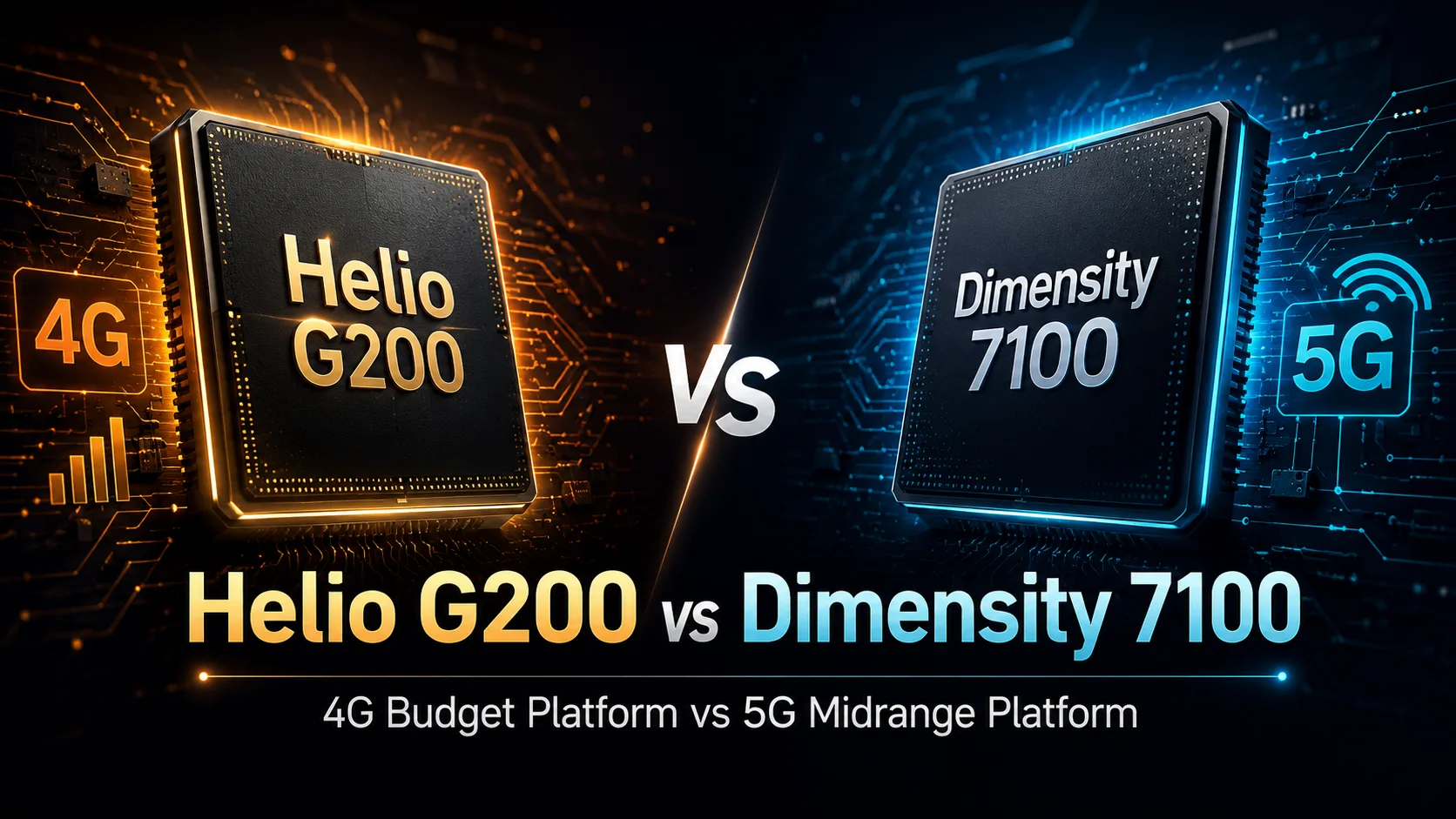
Helio G200 and Dimensity 7100 may be found in smartphones of similar price ranges, but technically they belong to different classes. Helio G200 is a new 4G platform for budget devices, utilizing a familiar combination of Cortex-A76 and Mali-G57. Dimensity 7100 is a step up: it features four Cortex-A78 cores, a Mali-G610 GPU, support for LPDDR5, UFS 3.1 storage, and 5G connectivity.
The question isn't which chip is faster: the Dimensity 7100 is significantly more powerful. The more important question is how much cheaper a smartphone with Helio G200 should be to make the purchase worthwhile.
Short Conclusion
Dimensity 7100 outperforms Helio G200 in key components of the platform: CPU, graphics, connectivity, memory, storage, and wireless interfaces. The only argument for Helio G200 is its lower price. While it also boasts a 6nm process, support for 120Hz displays, and cameras up to 200MP, the chip remains an evolution of the budget 4G lineup.
The main problem with Helio G200 is not its performance but its positioning: sometimes smartphones with this chip are marketed as gaming or mid-range devices. In practice, it's a platform for cheap 4G smartphones, not a replacement for Dimensity 7100.
At a similar price point, it's better to choose Dimensity 7100. Helio G200 makes sense only in significantly cheaper devices meant for messaging, video, browsing, navigation, and light gaming.
Key Differences
| Characteristic | Helio G200 | Dimensity 7100 |
|---|---|---|
| Class | Budget 4G Segment | Mid-range with 5G |
| CPU | 2× Cortex-A76 + 6× Cortex-A55 | 4× Cortex-A78 + 4× Cortex-A55 |
| GPU | Mali-G57 MC2 | Mali-G610 MC2 |
| Memory | LPDDR4X | LPDDR5 / LPDDR4X |
| Storage | UFS 2.2 | UFS 3.1 |
| Connectivity | 4G LTE | 5G |
| Wi-Fi | Wi-Fi 5 | Wi-Fi 6 |
| Bluetooth | 5.2 | 5.4 |
There are also some similarities: both chips are built on a 6nm process, support displays up to 120Hz, and cameras up to 200MP. But these don't level the chips. Dimensity 7100 wins not by just one specification but by several key components: CPU, GPU, memory, storage, and connectivity.
Processor: Two Cortex-A76 vs Four Cortex-A78
The main gap lies in the CPU. Helio G200 uses a 2+6 configuration: two performance-oriented Cortex-A76 cores and six energy-efficient Cortex-A55 cores. This is sufficient for messaging, browsing, and video, but quickly runs out of resources under heavy load.
Dimensity 7100 features a different configuration with four Cortex-A78 cores and four Cortex-A55 cores. It performs better in multitasking, handles heavy web pages, camera applications, photo processing, app installations, and background tasks more swiftly.
In real-world use, this translates to a faster response. A smartphone with Dimensity 7100 won't hit a CPU bottleneck as quickly. With Helio G200, the two performance cores can quickly reach their limits, especially when running a browser, camera, messaging apps, and updates simultaneously.
Graphics and Gaming
The graphics performance also favors Dimensity 7100. Helio G200 features a Mali-G57 MC2, whereas Dimensity 7100 boasts a Mali-G610 MC2. Neither of these GPUs belongs to the high-end gaming category, but the Mali-G610 is a newer and more powerful solution than the Mali-G57 MC2.
Helio G200 is suitable for light and medium gaming: Mobile Legends, Free Fire, and PUBG Mobile at moderate settings, as well as simple racing and casual games. For heavier titles like Genshin Impact, Honkai: Star Rail, or Warzone Mobile, you will need to lower the settings and accept frame drops.
Dimensity 7100 does not turn a smartphone into a gaming flagship, but it delivers more frames, a more stable FPS, and more resources for new game updates.
Benchmarks
Test results depend on the specific smartphone, cooling, memory, and firmware, so the numbers here should be taken as guidelines rather than exact performance figures. The general picture remains clear: Dimensity 7100 is significantly faster than Helio G200, especially under multi-core loads and in graphics performance.
| Test | Helio G200 | Dimensity 7100 | Difference |
|---|---|---|---|
| AnTuTu | around 570-620K | around 780-835K | Dimensity is about 30-40% higher |
| Geekbench 6 Single-Core | around 700-730 | around 990-1000 | Dimensity is about 35-40% higher |
| Geekbench 6 Multi-Core | around 1900-2000 | around 2850-2950 | Dimensity is about 45-50% higher |
| 3DMark | around 145-150 | around 270-280 | Dimensity is nearly twice as fast |
Helio G200 does not underperform for its class, but Dimensity 7100 is notably more advanced. The difference arises not merely from clock speeds but due to better CPU, GPU, memory, and storage configurations.
Memory and Storage
The distinction between LPDDR4X + UFS 2.2 and LPDDR5 + UFS 3.1 isn't always immediately apparent in specifications, but it becomes significant in real-world use. Memory and storage affect app launches, updates, camera performance, video recording, caching, and interface responsiveness.
Helio G200 with LPDDR4X and UFS 2.2 is fitting for an affordable smartphone. Dimensity 7100, using LPDDR5 and UFS 3.1, will take longer to hit speed limits on memory and storage, especially after a year or two when the device accumulates many apps, photos, caches, and background processes.
Camera and Display
Both chips support cameras up to 200MP and displays up to 120Hz, but this is more of a marketing parity than a true indication of capability. Support for 200MP merely indicates the upper limit of the platform, not the quality of photos taken. The final result depends on the sensor, optics, stabilization, and processing.
The situation is similar with displays. Both Helio G200 and Dimensity 7100 can support 120Hz. However, the more powerful chip can better maintain interface smoothness when scrolling through heavy pages, switching between apps, and handling camera tasks or games.
When Helio G200 Makes Sense
Helio G200 makes sense if the smartphone is significantly cheaper than a model with Dimensity 7100 and 5G is not required. It is suitable for calls, messaging, YouTube, browsing, navigation, banking apps, and light gaming.
It is a viable choice when price, battery, and screen are more important than maximum performance. In such scenarios, Helio G200 does not seem like a mistake: 6nm, 120Hz, UFS 2.2, and adequate speed for everyday tasks.
When to Opt for Dimensity 7100
Opt for Dimensity 7100 if the price difference is small and the smartphone is intended for several years of use. It has a stronger CPU, graphics, memory, storage, and connectivity, so it will lag less in normal tasks and gaming.
Conclusion
MediaTek Dimensity 7100 is a significantly stronger chip. It is faster in CPU tasks, better in graphics, supports 5G, and works with faster memory and storage. This makes it a better foundation for mid-range smartphones.
MediaTek Helio G200 is not a competitor to Dimensity 7100 but a compromise for cheap 4G models. It is suited for simple tasks, video, browsing, messaging, and light gaming, but it will hit bottlenecks more quickly in CPU, graphics, and memory.
If the prices are close, the conclusion is simple: Dimensity 7100 is the better choice. Helio G200 should only be considered when the smartphone is significantly cheaper, and heavy gaming, 5G, and sustained performance are not anticipated.
Advantages
- Higher Frequency: 2400 MHz (2200 MHz vs 2400 MHz)
- Newer Launch Date: January 2026 (May 2025 vs January 2026)
Basic
4x 2 GHz – Cortex-A55
GPU Specifications
Connectivity
Memory Specifications
Miscellaneous
- AIFF
- CAF
- MP3
- MP4
- WAV
- FLAC
- HE-AACv1
- HE-AACv2
- MP3
- H.265
- VP9
- H.265
- VP9
Benchmarks
Comparison of Devices
Related SoC Comparisons



Share in social media
Or Link To Us
<a href="https://cputronic.com/index.php/soc/compare/mediatek-helio-g200-vs-mediatek-dimensity-7100" target="_blank">MediaTek Helio G200 vs MediaTek Dimensity 7100</a>