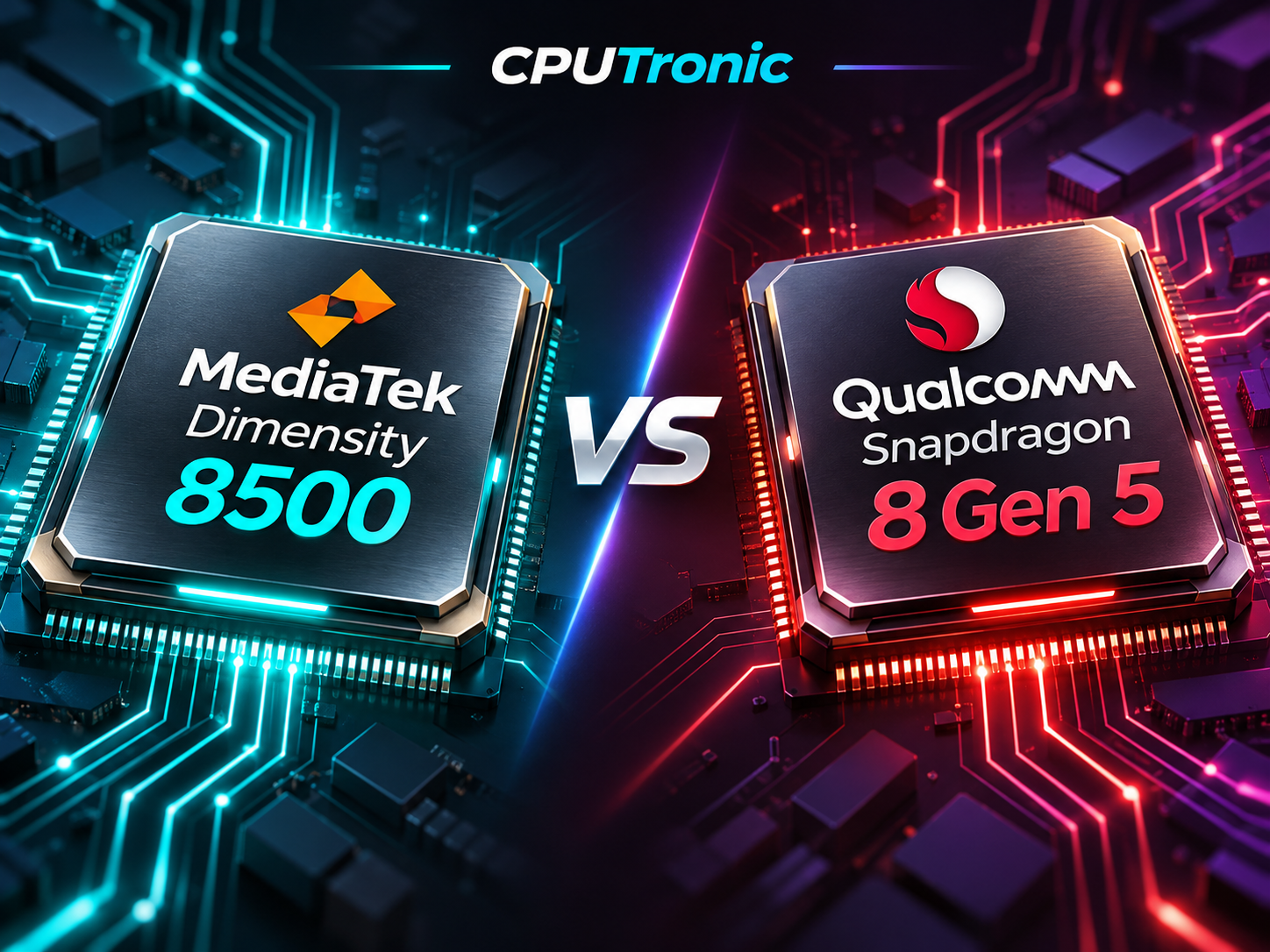
MediaTek Dimensity 8500
vs
Qualcomm Snapdragon 8 Gen 5

SoC Comparison Result
MediaTek Dimensity 8500 vs Snapdragon 8 Gen 5: CPU, Graphics Performance, and Capabilities Compared
The MediaTek Dimensity 8500 and Qualcomm Snapdragon 8 Gen 5 are designed for smartphones in different price categories. The Dimensity 8500 uses eight Cortex-A725 cores and Mali-G720 MC8 graphics, while the Snapdragon features Oryon cores and a more powerful Adreno GPU. In Geekbench 6, Qualcomm leads by 66% in the single-core test and 46% in the multi-core test. In 3DMark graphics tests, the difference ranges from 24% to 49%, depending on the smartphone and workload.
Key Specification Differences
| Specification | Dimensity 8500 | Snapdragon 8 Gen 5 |
|---|---|---|
| Announcement date | January 2026 | November 2025 |
| Process technology | TSMC 4 nm | TSMC 3 nm |
| CPU architecture | 8 × Cortex-A725 | 8 × Qualcomm Oryon |
| Core configuration | 1 × 3.4 + 3 × 3.2 + 4 × 2.2 GHz | 2 × 3.8 + 6 × 3.32 GHz |
| Graphics | Mali-G720 MC8 | Qualcomm Adreno |
| Wi-Fi | Wi-Fi 6E | Wi-Fi 7 |
| Bluetooth | 5.4 | 6.0 |
| Maximum 5G download speed | 5.17 Gb/s | 10 Gb/s |
| Video recording | 4K at 60 FPS | 4K at 120 FPS |
Both processors support LPDDR5X with data rates of up to 9600 Mb/s and UFS 4 storage. The main differences lie in CPU architecture, graphics performance, and wireless connectivity capabilities.
CPU Performance: Oryon Takes the Lead
The Dimensity 8500 uses eight Cortex-A725 cores divided into three frequency groups. The fastest core operates at up to 3.4 GHz, three additional cores reach up to 3.2 GHz, and the remaining four run at up to 2.2 GHz. This configuration does not include separate Cortex-A5xx efficiency cores.
The Snapdragon 8 Gen 5 features Qualcomm’s own Oryon cores: two Prime cores clocked at up to 3.8 GHz and six Performance cores reaching up to 3.32 GHz. The difference between the processors is related not only to clock speeds but also to their microarchitectural characteristics.
Geekbench 6 and AnTuTu 11 Results
| Benchmark | Dimensity 8500 | Snapdragon 8 Gen 5 | Snapdragon Advantage |
|---|---|---|---|
| Geekbench 6 Single-Core | 1,693 | 2,804 | +66% |
| Geekbench 6 Multi-Core | 6,897 | 10,057 | +46% |
| AnTuTu 11 | 2,120,347 | 3,057,215 | +44% |
The table shows approximate benchmark results rather than measurements from two smartphones tested under identical conditions. The AnTuTu scores specifically refer to version 11 and cannot be directly compared with AnTuTu 10.
The Snapdragon’s advantage is particularly noticeable in the Geekbench 6 single-core test. High single-core performance is useful when processing complex web pages, launching applications, and performing short computational tasks.
In the multi-core test, the gap narrows to 46%. Qualcomm’s additional performance can be useful when processing photos, exporting video, and performing other resource-intensive operations.
However, the interface and everyday applications will not become 46-66% faster. The Dimensity 8500 already provides sufficient performance for most everyday tasks.
Graphics Performance: Results from Specific Smartphones
The Dimensity 8500 features Mali-G720 MC8 graphics, while the Snapdragon 8 Gen 5 uses an Adreno GPU. Both GPUs support hardware-accelerated ray tracing, but Qualcomm delivers higher performance.
For comparison, consider the 3DMark results from specific smartphones.
| 3DMark Test | Dimensity 8500 - Smartphone and Score | Snapdragon 8 Gen 5 - Smartphone and Score |
|---|---|---|
| Solar Bay | Motorola Edge 70 Pro - 7,004 | Motorola Signature - 9,613 |
| Wild Life Extreme | Motorola Edge 70 Pro - 4,355 | Motorola Signature - 5,406 |
| Steel Nomad Light | Motorola Edge 70 Pro - 1,525 | Motorola Signature - 2,069 |
| Steel Nomad Light Unlimited | POCO X8 Pro - 1,283 | OnePlus 15R - 1,915 |
The table shows median results from user-run 3DMark tests. The Motorola Edge 70 Pro and POCO X8 Pro use Dimensity 8500 variants with the additional Extreme and Ultra designations.
In Solar Bay, which tests graphics performance with ray tracing, the Motorola Signature outperforms the Edge 70 Pro by 37%. The difference is 24% in Wild Life Extreme and 36% in Steel Nomad Light.
In Steel Nomad Light Unlimited, the OnePlus 15R scores 49% higher than the POCO X8 Pro.
These results demonstrate Adreno’s advantage, but they do not allow the entire difference to be attributed exclusively to the GPU. Clock speeds, power settings, cooling, and smartphone temperature all affect the results.
What This Means for Gaming
- Moderately demanding games. Both processors handle most games in this category without significant performance limitations.
- Demanding 3D games. The 3DMark results indicate an advantage for the Snapdragon 8 Gen 5, but they do not establish the specific FPS difference. Gaming tests at identical settings are required for that.
- Ray tracing. Both GPUs support the technology, but the Snapdragon achieves a higher result in Solar Bay.
- Extended gaming sessions. Performance may decrease after the device heats up. The extent of the reduction depends on the cooling system of the specific smartphone.
For a gaming smartphone, not only peak 3DMark scores matter, but also the results of extended tests under load.
Power Consumption and Heat
The Snapdragon 8 Gen 5 is manufactured using TSMC’s 3 nm process, while the Dimensity 8500 uses a 4 nm process. A smaller process node can increase transistor density and create conditions for improved energy efficiency, but it does not guarantee lower power consumption in the finished processor.
The core architectures also differ. Qualcomm uses Oryon, while MediaTek uses Cortex-A725. Their power consumption depends on clock speed, voltage, and workload characteristics.
Without direct power-consumption measurements under identical workloads, it is impossible to determine which chip is more energy-efficient. The Snapdragon’s higher benchmark results alone do not prove either higher or lower energy consumption.
Smartphone battery life also depends on the display, battery capacity, firmware, and power settings. Therefore, comparing device runtimes based solely on process technology is incorrect.
Connectivity, Cameras, and Artificial Intelligence
The Snapdragon 8 Gen 5 supports Wi-Fi 7, Bluetooth 6.0, and the Snapdragon X80 modem, with a theoretical 5G download speed of up to 10 Gb/s. The Dimensity 8500 supports Wi-Fi 6E, Bluetooth 5.4, and download speeds of up to 5.17 Gb/s.
In practice, the Qualcomm modem’s advantages depend on the capabilities of the mobile network and carrier. Both platforms provide sufficient bandwidth for ordinary web browsing, video calls, and streaming video.
For image processing, the Snapdragon offers a higher video-recording frame rate: up to 4K at 120 FPS versus 4K at 60 FPS on the Dimensity 8500. However, the actual recording modes are determined by the smartphone manufacturer. Even if the processor supports 4K at 120 FPS, the corresponding feature may not be available in the camera app.
MediaTek NPU 880 and Qualcomm Hexagon are used to accelerate artificial intelligence tasks. Both blocks are designed for local image processing, object recognition, and running neural-network models.
Their speed cannot be compared based on their names alone. Results from identical AI tests with comparable settings are required.
Which Processor Should You Choose?
The Dimensity 8500 is worth considering if:
- the smartphone is significantly cheaper;
- the main workload consists of browsing, applications, multimedia, and occasional gaming;
- display quality, battery life, and camera quality matter more than maximum CPU and GPU performance.
The Snapdragon 8 Gen 5 is preferable if:
- the smartphone is being purchased primarily for demanding games;
- resource-intensive applications are used regularly;
- you want more headroom in computational performance;
- Wi-Fi 7 and 4K video recording at 120 FPS are important, provided the feature is implemented in the selected device.
Conclusion
The Snapdragon 8 Gen 5 is substantially faster than the Dimensity 8500 in both compute and graphics performance. Its advantage is 66% in Geekbench 6 Single-Core, 46% in Multi-Core, and 44% in AnTuTu 11.
The Snapdragon also leads in graphics tests on specific smartphones. The difference ranges from 24% in Wild Life Extreme to 49% in Steel Nomad Light Unlimited. However, these figures cannot be directly applied to in-game FPS: the result depends on the workload and the device’s cooling system.
The Dimensity 8500 remains a capable solution for everyday tasks and modern games. Its appeal is determined primarily by the price of the smartphone.
If the price difference is small, the Snapdragon 8 Gen 5 is the better choice thanks to its faster CPU, more powerful graphics, and additional platform capabilities. If a Dimensity 8500 smartphone is significantly cheaper and maximum gaming performance is not required, paying extra for the Snapdragon is unnecessary.
Advantages
- Newer Launch Date: January 2026 (January 2026 vs November 2025)
- Higher Technology: 3 nm (4 nm vs 3 nm)
- Higher Frequency: 3800 MHz (3400 MHz vs 3800 MHz)
Basic
GPU Specifications
Connectivity
Memory Specifications
Miscellaneous
Benchmarks
Comparison of Devices
Related SoC Comparisons




Share in social media
Or Link To Us
<a href="https://cputronic.com/index.php/soc/compare/mediatek-dimensity-8500-vs-qualcomm-snapdragon-8-gen-5" target="_blank">MediaTek Dimensity 8500 vs Qualcomm Snapdragon 8 Gen 5</a>