Apple A15 Bionic
vs
MediaTek Dimensity 8500

SoC Comparison Result
Apple A15 Bionic vs MediaTek Dimensity 8500: over four years difference, but A15 is still faster in Single-Core
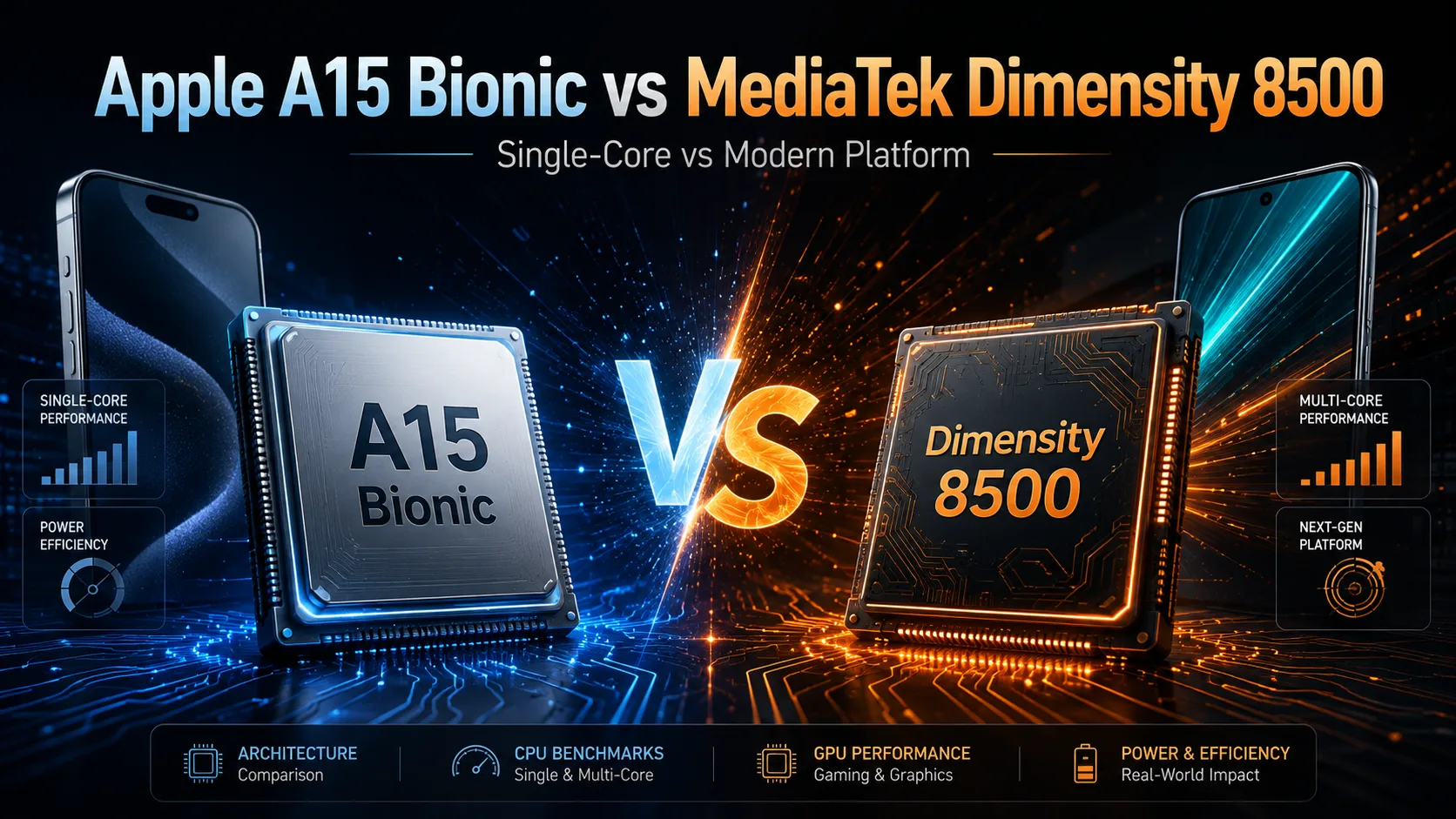
Apple A15 Bionic was released in September 2021, while MediaTek Dimensity 8500 came out in January 2026. In Geekbench 6, A15 still scores around 2333 points in Single-Core compared to 1693 for Dimensity 8500, which is about 38% more. In Multi-Core, MediaTek takes the lead with 6897 versus 5741 points, or around 20%.
Architecture and Memory
A15 Bionic is built on a 5nm process and utilizes six CPU cores: two high-performance Avalanche cores and four energy-efficient Blizzard cores.
Dimensity 8500 is built on a 4nm process and features eight Cortex-A725 cores. One core operates at a frequency of up to 3.4 GHz, three at up to 3.2 GHz, and four at up to 2.2 GHz. It supports LPDDR5X memory up to 9600 Mbps along with UFS 4 storage with MCQ.
| Specification | Apple A15 Bionic | MediaTek Dimensity 8500 |
|---|---|---|
| Year of release | 2021 | 2026 |
| Process technology | 5 nm | 4 nm |
| CPU | 2 high-performance + 4 efficient cores | 8x Cortex-A725 |
| Max frequency | 3.23 GHz | 3.4 GHz |
| GPU | Apple GPU, 4 or 5 cores | Mali-G720 MC8 |
| Memory | LPDDR4X | LPDDR5X |
| Storage | NVMe | UFS 4 + MCQ |
| NPU | 16-core Neural Engine | MediaTek NPU 880 |
The GPU configuration of the A15 depends on the device: the iPhone 13 has a 4-core GPU, while the iPhone 13 Pro and iPhone 14 have a 5-core GPU. Therefore, the graphical performance of smartphones on the A15 cannot be reduced to a single configuration.
Geekbench 6 in Real Smartphones
The performance of specific devices is influenced by cooling, power limits, and manufacturer settings, so it is useful to look not only at the average figures of the chip itself.
| Smartphone | Processor | Geekbench 6 Single | Geekbench 6 Multi |
|---|---|---|---|
| Apple iPhone 13 | A15 Bionic | 2241 | 5317 |
| Apple iPhone 13 Pro Max | A15 Bionic | 2427 | 6142 |
| Apple iPhone 14 | A15 Bionic | 2272 | 5584 |
| Xiaomi Redmi Turbo 5 | Dimensity 8500 | 1729 | 6949 |
| Xiaomi POCO X8 Pro | Dimensity 8500 Ultra | 1707 | 6611 |
| Honor Power 2 | Dimensity 8500 Elite | 1728 | 6762 |
The iPhone 13 Pro Max scores 2427 points in Single-Core, while devices with Dimensity 8500 maintain around 1700-1730. In Multi-Core, the situation changes: the Redmi Turbo 5 scores 6949 points against 6142 for the iPhone 13 Pro Max, giving MediaTek the lead here.
The designations Dimensity 8500 Ultra and Elite for specific smartphones do not indicate a transition to a different CPU architecture. The variation in results between these devices is mainly related to cooling, power limits, and firmware.
Why A15 Still Leads in Single-Core
The main strength of the A15 is its single-threaded performance: in Geekbench 6, a single core of the A15 is still significantly faster than the Cortex-A725 in the Dimensity 8500. High Single-Core performance is important for the interface, browser, and short loads, so iPhones on this chip still do not feel slow today.
In multi-thread tasks, the Dimensity 8500 comes out on top: eight Cortex-A725 cores handle workloads capable of utilizing all cores, including rendering, archiving, and processing large datasets.
Graphics: Here A15 Is Already Lagging
In 3DMark Wild Life Extreme, the Dimensity 8500 scores around 4058 points. The iPhone 14 shows approximately 2850 points, while the iPhone 13 Pro Max scores around 2960, making the difference about 37-42% in favor of MediaTek.
In Wild Life Extreme, Dimensity 8500 leads confidently, although the final result depends not only on the GPU but also on memory, cooling, and settings of the specific smartphone. Optimization of individual games for iOS may narrow this gap in real gaming tests; however, in modern cross-platform graphics tests, Dimensity 8500 is faster.
AnTuTu: A Significant Gap, But Comparison is Conditional
Dimensity 8500 scores around 2.36 million points in AnTuTu 10, compared to about 1.32 million for A15 Bionic. However, stating that MediaTek is 79% faster based on this number is misleading: AnTuTu evaluates not only CPU, but also GPU, memory, and interface, and results on Android and iOS cannot be directly translated into performance differences.
For CPU comparison, it is better to rely on Geekbench 6.
What to Choose in 2026
The Dimensity 8500 is better suited for a new smartphone if multi-thread performance and gaming are important. Additionally, the platform supports LPDDR5X, UFS 4, Wi-Fi 6E, Bluetooth 5.4, and MediaTek NPU 880, which are all more crucial for a 2026 device than the A15's advantage in Single-Core.
Choosing a smartphone with A15 should not be based on the chip itself but rather for iOS, cameras, Apple’s ecosystem, or the attractive price of a specific iPhone. Winning in Single-Core does not make the A15 a stronger platform overall.
Conclusion
The A15 is over four years older than the Dimensity 8500, but in Geekbench 6 Single-Core, it is still about 38% faster, which illustrates the headroom of Apple's architecture from that generation.
The Dimensity 8500 is quicker in Multi-Core, leads in graphics tests, and supports LPDDR5X, UFS 4, and newer wireless interfaces. While the A15 wins in Single-Core, when considering the overall combination of CPU, GPU, and platform capabilities, the final verdict goes to the Dimensity 8500.
Advantages
- Higher Technology: 4 nm (5 nm vs 4 nm)
- Higher Frequency: 3400 MHz (3230 MHz vs 3400 MHz)
- Newer Launch Date: January 2026 (September 2021 vs January 2026)
Basic
GPU Specifications
Connectivity
Memory Specifications
Miscellaneous
Benchmarks
Comparison of Devices
Related SoC Comparisons



Share in social media
Or Link To Us
<a href="https://cputronic.com/index.php/soc/compare/apple-a15-bionic-vs-mediatek-dimensity-8500" target="_blank">Apple A15 Bionic vs MediaTek Dimensity 8500</a>