Qualcomm Snapdragon 7s Gen 4
vs
MediaTek Dimensity 8500
SoC Comparison Result
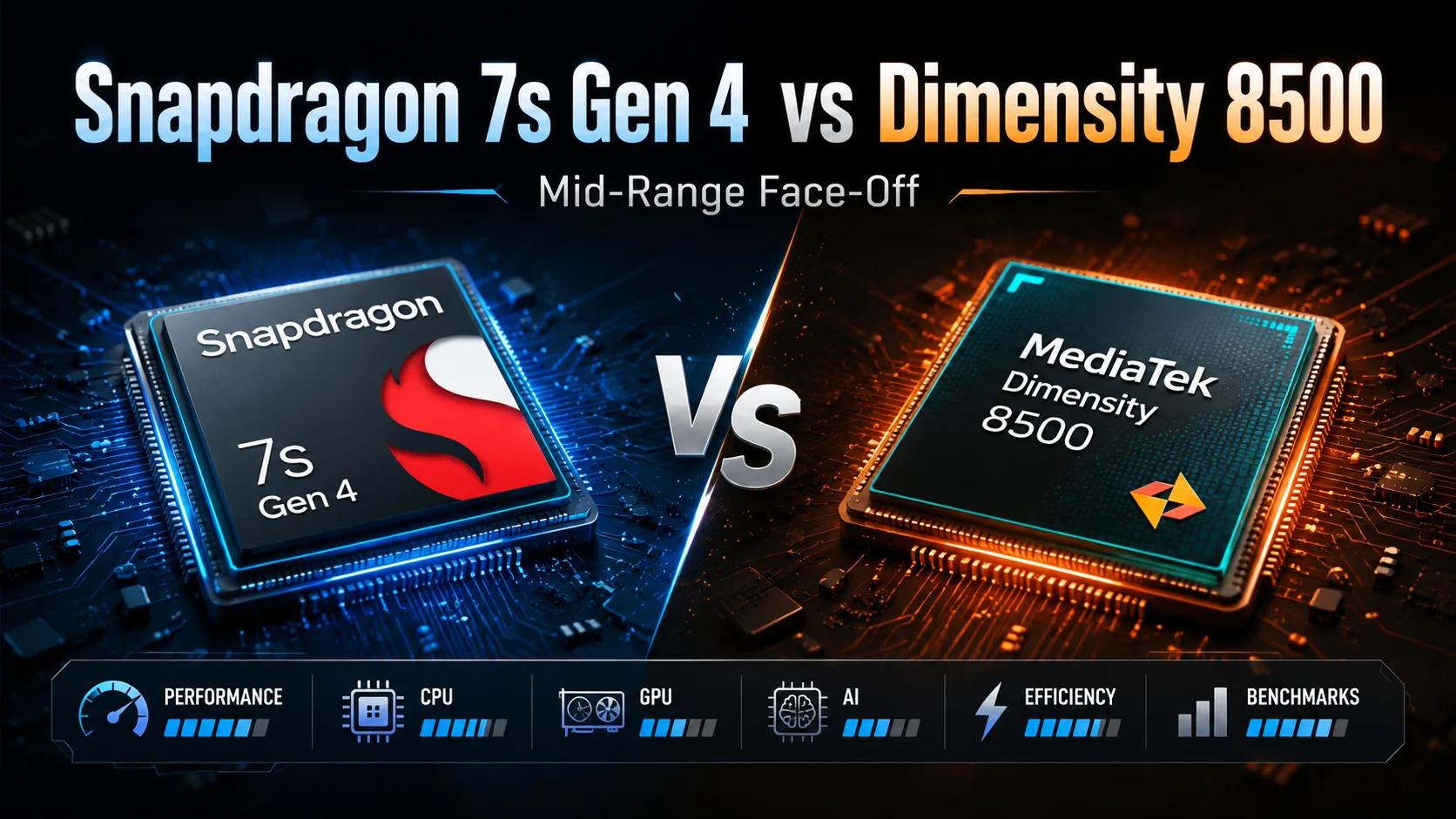
Snapdragon 7s Gen 4 vs Dimensity 8500: Qualcomm Loses by a Wide Margin
Snapdragon 7s Gen 4 and Dimensity 8500 have been compared due to their names, rather than their performance. Qualcomm has increased the clock speeds of the Snapdragon 7s Gen 3 but retained the previous configuration with four performance cores and four efficiency cores. The Dimensity 8500 features eight Cortex-A725 cores and a GPU that scores nearly four times better than the Adreno 810 in 3DMark.
The benchmarks create the impression that the platforms are closely matched in performance. In practice, Snapdragon 7s Gen 4 remains in the mid-range, while Dimensity 8500 delivers results comparable to recent flagship chips.
Key Differences
| Parameter | Snapdragon 7s Gen 4 | Dimensity 8500 |
|---|---|---|
| Process Technology | 4 nm | 4 nm |
| CPU Configuration | 1× 2.7 GHz + 3× 2.4 GHz + 4× 1.8 GHz | 1× Cortex-A725 3.4 GHz + 3× Cortex-A725 3.2 GHz + 4× Cortex-A725 2.2 GHz |
| Core Architecture | Cortex-A720 and Cortex-A520 | Eight Cortex-A725 |
| Graphics | Adreno 810 | Mali-G720 MC8 |
| Supported Memory | LPDDR5-6400, LPDDR4X-4266 | LPDDR5X-9600 |
| Video Recording | Up to 4K HDR at 30 fps | 4K HDR |
| Class | Mid-range | Upper mid-range |
The Snapdragon combines four Cortex-A720 with four energy-efficient Cortex-A520. The maximum clock speed has reached 2.7 GHz, however, the claimed CPU and GPU performance boost compared to Snapdragon 7s Gen 3 is only 7%. This represents a slight overclocking of the previous chip rather than a transition to a higher tier.
All eight cores of the Dimensity 8500 utilize the Cortex-A725 architecture: four operate at clock speeds up to 3.4 GHz, while the remaining four run at 2.2 GHz. The graphics are handled by the Mali-G720 MC8. According to MediaTek, it is 25% faster than the previous generation and consumes 20% less power.
Geekbench 6 on Specific Devices
The table shows Geekbench 6 results on specific smartphones. The Ultra and Elite labels are designated by the device manufacturers: the chip architecture remains the same, but results vary due to cooling, firmware, and power limits.
| Chip | Device | Single-Core | Multi-Core |
|---|---|---|---|
| Snapdragon 7s Gen 4 | Xiaomi Redmi Note 15 Pro+ 5G | 1221 | 3209 |
| Snapdragon 7s Gen 4 | Xiaomi Poco M8 Pro 5G | 1227 | 3183 |
| Snapdragon 7s Gen 4 | Nothing Phone (4a) | 1259 | 3393 |
| Average Snapdragon | - | 1236 | 3262 |
| Dimensity 8500 Ultra | Xiaomi Poco X8 Pro | 1564 | 6478 |
| Dimensity 8500 | Xiaomi Redmi Turbo 5 | 1659 | 6764 |
| Dimensity 8500 Elite | Honor Power 2 | 1728 | 6762 |
| Average Dimensity | - | 1650 | 6668 |
On average, Dimensity 8500 outperforms Snapdragon by 34% in Single-Core and more than twice in Multi-Core. The gap remains consistent across all devices in the table: even the minimum result for Dimensity is almost double the maximum result for Snapdragon under load on all cores.
The reason lies not only in clock speeds. Dimensity utilizes eight Cortex-A725 cores, whereas Snapdragon offloads half of its tasks to four smaller Cortex-A520 cores.
What Will Be Noticeable in Everyday Use
In messaging apps, browsers, and navigation, a smartphone with Dimensity will not feel twice as fast. In daily applications, the weakness of Snapdragon is hardly noticeable: factors like firmware, storage, and RAM size are more crucial here.
The gap becomes apparent in video editing, processing a series of photos, extracting archives, and simultaneously running several heavy applications. In such tasks, eight Cortex-A725 cores reduce waiting times and maintain acceptable performance longer.
The support for fast memory in specifications does not guarantee that the manufacturer will install it. Snapdragon 7s Gen 4 supports LPDDR5 and UFS 3.1, but the Redmi Note 15 Pro+ received a slower UFS 2.2 storage. The Poco X8 Pro with Dimensity 8500 has UFS 4.1 installed. Therefore, memory speed must be verified for specific smartphones rather than inferred from the chip name.
In Gaming, Snapdragon 7s Gen 4 is No Longer a Competitor
In graphics, the gap is even larger. The Nothing Phone (4a) with Snapdragon 7s Gen 4 scored 1118 points in 3DMark Wild Life Extreme, while the Poco X8 Pro with Dimensity 8500 scored 4311 points. In this test, the Dimensity GPU proved to be 3.9 times faster than the Adreno 810.
Adreno 810 handles simple games well but will require dialing down settings and resolution for heavier projects. Upscaling can enhance image clarity but will not turn this GPU into a solution from a different class.
Mali-G720 MC8 offers significantly more flexibility in selecting settings and resolutions. However, without adequate cooling, this headroom diminishes quickly. In a long stress test, the Poco X8 Pro lost about 20-25% of its performance, making proper cooling just as important as the chip itself.
Cameras, Connectivity, and AI
Snapdragon 7s Gen 4 supports a triple 12-bit ISP, cameras up to 200 MP, 4K HDR video recording at 30 fps, displays up to 144 Hz, Wi-Fi 6E, and Bluetooth 5.4. Its NPU can locally run compact generative models without relying on the cloud.
Dimensity 8500 uses an NPU 880 for local AI tasks and supports processing 4K HDR video. However, a more powerful ISP does not guarantee better camera performance; sensor quality, optics, and image processing algorithms play a crucial role.
Conclusion: Snapdragon Loses Too Much
The Dimensity 8500 is over twice as fast in Geekbench Multi-Core and nearly four times faster in 3DMark Wild Life Extreme. For gaming, video editing, and emulators, Snapdragon 7s Gen 4 is not a competitor.
A smartphone with Snapdragon should only be considered if it is significantly cheaper or has noticeably better displays, cameras, and support longevity. The designation "7s Gen 4" promises more than what the chip delivers: it is merely a slightly accelerated mid-range option, not a rival to the Dimensity 8500.
At a similar price, a device with MediaTek offers significantly higher performance and greater headroom for demanding applications.
Advantages
- Higher Frequency: 3400 MHz (2700 MHz vs 3400 MHz)
- Newer Launch Date: January 2026 (August 2025 vs January 2026)
Basic
GPU Specifications
Connectivity
Memory Specifications
Miscellaneous
- AIFF
- CAF
- MP3
- MP4
- WAV
- H.265
- VP9
Benchmarks
Comparison of Devices
Related SoC Comparisons




Share in social media
Or Link To Us
<a href="https://cputronic.com/index.php/soc/compare/qualcomm-snapdragon-7s-gen-4-vs-mediatek-dimensity-8500" target="_blank">Qualcomm Snapdragon 7s Gen 4 vs MediaTek Dimensity 8500</a>