MediaTek Dimensity 7400
vs
MediaTek Dimensity 9500s
SoC Comparison Result
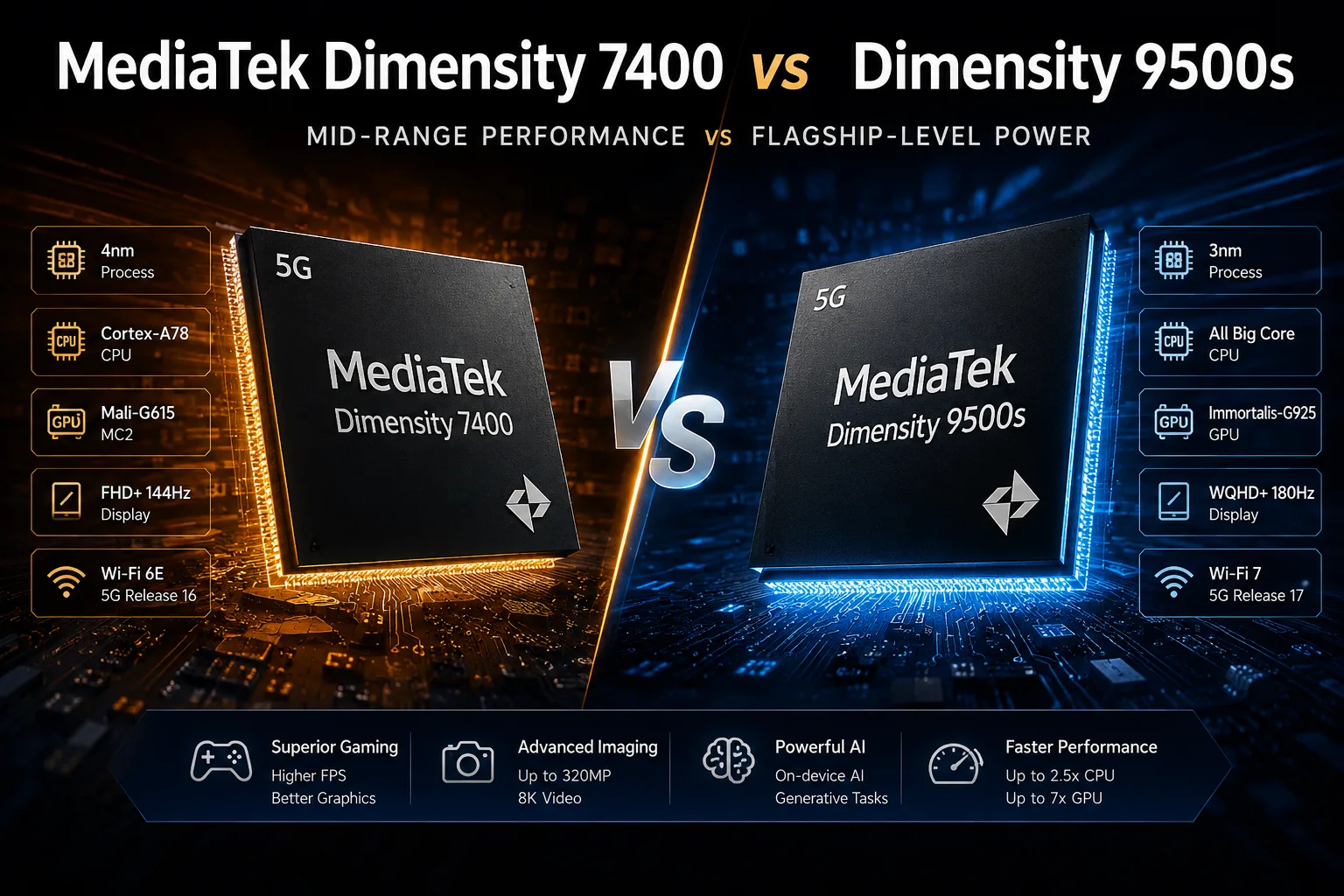
MediaTek Dimensity 7400 vs Dimensity 9500s: Mid-range vs Last Generation Flagship Platform
Eight cores and the MediaTek logo are nearly all that link the Dimensity 7400 and Dimensity 9500s. The former is intended for mid-range smartphones, while the latter is built on last-generation flagship architecture and is significantly stronger in gaming, video processing, and localized AI tasks.
What’s more interesting is how the transition to the 9500s changes smartphone performance and in which tasks its numerous advantages in tests are felt in practice.
Key Differences
| Feature | Dimensity 7400 | Dimensity 9500s |
|---|---|---|
| Process Technology | 4 nm | 3 nm |
| CPU | 4 × Cortex-A78 up to 2.6 GHz + 4 × Cortex-A55 | 1 × Cortex-X925 up to 3.73 GHz + 3 × Cortex-X4 + 4 × Cortex-A720 |
| CPU Architecture | performance and efficiency cores | All Big Core |
| GPU | Mali-G615 MC2 | Immortalis-G925, 11 or 12 cores |
| RAM | LPDDR4X or LPDDR5 | LPDDR5X-10667 |
| Storage | UFS 2.2 or UFS 3.1 | UFS 4 with MCQ |
| Camera | up to 200 MP | up to 320 MP |
| Video | up to 4K at 30 fps | up to 8K at 60 fps |
| Display | FHD+ up to 144 Hz | WQHD+ up to 180 Hz |
| Wireless | Wi-Fi 6E, 5G Release 16 | Wi-Fi 7, 5G Release 17 |
Results depend on the memory, cooling, and power limits of the specific smartphone.
CPU: Approximately 2.5 Times Advantage
The Dimensity 7400 features four Cortex-A78 cores clocked up to 2.6 GHz and four Cortex-A55 cores. This configuration is sufficient for everyday tasks like browsing, navigation, and communication.
The lack of power becomes noticeable during photo and video processing, unzipping large files, and frequently switching between resource-intensive applications. Cortex-A78 cores are slower than modern cores at the same frequency, while Cortex-A55 cores quickly become a bottleneck under multi-threaded load.
In the Dimensity 9500s, a single Cortex-X925 core operates at frequencies of up to 3.73 GHz. The remaining seven cores consist of three Cortex-X4 and four Cortex-A720 cores. There are no small cores from the Cortex-A5xx series here. Additionally, the processor has 12 MB of L3 cache and 10 MB of system cache.
In Geekbench 6, smartphones powered by the Dimensity 7400 generally score around 1030-1080 points in single-core tests and 2900-3100 in multi-core tests. The first devices with Dimensity 9500s show scores of approximately 2500-2670 and 7700-8400 points, respectively.
Thus, the 9500s is about 2.4 times faster in single-threaded mode and 2.5-2.7 times faster in multi-threaded mode.
In social media and video playback, the gap is much narrower than in benchmarks. The advantage becomes clear when launching large games, processing media content, and during prolonged multi-threaded load.
Gaming: The Main Advantage of Dimensity 9500s
The main limitation of the Dimensity 7400 remains the Mali-G615 MC2. This GPU can handle most popular mobile games, but in demanding titles, it is necessary to lower the settings, rendering resolution, or target frame rate.
The Dimensity 9500s uses the Immortalis-G925 with 11 or 12 cores. The GPU features hardware ray tracing, Opacity Micromap, and frame rate enhancement technologies. It supports modes of up to 120 FPS in games that have the support from the engine, display, and smartphone firmware.
A simple comparison of core counts here does not explain much; the architecture, frequencies, cache, and memory bandwidth differ. In computational tests, the GPU advantage of the 9500s reaches approximately seven times.
The main argument in favor of the 9500s is graphical performance, rather than a slight difference in interface responsiveness. The Dimensity 7400 requires moderate settings, whereas the higher-tier chip allows for high graphical quality and more stable frame rates.
Memory and Storage
The Dimensity 7400 works with LPDDR4X or LPDDR5 RAM and UFS 2.2 or UFS 3.1 storage. Therefore, two smartphones with the same processor can have significantly different speeds in launching applications, copying files, and loading games.
The Dimensity 9500s supports LPDDR5X-10667 and UFS 4 with multiple command queues. Fast memory and storage shorten load times and reduce latency when working with large files.
Camera: 9500s Excels in Processing
The Dimensity 7400 supports cameras with resolutions up to 200 MP and video recording at 4K at 30 fps. Its ISP handles hardware noise cancellation, HDR, and image stabilization.
The Dimensity 9500s works with sensors up to 320 MP, allows simultaneous use of three 36 MP cameras, and records video up to 8K. It also features 18-bit RAW processing and motion tracking capabilities.
The difference between 200 and 320 MP does not inherently indicate the quality of images. The primary advantage of the 9500s is the simultaneous processing of multiple cameras, enhanced HDR, and recording video at higher resolutions and frame rates.
A powerful processor cannot compensate for weak optics or a small sensor.
Local AI
The Dimensity 7400 is equipped with an NPU 655. It mainly speeds up photo processing and scene recognition.
The Dimensity 9500s can perform multimodal and generative tasks directly on the device: editing images, removing and redrawing objects, converting speech to text, creating brief summaries, and running models like Stable Diffusion XL.
MediaTek does not provide directly comparable TOPS metrics for these processors, so the exact difference in NPU power cannot be determined.
The advantage of the 9500s will only be noticeable in smartphones where the manufacturer truly employs local AI functions.
Display and Connectivity
The Dimensity 7400 works with Full HD+ displays at up to 144 Hz. This resolution better matches the capabilities of the Mali-G615 MC2 and does not impose unnecessary strain on the GPU.
The Dimensity 9500s is designed for WQHD+ panels with refresh rates up to 180 Hz. It is also claimed to support multi-sectional foldable displays.
The modem in the Dimensity 7400 is compliant with 5G Release 16 and offers download speeds up to 3.27 Gb/s. The Dimensity 9500s utilizes Release 17 and increases the theoretical limit to 7 Gb/s. In practice, speeds are more often limited by the mobile network than the smartphone's modem.
The lower processor supports Wi-Fi 6E while the higher one supports Wi-Fi 7.
Battery Life and Heat
The transition from 4 nm to 3 nm does not mean that the Dimensity 9500s will always run cooler. The new manufacturing process enhances efficiency, but the larger CPU and GPU of the higher chip consume more power under maximum load.
In long gaming sessions, the result of the 9500s highly depends on cooling and power limits. The Dimensity 7400 generates less heat but also performs the same tasks noticeably slower.
Therefore, comparing the temperature of processors in isolation from the smartphone's case, battery, and cooling system is inappropriate.
Dimensity 9500s Closer to 9400+ than to 9500
The name Dimensity 9500s hints at a simplified version of the Dimensity 9500. However, in terms of architecture, it is much closer to the Dimensity 9400+.
The Dimensity 9500 uses newer cores from the Arm C1 family, enlarged L3 cache, and a more modern storage subsystem. The Dimensity 9500s retains the Cortex-X925, Cortex-X4, and Cortex-A720, 12 MB L3, and UFS 4 with MCQ.
The CPU configuration, maximum frequency of the Cortex-X925, cache size, supported memory, and core ISP functionalities all align with the Dimensity 9400+.
MediaTek does not confirm whether the 9500s and 9400+ are built on the same chip. Thus, there is insufficient data to conclude a simple renaming. Based on published specifications, the 9500s appears to be an updated variant of the Dimensity 9400+ platform.
In practice, this means flagship-level CPU and GPU architecture from the previous generation without most limitations typical of the mid-range.
When It’s Worth Paying Extra for the Dimensity 9500s
The Dimensity 7400 is sufficient for everyday applications and gaming at moderate settings, especially if a lower-priced smartphone is a priority.
The premium for the 9500s is justified in demanding games, emulation, video processing, and localized AI tasks. In these scenarios, its advantages are perceptible even without referring to benchmarks.
Conclusion
The Dimensity 7400 uses older Cortex-A78 cores and dual-core Mali-G615 graphics. Its power is adequate for common applications, but the GPU limitations are already noticeable in demanding games.
The Dimensity 9500s has inherited flagship-level CPU and GPU from the previous generation. It is approximately two and a half times faster in processor tests and differentiates itself even more in graphics performance. The advantages are complemented by fast LPDDR5X memory, UFS 4 storage, more efficient ISP, and powerful NPU.
In the interface, the advantage of the 9500s is perceived moderately. In gaming, video processing, and localized AI tasks, the difference becomes substantial: the Dimensity 7400 requires reduced settings, while the 9500s maintains high performance without such compromises.
Advantages
- Higher Technology: 3 nm (4 nm vs 3 nm)
- Higher Frequency: 3730 MHz (2600 MHz vs 3730 MHz)
- Newer Launch Date: January 2026 (February 2025 vs January 2026)
Basic
3x 3.3 GHz – Cortex-X4
4x 2.4 GHz – Cortex-A720
GPU Specifications
Connectivity
Memory Specifications
Miscellaneous
- FLAC
- HE-AACv1
- HE-AACv2
- MP3
- H.265
- AV1
- VP9
Benchmarks
Comparison of Devices
Related SoC Comparisons




Share in social media
Or Link To Us
<a href="https://cputronic.com/index.php/soc/compare/mediatek-dimensity-7400-vs-mediatek-dimensity-9500s" target="_blank">MediaTek Dimensity 7400 vs MediaTek Dimensity 9500s</a>