MediaTek Dimensity 6400
vs
MediaTek Helio G200
SoC Comparison Result
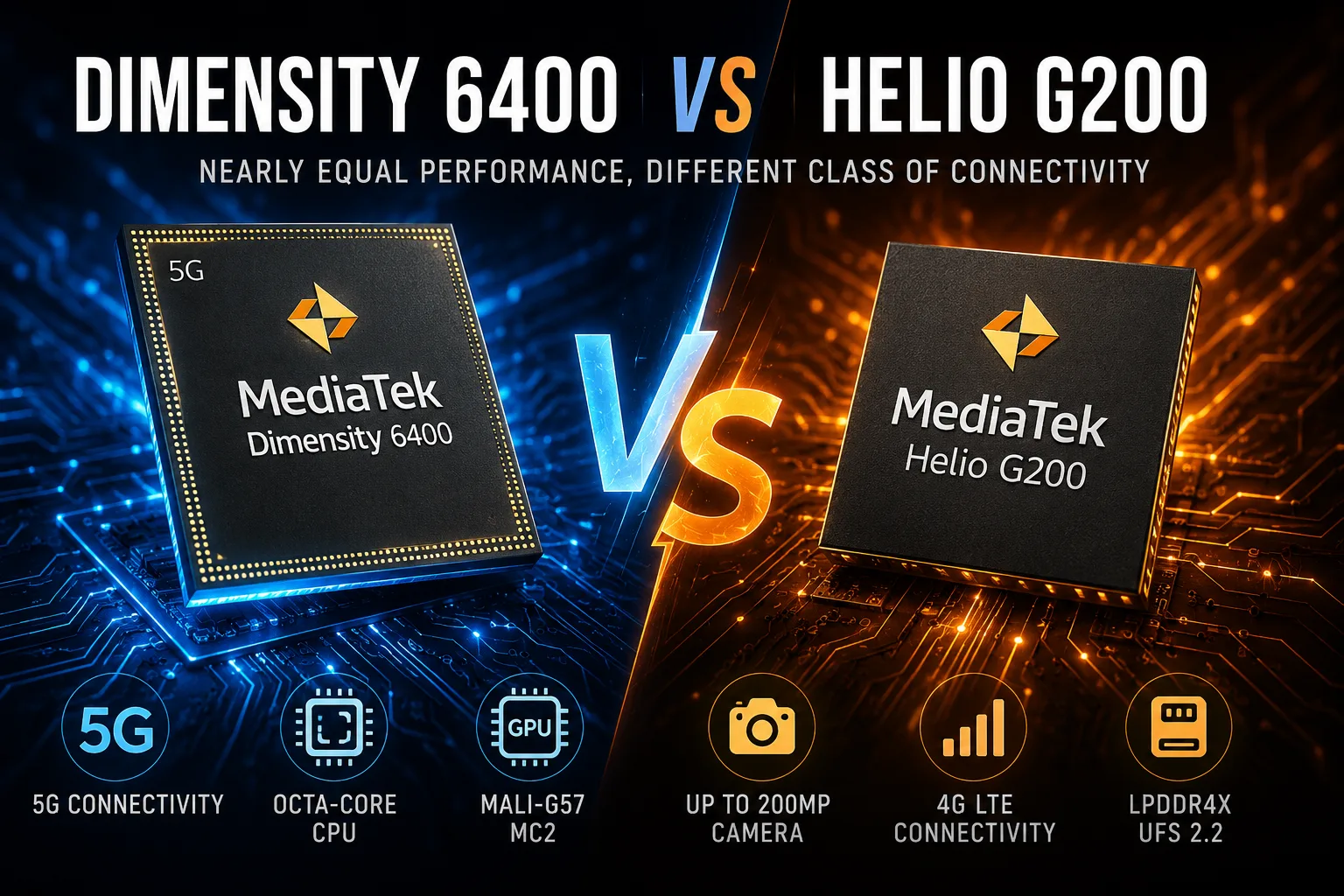
Dimensity 6400 vs Helio G200: Almost Equal Speed, but Different Connectivity Class
MediaTek Dimensity 6400 and Helio G200 belong to different product lines, yet their performance is quite similar. In AnTuTu 10, the difference between them is less than one percent, while in Geekbench 6, Dimensity 6400 is noticeably ahead only in CPU tests. Thus, the comparison hinges not on speed but on the class of connectivity: Dimensity 6400 supports 5G, whereas Helio G200 is limited to 4G and can support cameras up to 200 MP.
Both chips are manufactured using a 6nm process and share the same basic platform: Cortex-A76/Cortex-A55 cores, Mali-G57 MC2 graphics, LPDDR4X memory, and UFS 2.2 storage. The Dimensity 6400 stands out with its 5G support and higher clock speeds for its primary cores. In contrast, the Helio G200 remains a 4G chip but supports cameras up to 200 MP, HDR video, and offers improved performance in weak signal conditions.
Specifications
| Parameter | MediaTek Dimensity 6400 | MediaTek Helio G200 |
|---|---|---|
| Process Technology | 6 nm | 6 nm |
| CPU | 2× Cortex-A76 up to 2.5 GHz + 6× Cortex-A55 up to 2.0 GHz | 2× Cortex-A76 up to 2.2 GHz + 6× Cortex-A55 up to 2.0 GHz |
| GPU | Mali-G57 MC2 | Mali-G57 MC2 up to 1.1 GHz |
| Memory | LPDDR4X | LPDDR4X |
| Storage | UFS 2.2 | UFS 2.2 |
| Connectivity | 5G SA/NSA, 4G LTE | 4G LTE |
| Wi-Fi / Bluetooth | Wi-Fi 5, Bluetooth 5.2 | Wi-Fi 5, Bluetooth 5.2 |
| Camera | up to 108 MP or 16 + 16 MP | up to 200 MP or 16 + 16 MP |
| Display | up to 2520×1080, 120 Hz | up to 2520×1080, 120 Hz |
In terms of CPU, GPU, and memory, the differences are minimal. The Dimensity 6400 is distinguished by its 5G modem and higher frequency for its Cortex-A76 cores, while the Helio G200 is focused on supporting 200 MP cameras and catering to budget 4G smartphones.
Performance
In CPU tests, the Dimensity 6400 performs slightly better. It has the same core configuration as the Helio G200, but its two large Cortex-A76 cores operate at a frequency of up to 2.5 GHz instead of 2.2 GHz. This gives an advantage in single-thread tests and can marginally affect app launches, browser performance, and UI responsiveness.
| Benchmark | MediaTek Dimensity 6400 | MediaTek Helio G200 | Difference |
|---|---|---|---|
| Geekbench 6 Single-Core | 819 | 755 | Dimensity 6400 +8% |
| Geekbench 6 Multi-Core | 2116 | 2038 | Dimensity 6400 +4% |
| AnTuTu 10 | 437112 | 435929 | nearly parity |
In Geekbench 6 Single-Core, the Dimensity 6400 scores 819 against 755 for the Helio G200. The difference is about 8%, which aligns with the higher frequency of its primary cores. In Multi-Core, the gap narrows to 4%: 2116 points versus 2038. Here, the similarity in configuration with six Cortex-A55 cores clocked at 2.0 GHz plays a role.
AnTuTu 10 shows almost equal overall performance: 437112 points for the Dimensity 6400 and 435929 for the Helio G200. Such a difference is unlikely to be noticeable in real-world usage. In terms of overall performance, these chips belong to the same class.
Gaming and Graphics
In gaming, the Dimensity 6400 does not have a significant advantage either. Both chips utilize the Mali-G57 MC2 - an entry-level to mid-range graphics processor. It is suitable for less demanding games and medium settings in more demanding titles, but it does not guarantee stable high FPS on maximum graphics settings.
Games like PUBG Mobile, Mobile Legends, Standoff 2, and casual titles are suitable for this level. In Genshin Impact, Wuthering Waves, and other demanding projects, it is more realistic to aim for low or medium settings. In gaming, factors like cooling, memory, screen resolution, and the specific smartphone's firmware can play a more crucial role.
Connectivity
The main advantage of the Dimensity 6400 is its connectivity. It supports 5G, which is more critical for a smartphone in the coming years than the mere difference in percentages on Geekbench. Even if 5G is not needed daily, its presence increases the device's relevance.
The Helio G200 is limited to 4G. MediaTek claims improved performance under weak signal conditions, but in connectivity class, it is still a 4G platform. In regions where 5G is already actively utilized, the Dimensity 6400 is more logical. The Helio G200 makes sense where 4G is still sufficient and the smartphone is significantly cheaper.
Camera and Multimedia
On paper, the Helio G200 is superior in terms of camera capabilities. It supports sensors up to 200 MP and 12-bit processing for HDR video. This provides manufacturers with a convenient foundation for affordable 4G smartphones with an emphasis on camera capabilities.
The Dimensity 6400 supports cameras up to 108 MP, but this does not equate to inferior photo quality. Final image quality depends on the sensor, optics, stabilization, processing algorithms, and firmware. Therefore, cameras should be compared based on specific smartphones, not just on chip specifications.
What to Choose
The Dimensity 6400 is logically the better choice if the smartphone is intended for several years of use or if the price difference with the Helio G200 model is minimal. It is slightly faster, but it supports 5G and has a higher clock speed for its primary cores. For a budget smartphone, it represents a more versatile platform.
The Helio G200 is justified if the smartphone is cheaper, and 5G is not required. In terms of overall speed, it nearly matches the Dimensity 6400, while the support for 200 MP cameras allows manufacturers to emphasize the camera feature. However, at the same price point, the advantage goes to the Dimensity 6400.
Conclusion
The main advantage of the Dimensity 6400 is not performance but rather its 5G support. In terms of speed, it only slightly outpaces the Helio G200: the advantage is notable in Geekbench 6, but in AnTuTu 10, the chips are almost equal.
The Helio G200 makes sense for inexpensive 4G smartphones, especially where 5G is unnecessary or the model is significantly cheaper. When the pricing is close, it is more rational to choose a smartphone with the Dimensity 6400: it is not much faster but better suited for a device aimed at several years of use.
Advantages
- Higher Frequency: 2500 MHz (2500 MHz vs 2200 MHz)
- Newer Launch Date: May 2025 (February 2025 vs May 2025)
Basic
GPU Specifications
Connectivity
Memory Specifications
Miscellaneous
- AIFF
- CAF
- MP3
- MP4
- WAV
- H.265
- VP9
Benchmarks
Comparison of Devices
Related SoC Comparisons



Share in social media
Or Link To Us
<a href="https://cputronic.com/index.php/soc/compare/mediatek-dimensity-6400-vs-mediatek-helio-g200" target="_blank">MediaTek Dimensity 6400 vs MediaTek Helio G200</a>