MediaTek Helio G200
vs
Qualcomm Snapdragon 685

SoC Comparison Result
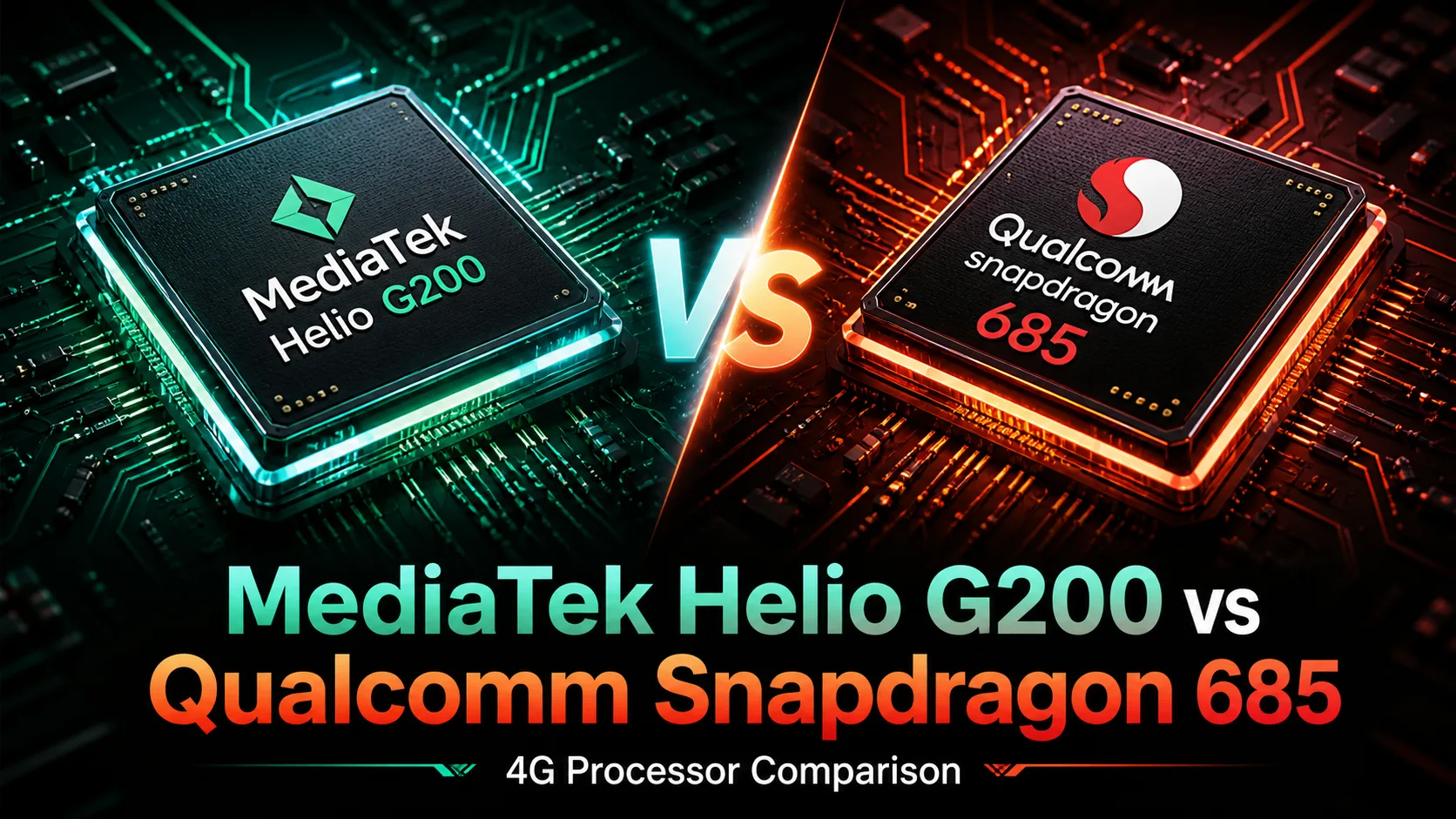
MediaTek Helio G200 vs Qualcomm Snapdragon 685: Which 4G Processor is Better to Choose
MediaTek Helio G200 and Qualcomm Snapdragon 685 are two processors for budget and mid-range smartphones without 5G support. At first glance, they look similar: both are manufactured using a 6nm process technology, both are designed for Android smartphones with displays up to 120 Hz, both support fast UFS 2.2 storage and are suitable for everyday tasks. However, a deeper look reveals that these are different platforms with varying performance capabilities.
The Snapdragon 685 is a proven solution frequently found in affordable smartphones from brands like Xiaomi, Redmi, Realme, Honor, and others. Its strengths lie in stability, good optimization, and predictable performance in simple tasks. The Helio G200 is a more recent 4G chip from MediaTek that focuses on Cortex-A76 cores, stronger graphics, support for cameras up to 200 MP, and gaming optimizations.
Comparison of Specifications
| Specification | MediaTek Helio G200 | Qualcomm Snapdragon 685 |
|---|---|---|
| Class | 4G SoC for affordable smartphones | 4G SoC for affordable smartphones |
| Process Node | 6nm TSMC | 6nm |
| CPU | 2x Cortex-A76 up to 2.2 GHz + 6x Cortex-A55 up to 2.0 GHz | 4x Cortex-A73 up to 2.8 GHz + 4x Cortex-A53 up to 1.9 GHz |
| GPU | Arm Mali-G57-class up to 1.1 GHz | Adreno 610 |
| Memory | LPDDR4X up to 4266 Mbps | LPDDR4X up to 4266 Mbps |
| Storage | UFS 2.2 | UFS 2.2 |
| Display | up to 2520 x 1080, up to 120 Hz | FHD+ up to 120 Hz |
| Camera | up to 200 MP | up to 108 MP |
| Connectivity | 4G LTE, Dual 4G VoLTE | 4G LTE, Snapdragon X11 LTE |
| 5G | No | No |
The key here is not just the numbers. The Snapdragon 685 has a higher maximum CPU frequency, but its Cortex-A73 cores are older than the Cortex-A76 in the Helio G200. Therefore, the lower clock speed of MediaTek does not mean lower real-world performance. In modern applications, Helio G200 often proves to be stronger due to its newer architecture and better CPU-GPU balance.
Performance: Helio G200 Offers More Headroom
In everyday use, both processors can handle messengers, browsers, YouTube, navigation, banking applications, and social media. However, the difference starts to become noticeable when the smartphone is under heavy load: multiple browser tabs, multitasking apps, photo processing, installing updates, gaming, or a heavy manufacturer interface.
The Helio G200 uses two Cortex-A76 cores. While it's not a flagship architecture, it is noticeably fresher and more powerful than the Cortex-A73 in the Snapdragon 685. Qualcomm may have four performance cores, and due to its higher frequency, the Snapdragon 685 can be decent in short tasks. However, in general responsiveness, multitasking, and handling modern applications, the Helio G200 usually has a better advantage.
It's important to understand that the Helio G200 is not a revolutionary processor. It is conceptually close to the Helio G99 and Helio G100, but it has enhancements in graphics, camera, and connectivity. Nonetheless, against the backdrop of the Snapdragon 685, it is perceived as a more relevant option for a smartphone intended to be used for 2-3 years rather than just a couple of months.
Benchmarks: How Much Faster is Helio G200
| Test | Approximate Advantage of Helio G200 over Snapdragon 685 |
|---|---|
| AnTuTu 10 | about 20-25% |
| Geekbench Single-Core | about 55-60% |
| Geekbench Multi-Core | about 30-35% |
| Graphics Tests | approximately 30-45% |
| Overall Headroom for Heavy Apps | approximately 25-35% |
In synthetic tests, the Helio G200 significantly outperforms the Snapdragon 685. This difference is particularly evident in single-core performance: the more modern Cortex-A76 gives MediaTek a serious advantage over the older Cortex-A73. In multi-core tasks, the gap is smaller due to the Snapdragon 685's four performance cores, but Helio G200 still remains ahead.
In AnTuTu, the advantage typically hovers around 20-25%, which accurately reflects the overall difference between the platforms. While it's not a gap indicating one chip is entirely outdated and the other is near flagship levels, this boost is noticeable for a budget smartphone. The interface should be more stable, apps will open quicker, and the headroom for future Android versions and heavy skins will be higher.
Synthetic tests should not be viewed as an absolute truth. Results depend on the specific smartphone, cooling, RAM size, storage speed, and firmware version. However, as a general benchmark, they highlight an important point: the Helio G200 is not just newer by name, but genuinely stronger in most scenarios.
Gaming: MediaTek has the Advantage
For gaming, the Helio G200 is particularly interesting. Its Arm Mali-G57-class graphics, clocked at up to 1.1 GHz, are better suited for modern mobile games than the Adreno 610 in the Snapdragon 685. Of course, this is not a flagship gaming chip and does not replace processors in the Snapdragon 7 series or Dimensity 8000 series. But among budget 4G chips, the Helio G200 is more convincing.
In games like PUBG Mobile, Mobile Legends, Free Fire, Asphalt, Standoff 2, and similar titles, both processors can deliver a comfortable FPS at moderate settings. However, in more demanding projects, the Helio G200 ought to remain relevant longer. It has a better GPU headroom, higher overall performance, and benefits from MediaTek's HyperEngine gaming optimizations.
That said, HyperEngine should not be seen as a magical acceleration. It's a set of optimizations for managing performance, network use, and power consumption, but real FPS still depends on the smartphone. A model with Helio G200, 8 GB of RAM, and UFS 2.2 will be significantly more enjoyable than a budget device with slow memory, weak cooling, and aggressive throttling.
Cameras: Helio G200 Offers More Capabilities
On paper, the Helio G200 is significantly stronger regarding cameras. It supports sensors up to 200 MP, while the Snapdragon 685 is designed for cameras up to 108 MP. This does not mean that every smartphone with Helio G200 will take better photos. Image quality depends on the sensor, optics, processing algorithms, stabilization, and manufacturer settings.
However, the MediaTek platform gives brands more freedom. The Helio G200 is better suited for smartphones where the manufacturer wants to install a high-resolution camera and actively promote the device’s photography capabilities. This is an important advantage in the budget segment.
The Snapdragon 685 cannot be described as weak in terms of cameras either. It still performs adequately for smartphones with 50, 64, or 108 MP sensors. However, when comparing the platform's potential, Helio G200 is ahead.
Display and Interface: Both Support 120 Hz
Both processors can be utilized in smartphones with Full HD+ displays and refresh rates up to 120 Hz. However, mere support for 120 Hz does not guarantee an ideally smooth interface. The processor needs to quickly render animations, switch between applications, and handle background processes.
Here, the Helio G200 is also preferable. Due to its newer cores and stronger graphics, it is better suited for a smartphone with a 120 Hz display. The Snapdragon 685 can be smooth in a well-optimized skin, but its headroom is smaller, especially if the manufacturer has added a heavy interface and numerous background services.
Connectivity: Both Without 5G, and This Should Be Considered
The main limitation of both processors is the lack of 5G support. If a smartphone is being purchased with the intent of using it for several years and 5G is already actively developing in your region, it may be worth considering alternatives like Dimensity 6100+, Dimensity 7020, Snapdragon 4 Gen 2, or other affordable 5G platforms.
If 5G is not required, both Helio G200 and Snapdragon 685 remain viable options. For messengers, videos, maps, social networks, and browsing, good 4G is still sufficient. MediaTek additionally emphasizes connectivity stability in weak signal conditions, which can be beneficial in rural areas, public transport, or locations with suboptimal coverage.
What to Choose
| Scenario | Better Choice |
|---|---|
| Need a budget smartphone for calls, messengers, and YouTube | Both will suffice |
| Maximum speed is important | Helio G200 |
| Need games at moderate settings | Helio G200 |
| Important to have a high-resolution camera | Helio G200 |
| Smartphone on Snapdragon 685 is significantly cheaper | Snapdragon 685 is acceptable |
| Need headroom for 2-3 years | Helio G200 |
| Need 5G | Better to choose another processor |
Conclusion
The MediaTek Helio G200 is a more successful processor than the Qualcomm Snapdragon 685 when comparing the capabilities of the platforms. It has a more modern CPU architecture, stronger graphics, support for cameras up to 200 MP, and better headroom for gaming, multitasking, and a smooth interface.
The Snapdragon 685 still remains a decent 4G chip for a budget smartphone. It will suit those who primarily use their phone for communication, video, browsing, social media, and light gaming. However, for the same price, a smartphone with the Helio G200 is a more sensible choice.
If the prices of the devices are close, it is better to choose the MediaTek Helio G200. The Snapdragon 685 only makes sense to choose if the smartphone based on it is significantly cheaper or has advantages in other parameters: display, battery, camera, build quality, or firmware quality.
Advantages
- Newer Launch Date: May 2025 (May 2025 vs March 2023)
- Higher Frequency: 2800 MHz (2200 MHz vs 2800 MHz)
Basic
GPU Specifications
Connectivity
Memory Specifications
Miscellaneous
- AIFF
- CAF
- MP3
- MP4
- WAV
- H.265
- VP9
Benchmarks
Related SoC Comparisons




Share in social media
Or Link To Us
<a href="https://cputronic.com/index.php/soc/compare/mediatek-helio-g200-vs-qualcomm-snapdragon-685" target="_blank">MediaTek Helio G200 vs Qualcomm Snapdragon 685</a>