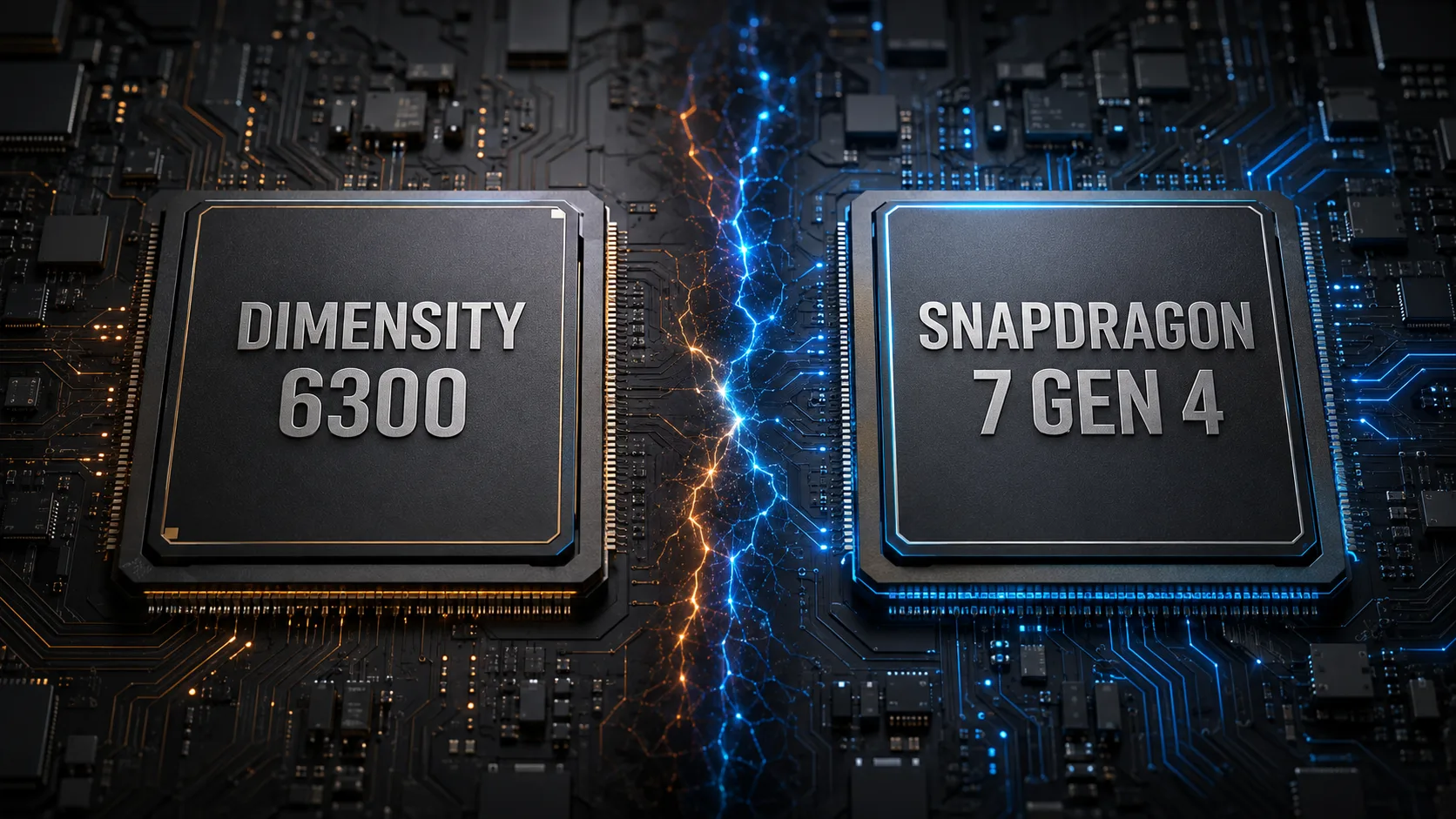
MediaTek Dimensity 6300
vs
Qualcomm Snapdragon 7 Gen 4

SoC Comparison Result
MediaTek Dimensity 6300 vs. Snapdragon 7 Gen 4: Budget 5G vs. Full-fledged Mid-range
MediaTek Dimensity 6300 and Qualcomm Snapdragon 7 Gen 4 belong to different price categories. The former is designed for budget 5G smartphones, while the latter offers significantly faster CPUs and GPUs, a modern ISP, and greater technical headroom. A comparison makes sense when the prices of finished devices overlap: then a smartphone with Dimensity 6300 must compensate for its weaker platform with features or a noticeable discount.
Key Differences
| Parameter | MediaTek Dimensity 6300 | Qualcomm Snapdragon 7 Gen 4 |
|---|---|---|
| Device Class | Entry-level with 5G | Mid-range |
| Process Technology | 6 nm | 4 nm |
| CPU Configuration | 2 × Cortex-A76, 6 × Cortex-A55 | 1 Prime, 4 Performance, and 3 Efficiency Kryo cores |
| Max Clock Speed | 2.4 GHz | 2.8 GHz |
| Graphics | Mali-G57 MC2 | Adreno 722 |
| Memory | LPDDR4X | Up to LPDDR5X |
| Storage | UFS 2.2 | Up to UFS 4.0 |
| Cameras and Video | Up to 108 MP | Up to 200 MP, HDR video 4K at 60 fps |
| Wireless Connectivity | Wi-Fi 5, Bluetooth 5.2 | Wi-Fi 7, Bluetooth 6.0 |
| Max 5G Speed | 3.3 Gbps | 4.2 Gbps |
The table shows the capabilities of the platforms, not the mandatory specifications of each smartphone. For instance, the Snapdragon 7 Gen 4 supports LPDDR5X, UFS 4.0, and Wi-Fi 7, but the vivo V60 received LPDDR4X, UFS 2.2, and Wi-Fi 5. Manufacturers may not utilize a significant portion of the chip's capabilities.
CPU Difference is Noticeable Without Benchmarks
The Dimensity 6300 employs two Cortex-A76 and six Cortex-A55 cores. This configuration handles messengers, navigation, video, and simple applications but finds its two performance cores insufficient for heavy multitasking. Lags become apparent when installing applications, processing photos, and switching between resource-intensive applications.
The Snapdragon 7 Gen 4 has five performance Kryo cores. One runs at speeds of up to 2.8 GHz, while the other four go up to 2.4 GHz. The newer architecture and larger performance cluster accelerate short operations and extended multithreaded loads.
Smartphone Benchmark Results
The table provides approximate results from the open database NanoReview. For some devices, only a few measurements are available, so the numbers indicate performance levels rather than guaranteed results for each unit. All AnTuTu scores refer to version 11.
| Smartphone | Processor | AnTuTu 11 | Geekbench 6, Single Core | Geekbench 6, Multi-core |
|---|---|---|---|---|
| OPPO A5 Pro 5G | Dimensity 6300 | 596,993 | 790 | 2,010 |
| Infinix Hot 50 5G | Dimensity 6300 | 586,229 | 740 | 1,981 |
| realme 14T 5G | Dimensity 6300 | 569,901 | 771 | 1,980 |
| realme 15 Pro 5G | Snapdragon 7 Gen 4 | 1,251,276 | 1,201 | 3,549 |
| vivo V60 | Snapdragon 7 Gen 4 | 1,231,015 | 1,247 | 3,557 |
| realme P4 Pro 5G | Snapdragon 7 Gen 4 | 1,282,176 | 1,209 | 3,575 |
In this selection, Snapdragon is around 60% faster in single-core Geekbench 6 and approximately 80% faster in multi-core. The gap in AnTuTu reaches about 2.1 times. Snapdragon retains responsiveness better under background load and provides a greater headroom for heavy applications.
Graphics - The Weakest Point of Dimensity 6300
Mali-G57 MC2 is suitable for casual games and less demanding online projects. In heavy games, it is necessary to lower the graphics quality, and even then, it does not guarantee a stable frame rate.
The results of specific smartphones in 3DMark Steel Nomad Light show not only a significant gap between the platforms but also a noticeable dependency of Dimensity 6300 on the device implementation.
| Smartphone | Processor | 3DMark Steel Nomad Light |
|---|---|---|
| realme 14x | Dimensity 6300 | 71 |
| OPPO A5 Pro 5G | Dimensity 6300 | 144 |
| vivo V50 Lite 5G | Dimensity 6300 | 149 |
| realme 15 Pro 5G | Snapdragon 7 Gen 4 | 666 |
| vivo V60 | Snapdragon 7 Gen 4 | 667 |
| realme P4 Pro 5G | Snapdragon 7 Gen 4 | 670 |
Even the best result from Dimensity in this selection is about 4.5 times lower. Adreno 722 allows running games with higher settings and complex graphical effects. The specific frame rate still depends on the game, cooling, and the smartphone's firmware.
Cameras and Artificial Intelligence
The Dimensity 6300 supports sensors with resolutions up to 108 MP; however, the video recording capabilities and computational photography align with the budget class. Camera resolution alone does not determine the quality of the shots.
The Snapdragon 7 Gen 4 features a triple 12-bit ISP, hardware electronic stabilization, and support for HDR video 4K at 60 fps. Its Hexagon NPU is designed for local language models, translation, image generation, and other generative AI functions.
Implementation depends on the manufacturer. The presence of an appropriate block in the SoC does not guarantee that all declared functions will appear in the firmware of a particular smartphone.
Battery Life and Heating
Determining a winner based on process technology alone is not feasible. The peak energy consumption of Dimensity 6300 may be lower, but this does not guarantee better battery life for the finished smartphone. Snapdragon quickly completes short tasks; however, its powerful GPU can consume more energy in games.
The final runtime is influenced by the battery, display, modem, firmware, and power limitations of a specific device. Therefore, choosing Dimensity 6300 for its presumed battery life is not advisable. It is essential to compare the results of finished smartphones rather than the numbers of 6 and 4 nm in the specifications.
What to Choose
With comparable pricing and features, a smartphone with Snapdragon 7 Gen 4 is preferable. It is significantly faster in everyday applications, around twice as powerful in the overall AnTuTu score, and more than four times stronger in heavy graphical tests. The platform also has a higher technical ceiling for memory, storage, cameras, connectivity, and local AI.
The Dimensity 6300 is justified in a significantly cheaper smartphone or in a model with specific advantages: better display, casing protection, cameras, battery, or longer software support. If such advantages are absent, an equal price turns the choice of Dimensity 6300 into a cost-saving measure by the manufacturer at the expense of the buyer.
Advantages
- Higher Technology: 4 nm (6 nm vs 4 nm)
- Higher Frequency: 2800 MHz (2400 MHz vs 2800 MHz)
- Newer Launch Date: May 2025 (April 2024 vs May 2025)
Basic
GPU Specifications
Connectivity
Memory Specifications
Miscellaneous
Benchmarks
Comparison of Devices
Related SoC Comparisons




Share in social media
Or Link To Us
<a href="https://cputronic.com/index.php/soc/compare/mediatek-dimensity-6300-vs-qualcomm-snapdragon-7-gen-4" target="_blank">MediaTek Dimensity 6300 vs Qualcomm Snapdragon 7 Gen 4</a>