Qualcomm Snapdragon 7 Gen 4
vs
Apple A16 Bionic


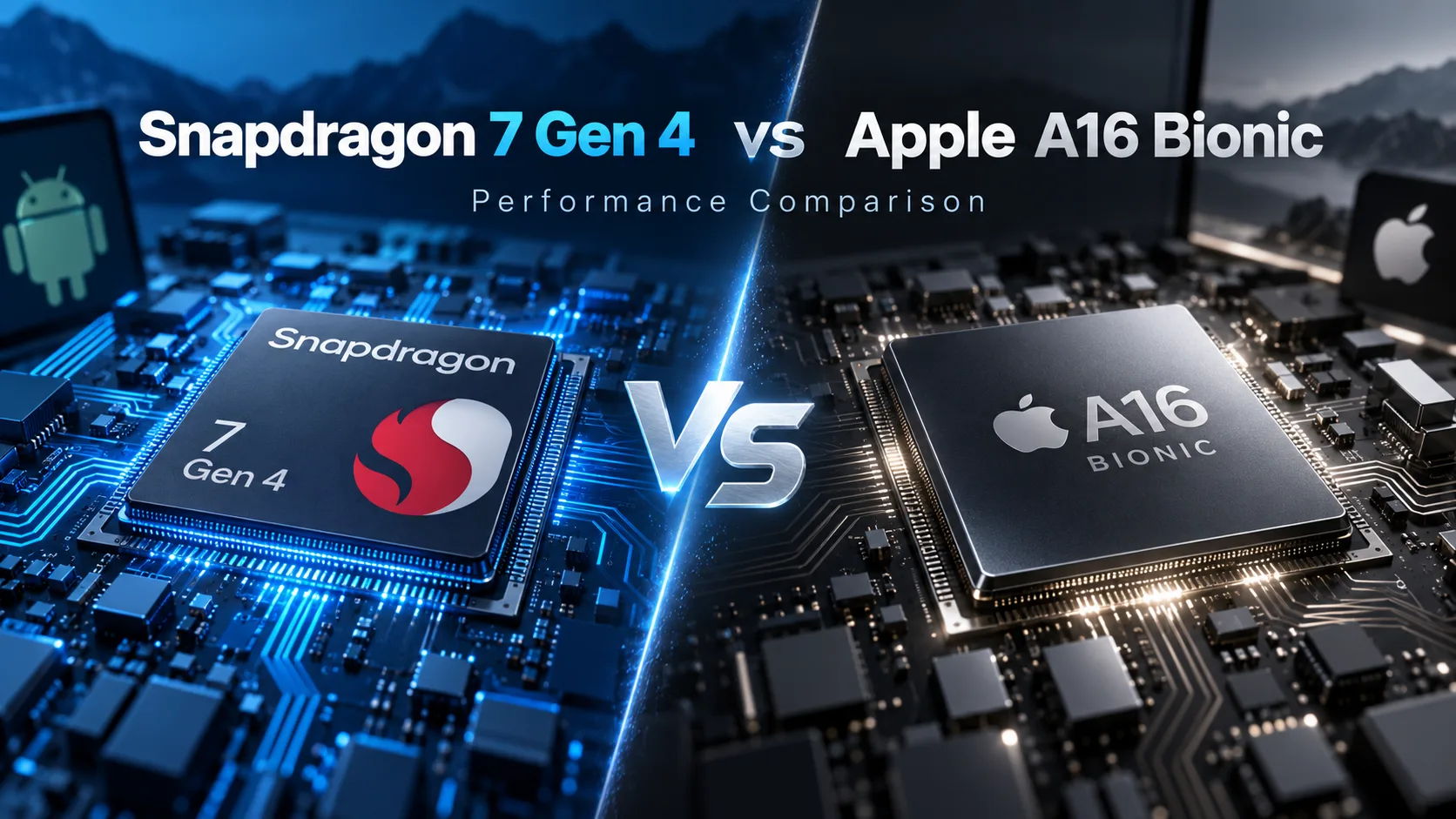
SoC Comparison Result
Snapdragon 7 Gen 4 vs. Apple A16 Bionic: How Much Faster Is the A16?
The Snapdragon 7 Gen 4 appeared almost three years after the A16 Bionic, yet Apple’s chip remains noticeably faster in CPU tests. In Geekbench 6, the A16 is nearly twice as fast in the single-core test and approximately 60% faster in the multi-core test. At the same time, the Snapdragon 7 Gen 4 supports LPDDR5X, UFS 4.0, and Wi-Fi 7, while smartphones featuring it are positioned in a lower price segment from the outset.
Key Differences
| Parameter | Snapdragon 7 Gen 4 | Apple A16 Bionic |
|---|---|---|
| Release year | 2025 | 2022 |
| Device class | Mid-range | Flagship |
| CPU | 1 + 4 + 3 cores | 2 + 4 cores |
| Maximum frequency | 2.8 GHz | 3.46 GHz |
| GPU | Adreno 722 | 5-core Apple GPU |
| Process technology | 4 nm TSMC | 4 nm TSMC |
| Memory | up to LPDDR5X | LPDDR5 |
| Storage | up to UFS 4.0 | NVMe |
| Wi-Fi | up to Wi-Fi 7 | Wi-Fi 6 |
The Snapdragon 7 Gen 4 includes one Prime core clocked at up to 2.8 GHz, four performance cores running at up to 2.4 GHz, and three efficiency cores. The A16 has six CPU cores, but its two performance cores deliver significantly higher single-threaded performance and run at up to 3.46 GHz.
The A16 was designed for Apple’s expensive flagships, while the Snapdragon 7 Gen 4 is intended for mid-range Android smartphones.
Smartphones, Benchmarks, and Prices
| Smartphone | Chip | Geekbench 6 Single / Multi | AnTuTu 11 | 3DMark Wild Life Extreme | Launch price |
|---|---|---|---|---|---|
| Realme 15 Pro 5G | Snapdragon 7 Gen 4 | 1201 / 3549 | 1 251 276 | - | around $370 |
| Vivo V70 | Snapdragon 7 Gen 4 | 1279 / 4114 | 1 410 609 | 2073 | around $500 |
| Nothing Phone (4a) Pro | Snapdragon 7 Gen 4 | 1332 / 4146 | 1 355 225 | 2068 | $499 |
| Apple iPhone 15 | A16 Bionic | 2612 / 6705 | 1 672 293 | 2868 | $799 |
| Apple iPhone 15 Plus | A16 Bionic | 2631 / 6602 | 1 527 281 | 3340 | $899 |
The price difference between the devices is substantial: Snapdragon 7 Gen 4 models launched at approximately $370-500, while the iPhone 15 started at $799.
Even smartphones with the same SoC can produce different results. Cooling, power limits, memory, and the manufacturer’s settings all affect the results, so the performance of a specific model should be assessed based on its benchmark results.
CPU Performance
In Geekbench 6, the Snapdragon 7 Gen 4 scores approximately 1325 points on average in Single-Core and 4081 points in Multi-Core. The A16 Bionic scores approximately 2562 and 6685 points, respectively.
In the single-core test, the A16 is approximately 93% faster, while in the multi-core test it is approximately 64% faster.
The gap is smaller in AnTuTu. The Snapdragon 7 Gen 4 scores around 976,000 points, while the A16 Bionic scores around 1.42 million. Apple’s advantage is approximately 46%.
Geekbench is more informative for comparing CPU performance because AnTuTu’s overall score also depends on the GPU, memory, and storage.
Graphics and Gaming
Smartphones with the Snapdragon 7 Gen 4 score around 2070 points in 3DMark Wild Life Extreme.
The iPhone 15 with the A16 scores around 2868 points, while the iPhone 15 Plus scores approximately 3340. Depending on the device, the A16’s advantage is approximately 40-60%.
The GPU gap is smaller than the gap in single-core CPU performance, but the A16 is still ahead here as well.
Memory, Storage, and Wireless Interfaces
The Snapdragon 7 Gen 4 supports LPDDR5X, UFS 4.0, Wi-Fi 7, and Bluetooth 6.0. However, a specific smartphone may use slower memory, storage, or a wireless module.
In devices with the A16, Apple uses NVMe storage, so directly comparing UFS 4.0 with the iPhone’s storage system based on the standard name alone would be incorrect.
Conclusion
The Apple A16 Bionic is noticeably faster than the Snapdragon 7 Gen 4 in CPU performance and retains an advantage in graphics. In Geekbench 6 Single-Core, the difference approaches twofold, while in Multi-Core the A16 is approximately 60% faster.
The Snapdragon 7 Gen 4’s advantage is more affordable smartphones with support for LPDDR5X, UFS 4.0, and Wi-Fi 7.
The A16 was originally designed for flagship iPhones and remains noticeably faster, while the Snapdragon 7 Gen 4 is intended for mid-range Android smartphones with a lower starting price.
Advantages
- Newer Launch Date: May 2025 (May 2025 vs September 2022)
- Higher Frequency: 3460 MHz (2800 MHz vs 3460 MHz)
Basic
4x 2.02 GHz – Sawtooth
GPU Specifications
Connectivity
Memory Specifications
Miscellaneous
Benchmarks
Related SoC Comparisons




Share in social media
Or Link To Us
<a href="https://cputronic.com/index.php/soc/compare/qualcomm-snapdragon-7-gen-4-vs-apple-a16-bionic" target="_blank">Qualcomm Snapdragon 7 Gen 4 vs Apple A16 Bionic</a>