Qualcomm Snapdragon 6s Gen 3
vs
MediaTek Dimensity 6300
SoC Comparison Result
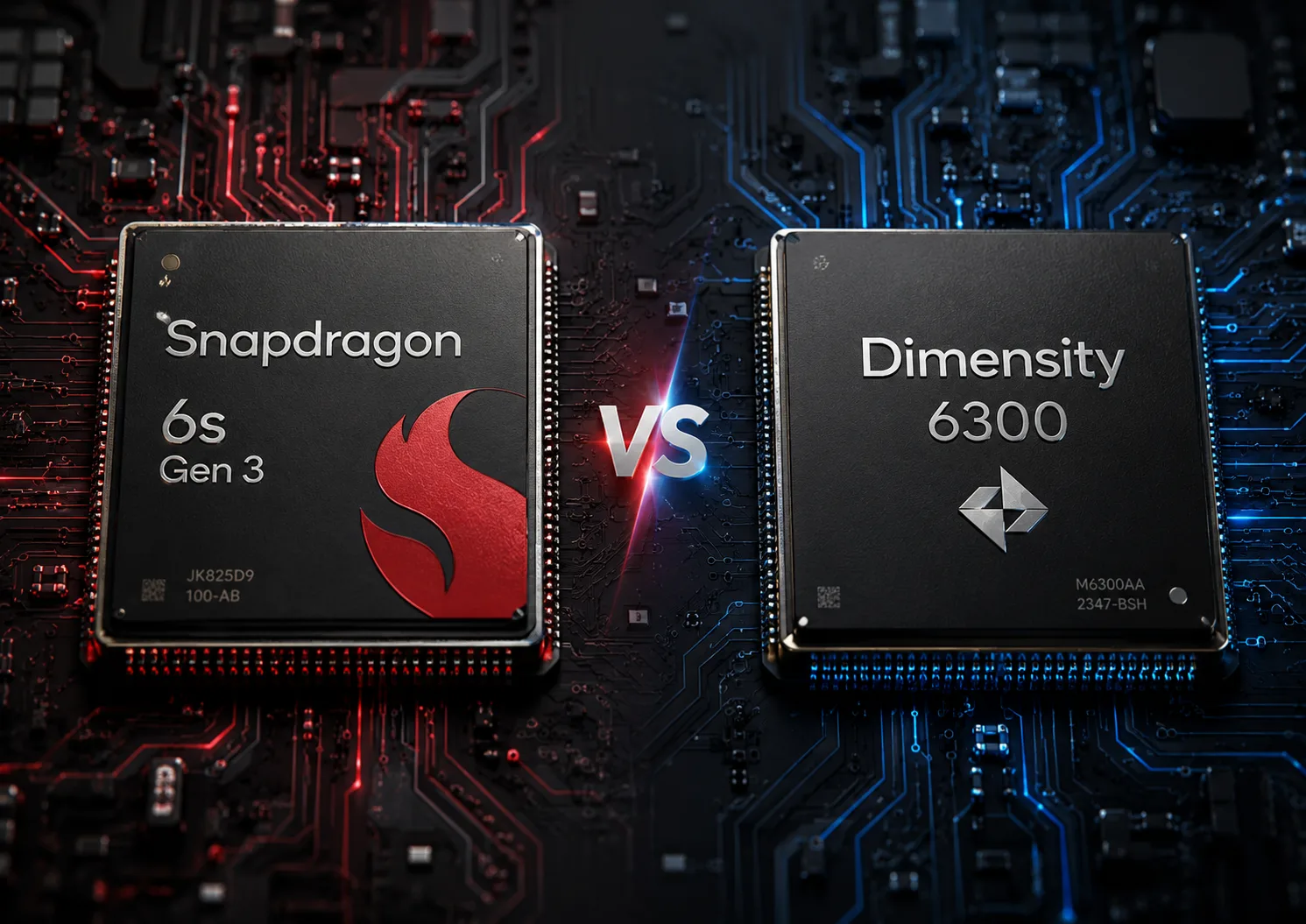
Snapdragon 6s Gen 3 vs Dimensity 6300: Which Budget 5G Chip is Better
Snapdragon 6s Gen 3 and MediaTek Dimensity 6300 are not a showdown of new technologies, but a comparison of two carefully updated budget 5G platforms. Both chips were released in 2024, both utilize a 6nm manufacturing process, and both are designed for affordable smartphones with 120Hz screens and 5G support. However, the approaches differ: Qualcomm focuses on newer Cortex-A78 CPU cores, while MediaTek targets a mass-market, accessible 5G chip with a decent set of features.
When comparing just the processors, the Snapdragon 6s Gen 3 is stronger. However, in the budget segment, it’s not just about the chip, but the whole smartphone: screen, memory, charging, camera, battery, and price. Therefore, the Dimensity 6300 should not be automatically dismissed, especially if the phone built on it is better equipped.
Important: Don’t Confuse Snapdragon 6s Gen 3 with Snapdragon 6 Gen 3
The name Snapdragon 6s Gen 3 can be misleading. It seems almost identical to Snapdragon 6 Gen 3, but they are different platforms.
Snapdragon 6 Gen 3 is noticeably higher class: it has a more powerful CPU configuration and an Adreno 710 GPU. The Snapdragon 6s Gen 3 is simpler and closer to the Snapdragon 695-class. Essentially, it is not a new leap in the 6 series but an upgrade of Qualcomm's older successful budget-midrange platform under a fresh name.
Dimensity 6300 has a similar story. It is also not a revolution but an evolution of the Dimensity 6100 Plus: the same basic logic with two performance cores Cortex-A76 and six Cortex-A55, but with increased frequency. Therefore, this comparison is interesting not only in speed but also in how fairly each chip looks in its class.
Main Differences
| Difference | Snapdragon 6s Gen 3 | Dimensity 6300 | What It Means |
|---|---|---|---|
| Fast Cores | 2x Cortex-A78 | 2x Cortex-A76 | Snapdragon is more modern |
| Frequency of Fast Cores | up to 2.3 GHz | up to 2.4 GHz | Dimensity is higher in frequency but not faster |
| Energy-efficient Cores | 6x Cortex-A55 | 6x Cortex-A55 | Parity |
| Graphics | Adreno 619 | Mali-G57 MC2 | Snapdragon usually performs better in games |
| Tech Process | 6nm | 6nm | One class |
| Memory | LPDDR4X | LPDDR4X | Parity |
| Storage | UFS 2.2 | UFS 2.2 | Parity |
| 5G Download | up to 2.5 Gbit/s | up to 3.3 Gbit/s | Dimensity is higher on paper |
| Wi-Fi | Wi-Fi 4/5 | Wi-Fi 5 | Both lack Wi-Fi 6 |
The main line in the table is not frequency but architecture. The Dimensity 6300 operates at up to 2.4 GHz, but it uses the older Cortex-A76. The Snapdragon 6s Gen 3 is limited to 2.3 GHz but features Cortex-A78. Therefore, it is usually faster in tasks where the performance of one or two powerful cores is important.
Performance: Snapdragon is Faster Where It Matters
In everyday use, the Snapdragon 6s Gen 3 should feel more responsive. Its advantage is particularly significant in browsing, launching applications, interface navigation, multitasking, and light photo processing. It’s not flagship-level but the performance headroom of the Qualcomm chip is higher.
The Dimensity 6300 is weaker in CPU architecture; however, it’s sufficient for regular tasks. Messengers, YouTube, navigation, calls, social media, banking apps, and daily photography do not require a large power margin. The difference is likely to manifest over time: a smartphone with Snapdragon has a better chance of remaining responsive longer, provided the manufacturer hasn’t skimped on memory and firmware.
Benchmarks
| Test | Snapdragon 6s Gen 3 | Dimensity 6300 | Difference |
|---|---|---|---|
| AnTuTu 11 | around 623,000 | around 533,000 | Snapdragon approximately +17% |
| Geekbench 6 Single-Core | around 938 | around 771 | Snapdragon approximately +22% |
| Geekbench 6 Multi-Core | around 2180 | around 1980 | Snapdragon approximately +10% |
| GPU Compute | around 1610 | around 1415 | Snapdragon approximately +14% |
| PCMark | around 11,500 | around 10,200 | Snapdragon approximately +13% |
In benchmarks, the Snapdragon 6s Gen 3 appears stronger almost everywhere. The most notable advantage is in Geekbench Single-Core, as single-threaded performance often affects the perceived speed in simple tasks.
However, the difference should not be exaggerated. This advantage exists within a single budget-midrange class, not a gap between a weak and a flagship chip. In specific smartphones, results may vary due to cooling, memory, firmware, and power limits.
Gaming and Graphics
In graphics, the advantage generally goes to the Snapdragon 6s Gen 3. Adreno 619 typically performs better than Mali-G57 MC2, especially in popular Android games where drivers and optimization are important. In PUBG Mobile, Call of Duty Mobile, Asphalt, and similar projects, Snapdragon should be more stable.
But it is not a gaming processor. In heavy games like Genshin Impact or Honkai: Star Rail, both chips will quickly hit low settings, heating, and restrictions of a specific smartphone. Snapdragon is better, but it doesn’t turn a budget phone into a gaming model.
Connectivity, Wi-Fi, and Camera
For 5G, the Dimensity 6300 has an interesting advantage: its claimed download speed is higher - up to 3.3 Gbit/s versus 2.5 Gbit/s for the Snapdragon 6s Gen 3. In practice, this rarely becomes a decisive factor. Actual speed depends on the operator, region, bands, smartphone antennas, and firmware.
In terms of Wi-Fi, both chips appear modest. Neither features Wi-Fi 6, which clearly reflects their class: these platforms are for affordable devices, where manufacturers save not only on CPU and GPU but also on the wireless component.
The camera situation is similar. Both chips support sensors up to 108 MP, but this number alone guarantees little. In actual smartphones, the specific sensor, OIS presence, optics, and processing matter more. A phone with the Dimensity 6300 and a good primary camera can shoot better than a model on the Snapdragon 6s Gen 3 with a simpler camera.
Why the Smartphone is More Important than the Bare Chip
If two smartphones are priced similarly and are otherwise close, the Snapdragon 6s Gen 3 is a more logical choice. It is faster, more modern in CPU, and usually performs better in graphics.
However, if a model based on the Dimensity 6300 is significantly cheaper or offers a better screen, more memory, faster charging, decent storage, or a camera with OIS, the choice becomes less obvious. In the budget segment, manufacturers can save on any component, and a faster chip doesn’t always compensate for a weak display, slow charging, or limited memory.
Before purchasing, it's important to consider not only the processor name but also several factors:
- resolution and brightness of the display;
- amount of RAM;
- type of storage;
- charging speed;
- presence of OIS in the main camera;
- battery capacity;
- quality of the interface and Android updates.
These parameters often have a greater impact on the daily experience with a smartphone than a difference of 10-20% in benchmarks.
What to Choose
Choose the Snapdragon 6s Gen 3 if interface speed, browsing, gaming, performance headroom, and a more reliable operation over the next couple of years are important. It has better CPU architecture, higher single-core performance, and usually stronger graphics. At the same price, it’s the preferred option.
Consider the Dimensity 6300 if a smartphone built on it is noticeably cheaper or better equipped. The chip itself is weaker, but it’s sufficient for ordinary tasks. It’s a decent platform for an affordable 5G smartphone if the manufacturer hasn’t cut corners on memory, screen, and battery.
Conclusion
The Snapdragon 6s Gen 3 wins in the chip comparison. It has newer Cortex-A78 cores, higher single-core performance, better results in most benchmarks, and usually stronger graphics. If the prices of the smartphones are identical, the Snapdragon appears more favorable.
However, it should not be perceived as a full new generational leap. The Snapdragon 6s Gen 3 is closer to an upgraded Snapdragon 695-class than to a true Snapdragon 6 Gen 3. The Dimensity 6300 is also not a revolution, but it honestly fulfills the task of an affordable 5G smartphone: decent everyday speed, 120Hz screens, UFS 2.2, and sufficient performance for most users.
The best chip is the Snapdragon 6s Gen 3. The best smartphone for your money is the one where the chip is complemented by a good screen, memory, battery, and camera.
Advantages
- Newer Launch Date: June 2024 (June 2024 vs April 2024)
- Higher Frequency: 2400 MHz (2300 MHz vs 2400 MHz)
Basic
6x 2 GHz – Cortex-A55
GPU Specifications
Connectivity
Memory Specifications
Miscellaneous
Benchmarks
Related SoC Comparisons



Share in social media
Or Link To Us
<a href="https://cputronic.com/index.php/soc/compare/qualcomm-snapdragon-6s-gen-3-vs-mediatek-dimensity-6300" target="_blank">Qualcomm Snapdragon 6s Gen 3 vs MediaTek Dimensity 6300</a>