NVIDIA Tesla V100 PCIe 32 GB
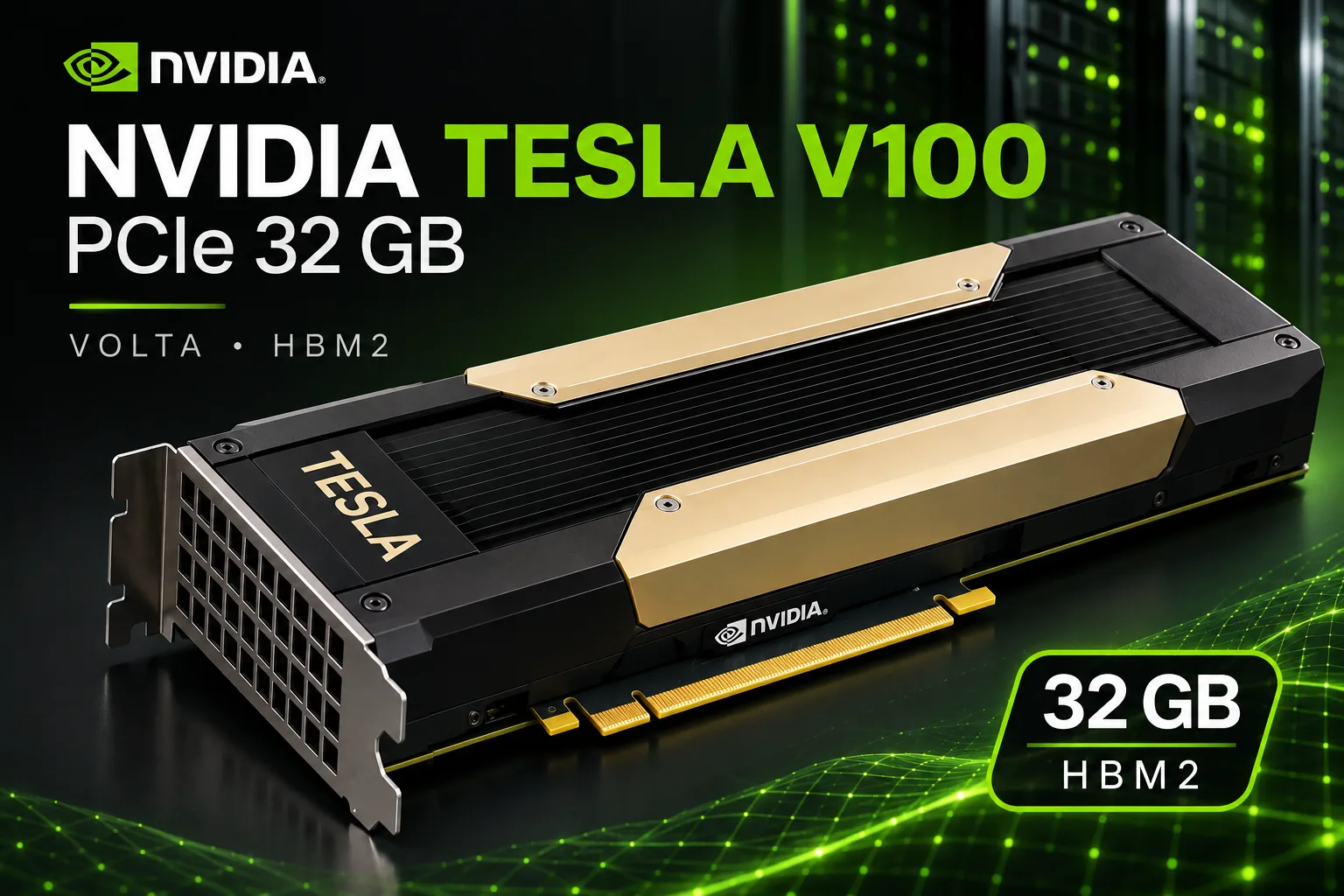
Tesla V100 PCIe 32 GB: memory for 27-billion-parameter models, but with a premium for the PCIe connector
The Tesla V100 PCIe 32 GB is a version of the V100 server accelerator with twice the memory. NVIDIA released it in March 2018 at a price of around $11,500. Today, decommissioned cards sell on eBay for about $700.
It has the same die, clock speeds, and 900 GB/s of memory bandwidth as the 16 GB version. But in 2026, capacity is what matters. The 32 GB of memory accommodates dense 27-32-billion-parameter models in 4-bit quantization with a long context, and the V100 produces around 30 tokens per second on them.
There are two drawbacks. Volta no longer receives new drivers and has no support for CUDA 13. And the PCIe version costs almost three times as much as the 16 GB model and noticeably more than an SXM2 module with the same capacity.
Position in the lineup
All V100 cards use the GV100 die: TSMC’s 12 nm process, 5120 CUDA cores, 640 first-generation tensor cores, and four HBM2 stacks on a 4096-bit bus. The 32 GB versions and their closest relatives are:
| Model | Memory | Bandwidth | Boost | TDP | Features |
|---|---|---|---|---|---|
| Tesla V100 PCIe 16 GB | 16 GB HBM2 | 900 GB/s | 1380 MHz | 250 W | the same card with half the memory |
| Tesla V100 PCIe 32 GB | 32 GB HBM2 | 900 GB/s | 1380 MHz | 250 W | passive heatsink, no NVLink or display outputs |
| Tesla V100 SXM2 32 GB | 32 GB HBM2 | 900 GB/s | 1530 MHz | 300 W | SXM2 server connector, NVLink |
| Tesla V100S PCIe 32 GB | 32 GB HBM2 | 1134 GB/s | 1601 MHz | 250 W | 2019 refresh |
| Quadro GV100 | 32 GB HBM2 | 870 GB/s | 1627 MHz | 250 W | display outputs, professional driver |
The PCIe version’s rated performance is 14 TFLOPS in FP32, 7 TFLOPS in FP64, and 112 TFLOPS on the tensor cores. The tensor cores work only with FP16. Volta has no RT cores, BF16, or TF32.
The same reference board appears in listings under different part numbers: PNY TCSV100M-32GB-PB, Dell 490-BENZ and 0HR5WD, HPE Q9U36A, Lenovo 4X67A12088, and Cisco UCSC-GPU-V100-32=.
Performance
Language models
Token generation speed is limited by memory bandwidth. As a result, the 32 GB V100 performs just like the 16 GB version on smaller models. Measurements by the llama.cpp developers using the same code version:
| Card | Memory | gpt-oss 20B, prompt (pp2048), tok/s | gpt-oss 20B, generation (tg128), tok/s | Llama 8B Q4_0, generation, tok/s |
|---|---|---|---|---|
| Tesla P40 | 24 GB GDDR5 | 1362 | 65 | 52 |
| Instinct MI50/MI60 | 32 GB HBM2 | 1066 | 144 | - |
| Tesla V100 PCIe 32 GB | 32 GB HBM2 | 2436 | 151 | 128 |
| GeForce RTX 3090 | 24 GB GDDR6X | 5824 | 210 | 155 |
| GeForce RTX 4090 | 24 GB GDDR6X | 13,127 | 264 | 179 |
| GeForce RTX 5090 | 32 GB GDDR7 | 21,011 | 412 | 282 |
On gpt-oss 20B, the V100 generates 28% more slowly than the RTX 3090 and is on par with the AMD card. The test does not specify whether the MI50 or MI60 was used. The V100 processes the prompt 2.3 times faster than the AMD card, but 2.4 times slower than the 3090.
This card is purchased for its 32 GB of memory, which accommodates dense 27-billion-parameter models. Below are owner reports: llama.cpp, one request, without acceleration. The SXM2 results also apply to the PCIe version: the cards have the same memory, and generation is limited specifically by it. The directly comparable rows are those using Qwen3.6 27B Q4_K_M.
| Configuration | Model and quantization | Generation, tok/s | Prompt, tok/s |
|---|---|---|---|
| V100 PCIe 32 GB | Qwen3.8 27B, UD-Q4_K_XL | 33.4 | 826 |
| V100 SXM2 32 GB | Qwen3.6 27B, Q4_K_M | 32.2 | - |
| V100 SXM2 32 GB | Qwen3.6 27B, Q8_0 | 22.8 | - |
| RTX 5090 | Qwen3.6 27B, Q4_K_M | 77 | - |
Generation at 32-33 tokens per second on a 27B model in 4-bit quantization is sufficient for chat and agent tasks. The RTX 5090 is 2.4 times faster, but it also costs almost nine times as much.
Software techniques have a greater impact than choosing between PCIe and SXM2. With MTP, which predicts multiple tokens per step, Qwen3.8 27B accelerates from 33 to 57 tokens per second. The improvement is greatest on code and smaller on prose. A vLLM fork in a single thread is 10% slower than llama.cpp. However, with four simultaneous requests, it produces a combined 110 tokens per second, compared with 75.7.
As the context grows, speed declines: from 33.4 tokens per second with an empty context to 28 at 32,000 tokens and 15.8 at 131,000. Cooling also needs to be monitored. One owner reported that the card dropped to 15.7 tokens per second until he set the server fans to maximum.
In one test, the V100 proved more energy-efficient than the RTX 4070. On Qwen3.5 4B, it produced 107 tokens per second at 154 W, while the 4070 produced 91 tokens at 173 W-in other words, 30% fewer tokens per joule. The 4070 processes the prompt faster: 5860 tokens per second versus 4445.
Training, calculations, and gaming
The 32 GB of memory allows larger models to be fine-tuned in FP16, but without BF16 and FlashAttention 2, modern training pipelines have to be reworked. According to Lambda’s measurements on SXM2 versions, the A100 trains 1.6-3.4 times faster.
The V100 remains strong in FP64. Its 7 TFLOPS is approximately five times more than the RTX 4090, while its 32 GB of memory can accommodate large grids for CFD and molecular dynamics.
The card is unsuitable for gaming. It has no display outputs, DLSS, or ray tracing, and its performance is slightly below that of the RTX 4060 Ti.
Software support
The R580 driver branch is the last one to support Volta. CUDA 13 does not compile for this architecture, so CUDA 12.x is the remaining option. Prebuilt versions of llama.cpp and LM Studio are gradually dropping V100 support. One owner found that KV-cache quantization silently moved to the CPU specifically because Volta is absent from CUDA 13.
The platform is being kept alive by enthusiasts: vLLM forks for sm_70, an ExLlamaV3 port, and llama.cpp builds with MTP. That is enough for home experiments. In a production system, you will depend on how much longer their authors continue supporting them.
Prices and where to buy one
New V100 cards have not been produced for a long time; the card is now available only used.
| Offer | Configuration | Price |
|---|---|---|
| eBay US, lowest price (October 2026) | V100 PCIe 32 GB | ~$685-695 |
| eBay US, average among active listings | V100 PCIe 32 GB | ~$920 |
| Amazon / Newegg (October 2026) | V100 PCIe 32 GB | $799 / $839 |
| Individual overseas sellers | V100 PCIe 32 GB | $400-500 |
| SXM2 module + adapter | V100 SXM2 32 GB | ~$250-600 |
| IT Creations | V100S PCIe 32 GB | $8937 |
| TechMikeNY, Dell PowerEdge R740 | server with one V100 PCIe 32 GB | $12,156 |
The low end of eBay pricing has barely moved since the beginning of the year: about $707 in February and about $685 now. The card appears below $500 only from individual overseas sellers. Such listings, like the cheapest ones on eBay, usually come without a warranty. The price should also include a fan with a shroud: without server airflow, the passive heatsink overheats.
Resellers and server builders ask an order of magnitude more. With a server build, you are mainly paying for the processors, memory, and drives.
Competitors and alternatives
Tesla V100 SXM2 32 GB with an adapter. The same die and the same capacity, with a 10% higher clock speed, for $250-600 including the adapter. The drawbacks are having to assemble it yourself, the noisy stock fan, and 300 W under load. For a home PC, this is the cheapest way to get 32 GB of HBM2.
Two V100 PCIe 16 GB cards. About $470 for the same 32 GB. llama.cpp will split the model across layers, and generation will remain at the level of a single card. You will need two x16 slots and a power supply with 500 W of headroom.
GeForce RTX 3090. It is 20-40% faster in generation, processes prompts 2.4 times faster, and additionally offers BF16, FlashAttention, and supported drivers. A 27B model in 4-bit quantization fits in its 24 GB, but with less room for context; a 32B model in Q5-Q6 does not. It costs about $1386, twice as much as the V100.
GeForce RTX 5090. The same 32 GB of memory and much higher speed. Due to the memory shortage, it costs from $6000 despite a recommended price of $1999. That works out to about $190 per gigabyte, compared with $22 for the V100.
AMD Instinct MI50 32 GB. Generation performance is on par with the V100, while prompt processing is more than twice as slow. It costs $120-210 from suppliers on Alibaba and $500-650 on eBay. In practice, the cards work reliably mainly with llama.cpp and basic PyTorch.
Conclusion
By modern standards, the V100 PCIe 32 GB is a slow compute device with large, fast memory. It is sufficient for holding a 27-32-billion-parameter model with a long context and working with it at a comfortable pace. The limitations begin with long prompts, training, and software. The card is not suitable for production systems.
A reasonable price for the PCIe version is up to $450-500. At the current $700, it loses to a 32 GB SXM2 module with an adapter. Paying extra for the PCIe version makes sense only if the card is installed in a rack server such as a Dell R740 or HPE DL380: an adapter cannot be installed there, while the built-in airflow solves the cooling issue.
If 24 GB is sufficient and you need speed with proper software support, it is better to pay extra for an RTX 3090. If you need the maximum memory for the minimum price, the V100 SXM2 32 GB or MI50 is the better deal.
GPU Comparison
Compare Tesla V100 PCIe 32 GB with other GPUs
Basic
Memory Specifications
Display and Media
Theoretical Performance
Miscellaneous
Benchmarks
Compared to Other GPU
Related GPU Comparisons


Share in social media
Or Link To Us
<a href="https://cputronic.com/index.php/gpu/nvidia-tesla-v100-pcie-32-gb" target="_blank">NVIDIA Tesla V100 PCIe 32 GB</a>