Intel Core Ultra X7 358H
Intel Core Ultra X7 358H: Analysis of the Next-Generation Panther Lake Processor for Laptops
The introduction of Intel Core Ultra X7 series processors based on the Panther Lake architecture marks a new phase in the evolution of mobile platforms. The 358H model, combining an advanced 3nm manufacturing process, a hybrid architecture with 16 cores, and support for the latest standards, positions itself as a solution for high-performance ultra-thin laptops. In this article, we will thoroughly analyze the capabilities of this chip, its performance, and optimal usage scenarios.
Architecture and Manufacturing Process: The Foundation of Power
The Intel Core Ultra X7 358H processor, known by the codename Panther Lake, is built on a 3nm technology process. This allows for increased transistor density, directly impacting energy efficiency and performance.
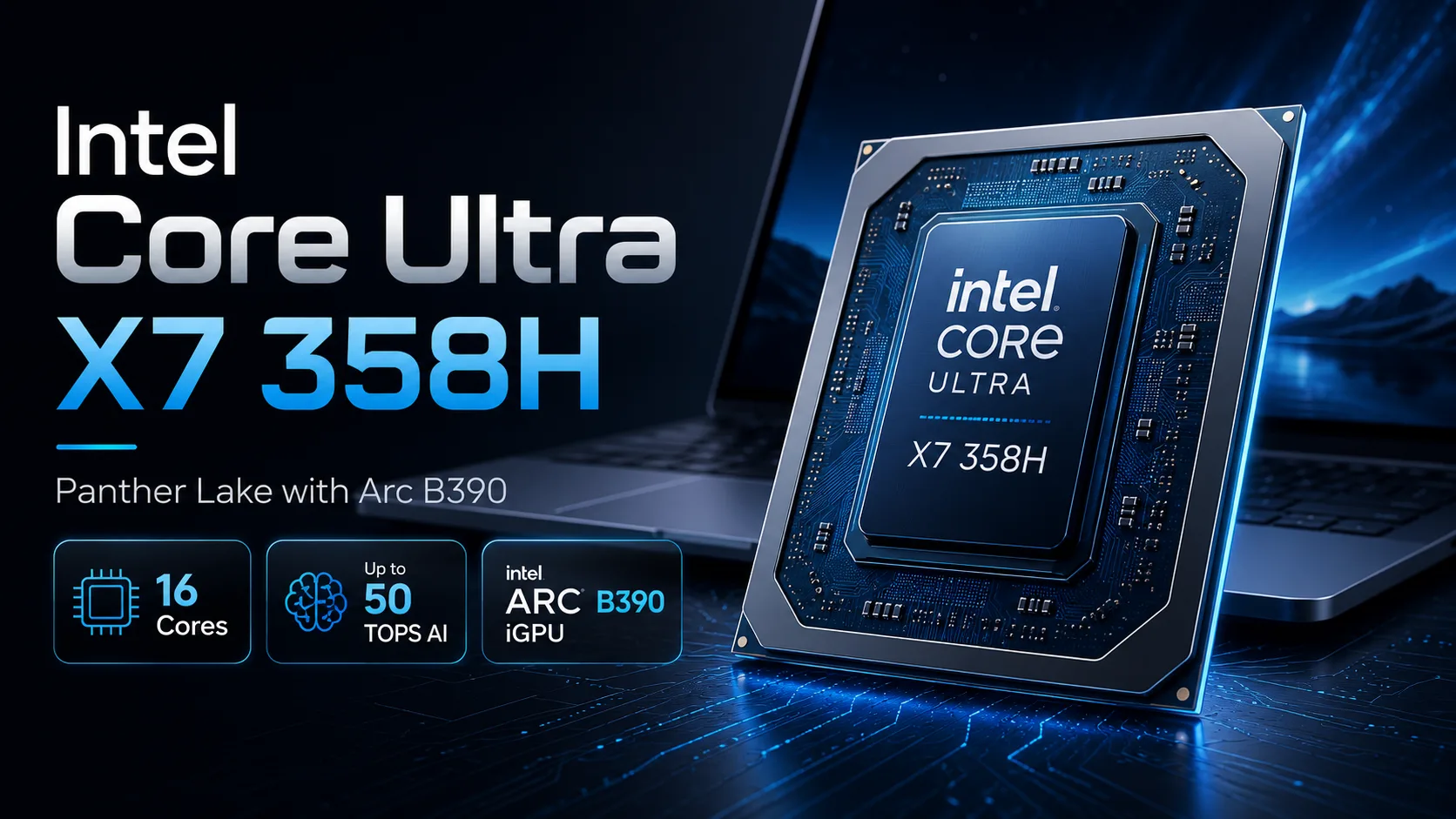
Key architectural features:
- Hybrid Core Structure: The chip includes 16 physical cores divided into two types:
- Performance Cores (P-cores): 4 cores with Hyper-Threading support (8 threads total). The base frequency is 2.2 GHz, while the maximum turbo frequency reaches 4.8 GHz. These cores are responsible for handling heavy single-threaded and multi-threaded tasks.
- Efficient Cores (E-cores): 12 cores operating at a base frequency of 1.7 GHz. They do not support Hyper-Threading, so the total number of processor threads is 16. E-cores are designed for background and light tasks, ensuring minimal power consumption.
- Cache Memory: The cache configuration includes 112 KB L1 per core, 3 MB L2 for each performance core, and a total L3 cache of 18 MB. This hierarchy is optimized to reduce data access latencies.
- Integrated Graphics: The processor features an integrated graphics controller (iGPU) with 12 execution units (EUs). The GPU frequency ranges from a base of 800 MHz to a maximum dynamic frequency of 2300 MHz. This solution, based on the new Xe-LPG+ architecture or its successor, is expected to provide a significant performance boost compared to previous generations of Iris Xe.
- System Bus and Interfaces: The processor uses an FCBGA-2049 socket. It supports the PCI Express 5.0 standard, doubling the bandwidth compared to PCIe 4.0 and ensuring high speed for modern storage devices.
Power Consumption and Thermal Design Power (TDP)
The nominal thermal design power (TDP) of the Core Ultra X7 358H processor is rated between 20-28 W. This specification serves as a reference for laptop manufacturers:
- 20 W Mode: Allows for the creation of ultra-thin and lightweight devices (ultrabooks) with passive or very compact active cooling. In this mode, peak performance will be limited.
- 28 W Mode: This mode is for more powerful thin laptops and compact workstations. The cooling system in such devices can sustain high frequencies longer, especially in turbo mode.
- Maximum Operating Temperature: Stands at 110 °C, which is a standard value for modern mobile processors.
The flexibility of TDP configuration allows OEM manufacturers to balance between chassis thickness, cooling system noise, and overall performance across different laptop lines.
Performance: Test Results and Real-World Scenarios
According to synthetic test results, the processor demonstrates a high level of performance.
- Single-Core Speed: A Geekbench 6 score of 2735 and 4282 points in PassMark CPU Single Core indicate excellent responsiveness in everyday tasks: web browsing, office applications (Word, Excel), and running lightweight software. This performance is bolstered by the high turbo boost up to 4.8 GHz on the P-cores.
- Multi-Core Power: Scores of 10486 in Geekbench 6 Multi-Core and 29426 in PassMark CPU Multi-Core show significant potential for multi-threaded workloads, aided by the 12 efficient cores that handle the majority of parallel tasks.
- Real-World Scenarios:
- Office Work and Multitasking: Streaming video, numerous browser tabs, document work, and communication through messengers are all performed flawlessly. The E-cores efficiently offload the P-cores, maintaining high system responsiveness.
- Multimedia and Content Creation: Hardware blocks accelerate video encoding and decoding in H.264/HEVC/AV1 formats. For light video editing in 1080p or 4K (with simple effects), the performance is sufficient. For professional work with 8K or complex color grading, discrete graphics will be required.
- Gaming on iGPU: The integrated graphics operating at up to 2.3 GHz will allow smooth gameplay in popular online games (such as Dota 2, CS:2, Valorant) at Full HD resolution on low or medium settings. For AAA titles from recent years, the iGPU will only suffice for the lowest settings at 720p-1080p. Paired with an entry-level or mid-range discrete graphics card (e.g., NVIDIA GeForce RTX 4050/4060), the processor will not become a bottleneck in most games.
- Turbo Mode Behavior: Intel Turbo Boost technology will dynamically raise the P-core frequencies to 4.8 GHz when thermal headroom permits. The duration and stability of operation at maximum frequencies depend entirely on the cooling efficiency of the specific laptop. In thin chassis, turbo mode may be short-lived (15-30 seconds), while in thicker devices, it can be sustained longer.
Usage Scenarios: Who Needs the Core Ultra X7 358H?
This processor is neither aimed solely at extreme gaming nor strictly office applications. It occupies the niche of high-performance thin and versatile laptops.
- Professionals valuing mobility: Engineers, analysts, developers working with large data sets, virtual machines, and moderately complex computations. They need solid multi-threaded performance in a portable form factor.
- On-the-go content creators: Photographers, video editors, bloggers requiring a laptop for quick photo editing, lightweight video editing, and graphic work on the move. Hardware acceleration for codecs and good multi-threading will be advantageous here.
- Students in technical and creative fields: A versatile solution for study, programming, entry-level CAD systems, and entertainment.
- Gamers focused on portability: For those choosing a compact (but not necessarily ultra-thin) gaming laptop with a discrete graphics card. The processor will deliver high FPS in esports and will not limit the GPU in most modern games.
- Demanding users: For those who prioritize maximum system responsiveness, a smooth interface, quick operations with heavy web applications, and multitasking.
Battery Life and Energy Efficiency
The impact of the processor on battery life is significant. Thanks to the 3nm technology process and the updated Panther Lake hybrid architecture, progress in this area can be expected.
- Role of E-cores: The 12 efficient cores can handle most background and light tasks (checking emails, listening to music, working with text) with minimal power consumption. P-cores can remain in sleep mode or operate at very low frequencies during this time.
- Dynamic Management: Technologies like Intel Thread Director (task scheduler), in close collaboration with Windows 11, intelligently allocate tasks between P- and E-cores to complete work with minimal energy expenditure.
- Operating Scenarios: Under moderate loads (web surfing, document work), a laptop equipped with such a processor in a thin chassis with a 60-75 Wh battery can provide solid battery life. Under heavy load (rendering, gaming), the time will naturally drop to 2-4 hours as all cores operate at high frequencies, and likely discrete graphics are engaged.
- Support for Modern Memory Standards: Working with energy-efficient LPDDR5x-8400 memory also contributes to the overall reduction in platform power consumption.
Comparison with Competitors and Previous Generations
- Within Intel’s Lineup: The Core Ultra X7 358H represents a significant step forward compared to Meteor Lake processors (e.g., Core Ultra 7 155H). The transition to a 3nm technology process, support for faster LPDDR5x-8400 memory, and a new graphics controller promise improvements in both CPU and iGPU performance at equal or lower power consumption. Although the L3 cache size (18 MB) may be smaller than that of some top Meteor Lake chips, the new architecture is designed to compensate for this.
- AMD Ryzen AI (Strix Point) Platform: The main competitors will be the AMD Ryzen AI 9 HX-series processors, also built on advanced technology processes and equipped with a powerful NPU and iGPU based on RDNA 3.5 architecture. The key battleground will be the balance between CPU performance, iGPU graphics, and energy efficiency. The synthetic test results of the Core Ultra X7 358H suggest it will be a formidable competitor in both multi-core and single-core tasks.
- Apple Silicon (M4): Apple M4 processors for MacBook Air/Pro set the standard for energy efficiency and performance per watt in their ecosystem. For cross-platform users, comparisons are not always valid due to differences in OS and software. However, Intel clearly focuses on narrowing this gap in battery life while ensuring full compatibility with x86 software and Windows.
- Previous Generations (Raptor Lake-H): Compared to 13th/14th generation Core i7/i9 H-series chips with a TDP of 45 W, the 358H model in the 28 W mode may fall short in sustained multi-threaded loads due to the higher power limits of its competitors. However, in short bursts and in terms of energy efficiency, Panther Lake should appear more favorable.
Advantages and Disadvantages of the Processor
Strengths:
- Advanced 3nm technology process, promising high performance per watt.
- Balanced hybrid architecture (4P+12E) for effective operation across various scenarios.
- Excellent single-core performance due to high turbo boost up to 4.8 GHz.
- Support for the latest standards: PCIe 5.0 and high-speed LPDDR5x-8400/DDR5-6400 memory.
- Promising integrated graphics with a high maximum frequency (2.3 GHz).
- Wide TDP configuration (20-28 W), allowing the chip to be used in various laptop form factors.
Potential Drawbacks:
- Limited turbo mode in thin chassis. In ultrabooks with a TDP of 20 W, maximum frequencies will be available only briefly.
- Lack of ECC memory support, excluding its use in corporate workstations requiring error correction.
- Multi-core performance in sustained heavy tasks may lag behind processors with higher TDP (45 W+) from Intel or AMD.
- Success heavily depends on the cooling system implementation by the laptop manufacturer.
Recommendations for Choosing a Laptop with Core Ultra X7 358H
When selecting a device, the implementation of the processor is just as crucial as the CPU itself.
- Device Type:
- Premium Ultrabook: Expect a TDP around 20-24 W. Focus on design, weight (<1.5 kg), and battery life. Performance will be very good for everyday tasks, but under prolonged maximum load, thermal throttling may occur.
- Universal Thin Laptop (Performance Ultrabook): More robust models weighing 1.5-1.8 kg with a TDP of 28 W. They feature improved cooling and often starter-level discrete graphics (GeForce MX, RTX 3050). The best balance of mobility and power.
- Compact Creative Workstation/Gaming Laptop: Devices with 14-16 inch displays but thicker chassis designed for effective heat dissipation. Here, the processor will be able to unleash its full potential paired with powerful discrete graphics.
- What to Look For:
- Cooling System: Review feedback to understand how specific models handle prolonged loads. Two fans and multiple heat pipes are preferable.
- RAM: Prefer laptops with LPDDR5x-8400 memory for maximum speed and energy efficiency. A minimum of 16 GB is recommended; for creative tasks, 32 GB is better. Remember that in most laptops with LPDDR memory, it is soldered.
- Storage: Ensure the presence of a fast SSD with a PCIe 4.0 or 5.0 interface.
- Display: For creative work, coverage of color spaces DCI-P3 or Adobe RGB is required. For gaming, a high refresh rate (120 Hz or higher).
- Ports: Availability of Thunderbolt 4/USB4 will be a significant advantage for connecting external devices and monitors.
Final Thoughts
The Intel Core Ultra X7 358H is a next-generation processor aimed at those who refuse to choose between power and portability. It offers high single-core speed for system responsiveness, solid multi-threaded performance for professional tasks, and modern integrated graphics for light gaming and multimedia work.
Key Benefits:
- Power in a Thin Chassis: The ability to achieve workstation-level performance of previous generations in an ultrabook format.
- Energy Efficiency: Enhanced battery life thanks to the 3nm process and thoughtful hybrid architecture.
- Future-Ready: Support for PCIe 5.0 and high-speed LPDDR5x memory ensures a foundation for working with new peripheral devices and applications.
This processor will be an excellent choice for demanding mobile users, students, professionals, and gamers who value balance and are not willing to sacrifice either design or performance. Ultimately, success will depend on how laptop manufacturers implement the potential of this chip in specific devices.
Basic
CPU Specifications
Memory Specifications
GPU Specifications
Miscellaneous
Benchmarks
Compared to Other CPU
Share in social media
Or Link To Us
<a href="https://cputronic.com/index.php/cpu/intel-core-ultra-x7-358h" target="_blank">Intel Core Ultra X7 358H</a>